

Read our market review and find out all about our theme of the week in MyStratWeekly and its podcast with our experts Axel Botte, Aline Goupil-Raguénès and Zouhoure Bousbih.
Summary
Listen to podcast (in French only)
(Listen to) Axel Botte's podcast:
- Review of the week – Warsh wants to raise rates, job report better than expected;
- Theme – A summary view of the summer’s main events.
Podcast slides (in French only)
Download the Podcast slides (in French only)Topic of the week: Back to school: a summary view of the main summer events
- US growth slowed to 1.5% as job creation dropped sharply. AI investment spending remains the main driver of growth in the United States. In the euro area, activity proved resilient to energy price hikes, although France skirted recession in Q2. China’s domestic demand is still weak;
- Kevin Warsh’s hawkish message likely foreshadows action in September to curb inflation pressures. Labor market concerns are downplayed;
- Japan and the US intervened to support the flagging yen with little success so far;
- Equity markets posted positive returns despite rotation out of technology in August;
- In turn, credit spreads remain tight. However, in sovereign space, France spreads are under pressure.
Back to school: a summary view of the main summer events
The Federal Reserve prioritized inflation control over labor market concerns during summer 2026, with Chairman Kevin Warsh reaffirming the 2% PCE target at Jackson Hole. Europe navigated a fragile environment with France narrowly avoiding recession and the ECB poised to raise rates in September. Global bond markets experienced synchronized yield rises, with U.S. 10-year Treasuries climbing to 4.76% and German Bunds surging past the 3.30% threshold. Sector rotation away from technology toward financials and resources occurred in August, while currency markets saw dollar weakness despite rising U.S. yields, as intervention efforts provided only temporary yen support.
The Fed chooses to ignore labor market weakness to focus on inflation
Warsh prioritizes inflation over employment
The dominant theme in the US this summer was the tension between persistent inflation and a softening labor market. Core PCE inflation held at 3.3% year-on-year in July, while consumer spending stalled — giving the Federal Reserve limited room to maneuver. The labor market deteriorated notably: nonfarm payrolls shed 23k jobs in July, following downward revisions to prior months, even as the unemployment rate edged down to 4.1% amid falling labor force participation. Consumer confidence fell to a seven-month low in August. Meanwhile, business investment continued to power ahead spurred by AI spending, which accounts for half of the capital expenditure growth in the economy.
The summer's marquee policy event was the Jackson Hole symposium, where Fed Chairman Kevin Warsh delivered his first major speech, making clear that curbing inflation — still well above the 2% target — is the central bank's overriding priority. After a difficult communication exercise in July, he reaffirmed that 2% target applied to the PCE deflator. His hawkish tone fueled rate-hike bets, driving the biggest jump in 2-year Treasury yields since mid-June. Three Fed officials had already dissented at the July meeting in favor of immediate hikes.
On the fiscal side, a wave of tariff refund payments — following a Supreme Court ruling declaring the levies illegal — widened the federal budget deficit to $1.8 trillion for the first ten months of fiscal 2026. Treasury Secretary Scott Bessent made a series of market interventions on the yen in coordination with the Japanese Ministry of Finance and signaled a potential doubling of Treasury bond buybacks. Both operations have failed to stem upward pressure on the dollar-yen exchange rate and long-term bond yields.
Europe navigating through a troubled environment
Activity held up in Europe
Europe navigated a fragile international growth environment over the summer. France narrowly avoided recession, with output contracting 0.2% in the first quarter and stagnating in the June quarter, partly due to heat waves that crippled agricultural production. The Bank of France cut its 2026 GDP forecast to just 0.5%, citing Middle East conflict-driven inflationary pressures. By contrast, Germany beat consensus expectations with a 0.3% expansion in the June quarter. However, the drought and the low level of the Rhine River could weigh on activity in the third quarter. Spain continues to record the highest growth in the euro area. Portugal also reported solid GDP growth of 2.5% year-on-year in the second quarter.
Inflation is set to increase in the coming months from 2.9% in July. The ECB must be vigilant regarding price pressures as wage demands may rise in response to past energy price shocks. The central bank is therefore likely to raise rates in September.
China’s subpar summer
China domestic demand slowdown
China faces an uneven economic performance. Authorities frame it as a story of technological resilience with plans for a $295 billion AI infrastructure buildout over five years, targeting a nationwide network of data centers. However, business confidence remains soft. The sharp reduction in Chinese oil imports which helped keep a lid on global crude prices was probably a factor resulting in a shortfall in aggregate demand. Retail sales slowed further to just 0.6% year-on-year. Housing investment keeps shrinking at double-digit rates. Anti-involution policies continue to weigh on business investment, so that aggregate domestic demand remains weak. In Japan, growth came in slightly below expectations in the second quarter. Japan’s export performance however remain quite solid.
Bond Markets: Synchronized Global Yield Rise Amid Persistent Inflation Concerns
Upward pressure on bond yields
The summer months of 2026 witnessed a pronounced bear steepening across global sovereign bond markets, with yields rising significantly as central banks maintained their vigilant stance against inflation. The U.S. Treasury 10-year yield climbed 29 bps to 4.76%, while German Bunds experienced an even more dramatic 46 bp surge to 3.32%. This synchronized tightening reflected markets' recalibration of monetary policy expectations, with the 2-10 year curve steepening by 14 bps in the U.S. and 6 bps in Germany.
European sovereign credit differentiation intensified during the period, with French OATs widening 6 bps against Bunds to 85 bps—a reflection of mounting fiscal concerns ahead of the 2027 presidential election. Italian BTPs similarly underperformed, widening to 83 bps, while Spanish bonds demonstrated relative resilience, tightening 3 bps to 45 bps. Inflation expectations remained elevated, with eurozone breakeven inflation rising 32 bps to 2.17%, substantially outpacing the 9-bp increase in U.S. TIPS breakevens, suggesting European markets harbor greater concern over the persistence of price pressures.
Equity Markets: Sector Rotation Amid Technology Correction
Global equity markets displayed notable divergence during the two-month period, characterized by a pronounced rotation away from technology stocks and toward value-oriented sectors. While the S&P 500 managed a modest 2.4% gain and the Euro Stoxx 50 advanced 2.0%, technology-heavy indices struggled, with the Nasdaq 100 declining 3.1% and the Nikkei falling 4.5%. The VIX's 7.1% decline to 15.28 suggested that despite the technology selloff, broader market stress remained contained.
European sector performance revealed a compelling rotation narrative. Financial services led the charge with a remarkable 12.5% advance, while banks gained 8.1% and insurance companies rose 5.9%, benefiting from the rising interest rate environment. Resource-based sectors also outperformed, with basic materials surging 15.5% and oil & gas advancing 3.4%. Conversely, interest-rate sensitive sectors underperformed markedly: real estate fell 6.7%, utilities declined 4.7%, and technology retreated 8.3%, reflecting the impact of higher discount rates on growth-oriented valuations.
Foreign Exchange: Dollar Weakness Amid Policy Divergence
Currency markets exhibited a notable shift in dollar dynamics, with the DXY index declining 1.6% to 99.55 despite rising U.S. yields—a development that suggests markets are questioning the sustainability of American monetary tightening. The euro strengthened 1.6% against the dollar to $1.16, while sterling gained 2.2% to $1.35, indicating renewed confidence in European assets despite regional challenges.
The yen's 1.7% appreciation against the dollar to 159.81 over the summer months masks the difficulty of to manage a successful intervention in the currency market. The MoF sold close to $100 billion to support the yen with some help from the US Treasury, intervening more modestly on the euro-yen exchange rate. The yen originally strengthened to 155.22, but retraced part of the gains thereafter as US yields increased. Meanwhile, the Chinese yuan's 1.0% strength to 6.720 against the dollar reflected continued resilience in China's trade position and potential policy support.
Conclusion
Kevin Warsh’s hawkish message in Jackson Hole may clash with the interests of the US Treasury as global bond yields rise. Interventions on the yen and the Treasury bond markets have failed to stem downward pressure. Higher bond yields have sparked rotation out of technology stocks although stock markets fared well through the summer months. Low volatility kept credit spreads in check. In sovereign space, France’s OATs have started to price in election and fiscal risks. The yen has whipsawed as market participants expect the BoJ to hike rates soon.
Axel Botte
Chart of the week
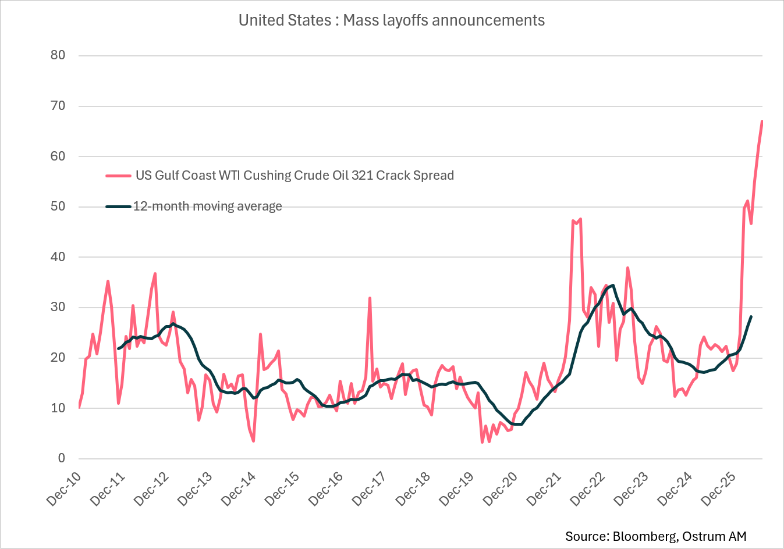
The price of distilled petroleum products is exploding worldwide. Certainly, crude oil prices play a role in the rising cost of gasoline, kerosene, or naphtha, but Middle East tensions only explain part of the upward acceleration.
The international oil market is primarily a crude oil market, with refining conducted locally. Little crude oil exits through the Strait of Hormuz (and virtually no gas) and very few refined products, but the marginal impact of this shortage is proportionally more significant.
The bottleneck lies elsewhere. There is a real lack of refining capacity in the United States. Their utilization rate stands at 95%. Ukrainian attacks have struck a significant number of Russian export refineries. China has seized upon the problem, meaning it should produce more gasoline in the coming months and help alleviate these tensions.
Figure of the week
5 %
30-year OAT yield hit 5% on September 2, 2026.
Market review: Kevin Warsh wants to raise rates
- United States: Job report better than expected in August with 162k gain and unemployment stable at 4.1%.
- Central banks: Warsh appears to want to raise rates, Lagarde will do so ;
- Rates: The upward trend on long-term bond yields continues though the yen’s rebound stems the upside.
Warsh Wants to Raise Rates...
Expectations of monetary tightening and fiscal risk premia have fueled the steady rise in yields over the summer. August's US CPI reading is keenly awaited by markets. Energy prices bear watching, though low volatility remains supportive of risk assets.
Kevin Warsh's Jackson Hole speech appears to have altered the game regarding the Fed's near-term rate outlook. Price trends are not converging sufficiently quickly towards the 2 % target according to Warsh, making August's CPI release particularly significant. The employment report (+162k) represents the best reading since spring, even if question marks remain over the quality of jobs created. Unemployment is only improving for the least skilled whilst university graduates continue to struggle with job placement. Wages are moderate to 3.1 % year-on-year. Activity indicators such as the ISM surveys are upbeat in August despite the tariff environment and rising input costs.
In the eurozone, inflation rebounded to 3.3 % according to August's flash estimate, though it is noteworthy that core inflation is not accelerating. Service inflation remains elevated but stable at 3 %. Rising refining margins should continue to fuel energy inflation through year-end. Gas prices also sit above €70/MWh.
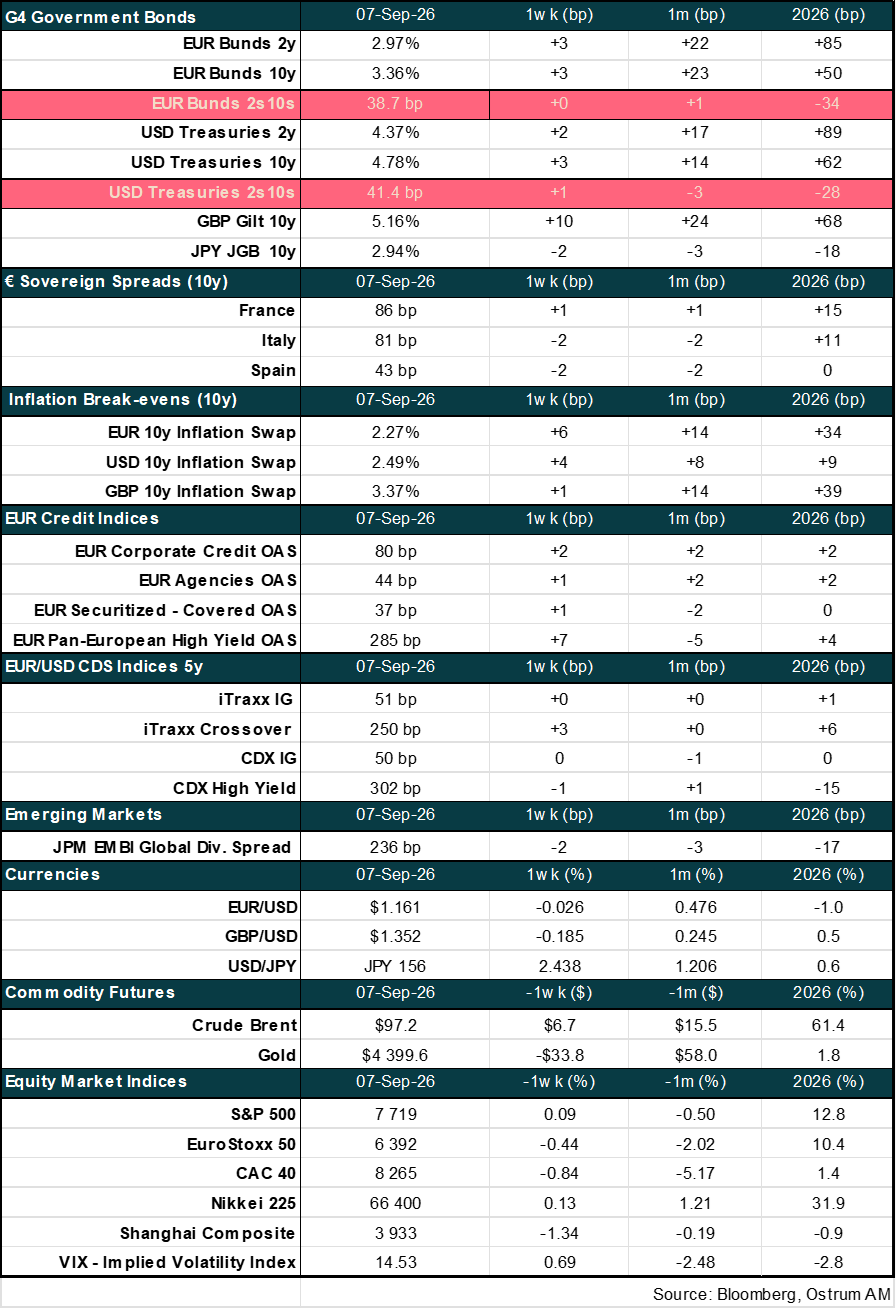
Price action across financial markets reflects both a global monetary tightening environment and fiscal concerns. The T-note yield briefly touched 4.80 %, its highest level since January 2025. The probability of a September Fed hike is rising ahead of August inflation data. The federal deficit is drifting higher, notably due to interest burdens that will inevitably worsen should Fed funds rise. Inflation breakevens are climbing slightly in reaction to renewed Gulf tensions where exchanges of fire have resumed. Brent crude has consequently climbed back to $95. In the eurozone, the Bund (3.33 %) follows the global rates movement, often driven by long-term JGBs. The French spread (86 bps) faces greater pressure ahead of budget discussions that will prefigure the 2027 presidential election. Yen interventions have met with limited success, meaning the key lies with the BoJ, which must act swiftly on rates. As tightening becomes clearer, Japanese yields are easing in anticipation of reallocations towards the domestic market. The yen is rebounding to 156 per dollar.
Equity markets ended the week mixed. Europe lost slightly more than 1 % whilst Wall Street posted modest gains. Implied volatility (VIX at 15 %) remains very subdued. Sector rotations are inducing decorrelation effects that reduce volatility. This environment remains favorable for credit spreads. Euro IG widened 3 bps without CDS indices moving much. European high yield spreads also widened modestly (+4 bps).
Axel Botte
Main market indicators
-

Axel Botte Head of markets strategy