

Read our market review and find out all about our theme of the week in MyStratWeekly and its podcast with our experts Axel Botte, Aline Goupil-Raguénès and Zouhoure Bousbih.
Listen to podcast (in French only)
(Listen to) Axel Botte’s and Aline Goupil-Raguénès’ podcast:
- Review of the week – Continued rise in interest rates and stronger growth in the US along with marked imbalances;
- Theme – The need to rapidly reduce the public deficit.
Podcast slides (in French only)
Download the Podcast slides (in French only)Topic of the week: France: The Need to Rapidly Reduce the Public Deficit
- From a public finance perspective, France stands out from its euro area peers with one of the largest budget deficits and a rising public debt-to-GDP ratio that is already at a high level;
- According to a report commissioned by the French government and prepared by four independent economists, the budget deficit would rise to nearly 7% of GDP by 2030 under unchanged policies, while public debt would increase by more than 10 percentage points, reaching 131% of GDP by the end of the decade;
- The report’s conclusions are unequivocal: France urgently needs to take action to stabilize its public debt-to-GDP ratio;
- To achieve this, a structural primary surplus of 0.8% of GDP would need to be generated by 2032, corresponding to an effort of €125 billion;
- The report stresses that action must be taken as early as 2027, as postponing the adjustment until 2028 would significantly undermine its effectiveness;
- To achieve debt stabilization, the adjustment must first and foremost focus on public spending. Real political will will be the key to success.
France: The Need to Rapidly Reduce the Public Deficit
France stands out within the euro area for both the size of its budget deficit and a public debt-to-GDP ratio that continues to rise from an already elevated level. To inform the public debate ahead of the presidential election and contribute to the preparation of the 2027 budget, the government commissioned four independent economists to assess the outlook for public finances through 2030 and develop fiscal rebalancing scenarios starting in 2027. Their report recommends a cumulative fiscal adjustment of €125 billion by 2032 to stabilize public debt, primarily through expenditure-side measures implemented from 2027 onwards.
Assessment: A Significant Public Finance Imbalance
France has one of the highest public deficits in the euro area…
France recorded the second-largest public deficit in the euro area after Belgium in 2025, at 5.1% and 5.2% of GDP respectively, compared with 2.9% for the euro area as a whole, according to Eurostat. In contrast, Portugal, Greece and Ireland posted budget surpluses.
This fiscal imbalance largely reflects the size of the primary deficit, defined as the budget balance excluding interest payments on public debt (pink bars in the chart). In 2025, France’s primary deficit reached 2.9% of GDP, matching the levels observed in Belgium and Slovakia and ranking among the highest in the euro area. This contrasts with the primary surpluses recorded by Greece, Ireland, Portugal and Italy, while Spain has returned to a broadly balanced primary position.
The public deficit is also being affected by the rising interest burden on government debt (blue bars), driven by the gradual refinancing of maturing bonds at higher interest rates. This phenomenon is not specific to France but affects all countries as global bond yields have increased. The rise in yields largely reflects the monetary tightening implemented by central banks since 2022 to contain inflation, including by the ECB and the Federal Reserve, as well as market expectations of further rate increases in response to the energy shock stemming from the conflict in the Middle East.
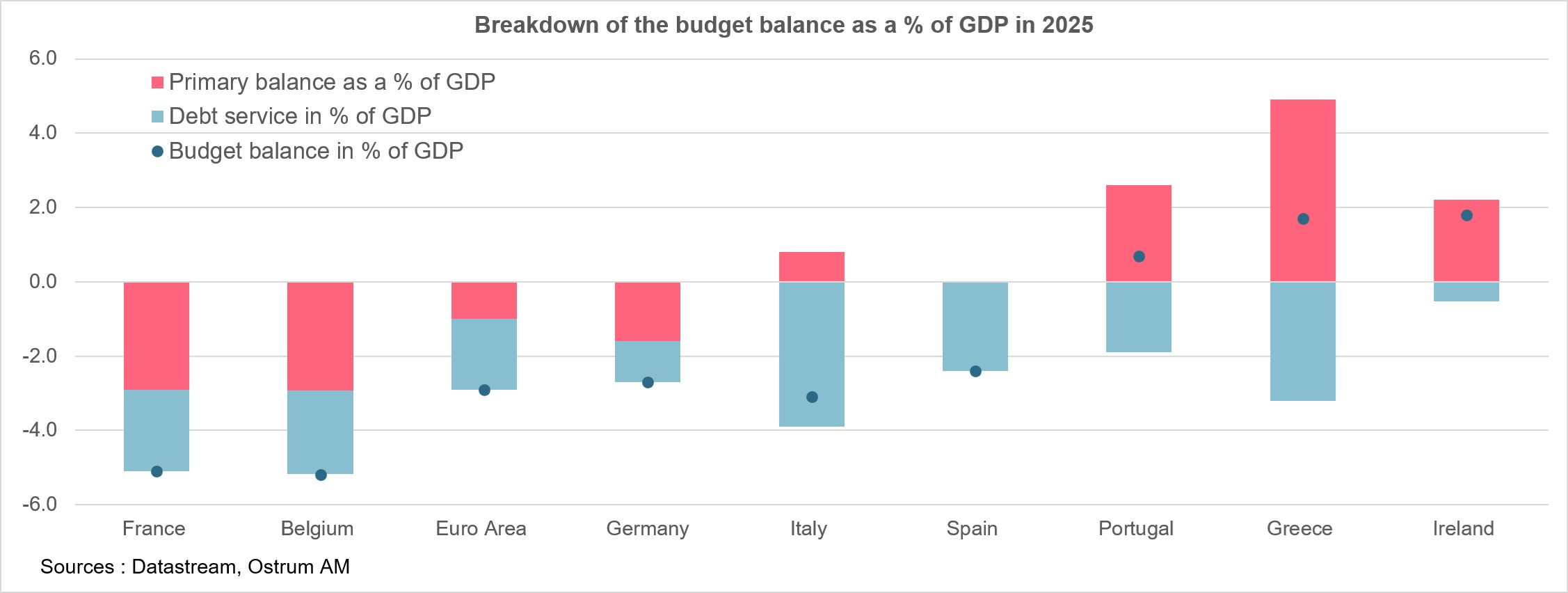
Another contributing factor has been the end of central banks’ quantitative easing programs, under which government bonds were purchased on a large scale to exert downward pressure across the yield curve. The ECB is now reducing the size of its balance sheet by no longer reinvesting the proceeds from maturing securities under its Asset Purchase Programme (APP) and Pandemic Emergency Purchase Program (PEPP). To a lesser extent, concerns over fiscal sustainability in highly indebted countries have also contributed to higher bond yields. Against this backdrop, France’s interest expenditure amounted to 2.2% of GDP in 2025
…resulting in a continued increase in public debt.
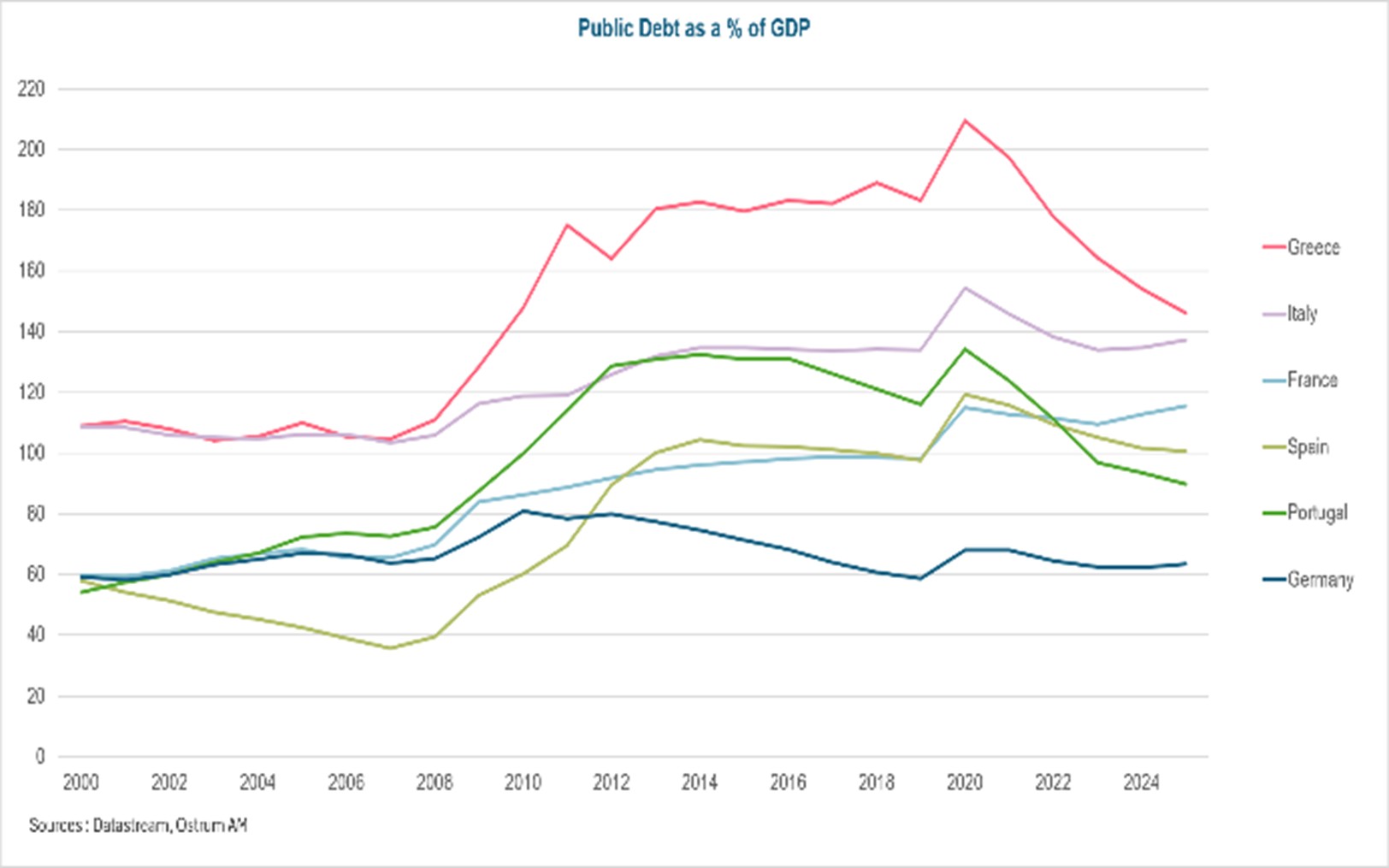
France’s public debt-to-GDP ratio stood at 115.7% in 2025, compared with 88.7% for the euro area . This is the third-highest ratio in the euro area, behind Greece and Italy, whose debt levels reached 146.1% and 137.1% of GDP, respectively. Unlike these countries, France’s debt-to-GDP ratio had returned by 2025 to levels close to those recorded in 2020, during the Covid-19 crisis. This development mainly reflects the persistence of a large public deficit, in particular a sizeable primary deficit, whereas the primary surpluses achieved by Greece and Italy have contributed to reducing their public debt ratios.
The Need for Rapid Deficit Reduction
The Mission on Public Finance Transparency
Last May, the government appointed four independent economists to assess the outlook for France’s public finances through 2030 and to develop fiscal rebalancing scenarios starting in 2027. Their report, published on 15 July, aims to “inform the public debate, particularly in the run-up to the next presidential election, and contribute to discussions surrounding the preparation of the 2027 budget.”
Before outlining potential adjustment paths, the authors first developed the public finance trajectory under unchanged policies. This provides a benchmark against which the scale of the fiscal consolidation required can be assessed, taking into account the underlying trajectory of public revenues and expenditures.
Unchanged-policy fiscal outlook
Public deficit widening to nearly 7% of GDP by 2030
According to the report, under an unchanged-policy scenario, the public deficit would deteriorate significantly from 2027 onwards, reaching 5.9% of GDP that year and continuing to widen thereafter to almost 7% of GDP by 2030 (6.8%).
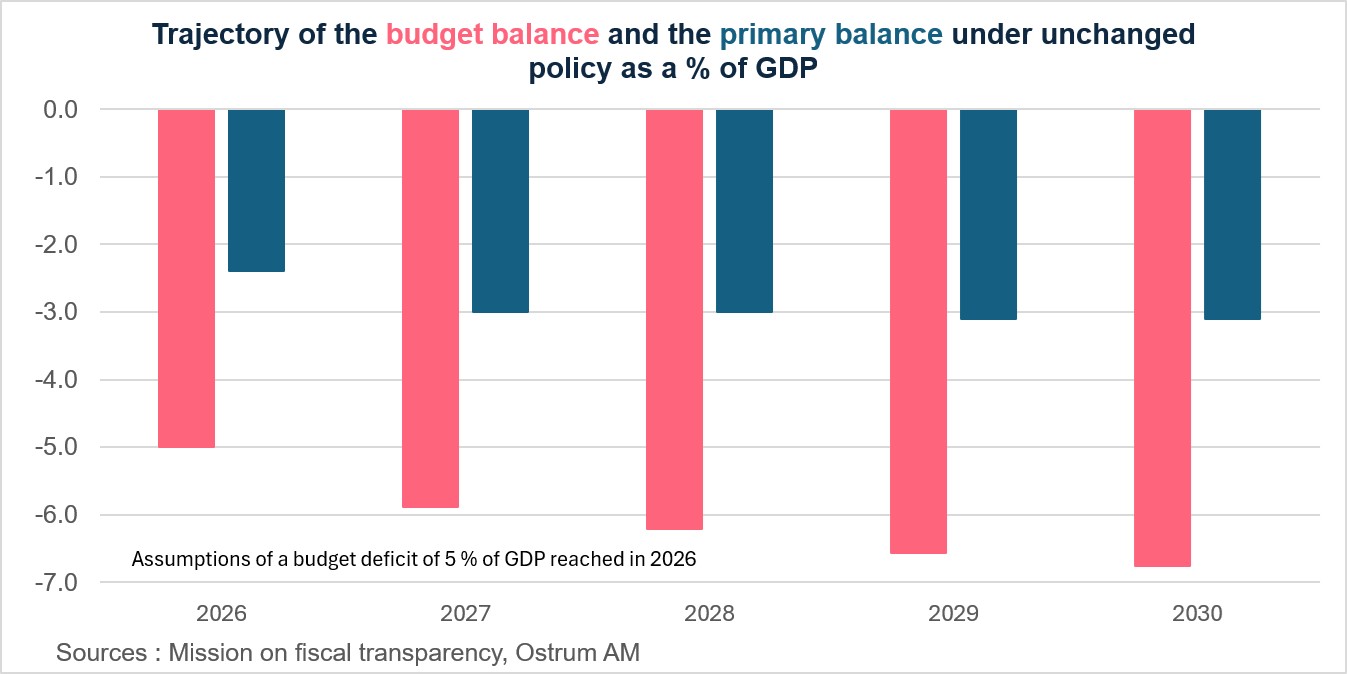
The projected deterioration in the public deficit is primarily driven by rising public expenditure, including debt-servicing costs.
Roughly half of the deterioration is expected to occur as early as 2027, amounting to 0.9 percentage points of GDP. Four main factors account for this increase: higher debt-interest payments, which explain almost one-third of the deterioration; increased defence spending under the Military Programming Law; rising pension and healthcare expenditures, notably as a result of the suspension of the pension reform; and, on the revenue side, the expiry of the temporary levy on large corporate profits.
From 2028 to 2030, the deficit is projected to widen at a more gradual but steady pace of around 0.3 percentage points of GDP per year. This deterioration mainly reflects the rising interest burden associated with the refinancing of maturing debt issued at very low interest rates with new debt carrying higher borrowing costs. As a result, debt-servicing costs are expected to increase by around €10 billion per year. Additional pressures stem from higher pension and healthcare spending linked to population ageing, despite the reinstatement of the pension reform in 2028, as well as from the planned increase in defence expenditure. Consequently, the primary deficit is projected to remain elevated throughout the period, fluctuating between 3.0% and 3.1% of GDP from 2027 to 2030.
These projections assume that the government's target of reducing the public deficit to 5% of GDP in 2026 is achieved. However, this is increasingly unlikely given weaker-than-expected economic growth, with the government's growth forecast having been revised down to 0.5% from an initial 1.0%, and a larger-than-anticipated increase in debt-servicing costs due to tensions in bond markets. The Prime Minister has therefore revised the 2026 deficit forecast upwards to 5.4% of GDP. This mechanically worsens the medium-term fiscal outlook through to 2030.
Gradual Increase in Public Debt to 131% of GDP by 2030
Under an unchanged-policy scenario, the worsening of the public deficit would lead to a steady increase in the public debt-to-GDP ratio, by around 13 percentage points between 2026 and 2030. It would rise from 118% of GDP in 2026 (an assumption based on the annual progress report submitted by France to the EU) to 130.5% in 2030. This increase would be driven primarily by the persistence of a large primary deficit.
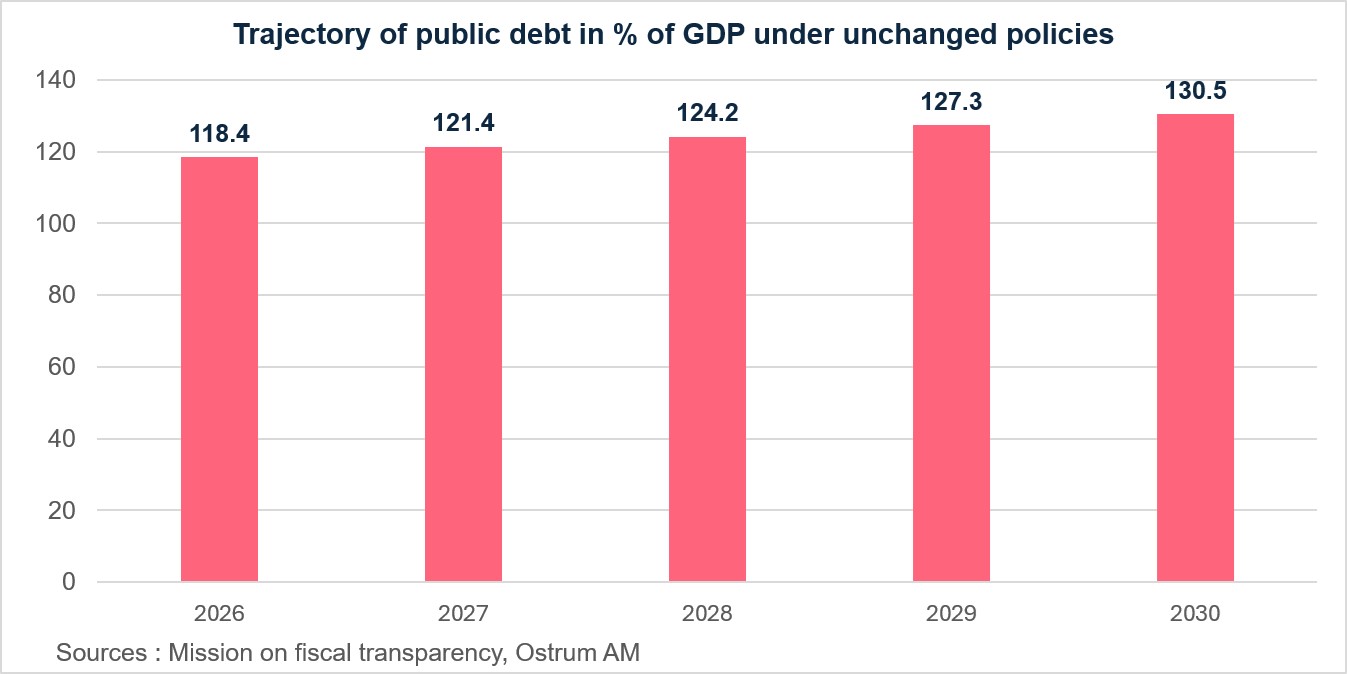
Stabilising the debt-to-GDP ratio requires the primary balance to be at least in equilibrium, when nominal GDP growth equals the implicit interest rate on debt, defined as interest expenditure relative to the outstanding stock of debt. In 2026, nominal GDP growth (g) and the implicit interest rate on debt (r) are assumed to be broadly equal. However, because the primary balance remains in deficit, the debt-to-GDP ratio continues to increase.
From 2029 onwards, a second factor comes into play alongside the persistently large primary deficit: the “snowball effect”. The implicit interest rate on debt is projected to exceed nominal GDP growth (r – g > 0), meaning that the debt-to-GDP ratio would continue to rise even if the primary balance were balanced or close to balance. A rapid increase in public debt relative to GDP could undermine investor confidence. Investors may then demand higher yields to hold French government bonds, further increasing interest expenditure and, in turn, the public deficit and debt burden.
A fiscal effort of around €125 billion by 2032 is needed to stabilize the debt-to-GDP ratio
Ensuring the sustainability of France’s public finances requires stabilizing the public debt-to-GDP ratio. When the interest rate exceeds the economy’s growth rate (r > g), achieving this objective requires generating a primary surplus. The debt-stabilizing primary balance is equal to the difference between the interest rate and the growth rate multiplied by the initial stock of debt.
In their report, the four economists estimate that France would need to reach a structural primary surplus of 0.8% of GDP by 2032 in order to stabilize the debt-to-GDP ratio at around 120%. This implies an adjustment of 3.6 percentage points of GDP over five years, equivalent to approximately €125 billion in savings by 2032. This estimate takes into account the underlying growth in public spending as well as higher interest rates, which are expected to remain above potential economic growth.
To create fiscal buffers that could be mobilized in the event of future crises, the Conseil d’Analyse Économique recommends targeting a primary surplus exceeding the debt-stabilizing level by an additional percentage point. After accounting for underlying spending trends, this would imply a consolidation effort of around €160 billion by 2032.
The authors stress the importance of acting immediately, arguing that “the cost of inaction in 2027 is prohibitive.” Delaying the adjustment would require a larger fiscal effort to be implemented over a shorter period, potentially weighing on growth and undermining investor confidence. By contrast, action taken from 2027 onward would allow for a more rapid correction of the debt trajectory.
The report advocates a strategy based on all three pillars of fiscal consolidation: expenditure restraint, higher public revenues, and structural reforms aimed at boosting economic growth. However, the authors emphasize that the primary focus should be on major spending items, given that French public expenditure remains among the highest in the euro area, accounting for 57.2% of GDP in 2025, compared with 49.7% for the euro area, according to the European Commission. In their view, temporarily suspending the indexation of certain expenditures to inflation, with the exception of minimum social benefits and minimum old-age pensions, should not be ruled out. By contrast, the scope for increasing taxes appears limited, given France’s already high tax burden and the constraints imposed by international tax competition.
Conclusion:
The findings of the Public Finance Transparency Mission leave little room for doubt. France urgently needs to take action to stabilise its public debt ratio. According to the report, a fiscal adjustment of €125 billion will be required by 2032, with the primary focus placed on containing public expenditure. The authors stress that action must begin as early as 2027, as postponing the adjustment until 2028 would be highly detrimental. Delaying consolidation would necessitate a larger adjustment over a shorter period, increasing the risk of weighing on economic growth and undermining investor confidence. By contrast, acting from 2027 would allow the debt trajectory to be brought under control much more rapidly. Achieving this objective will require strong political commitment and decisive policy action.
Aline Goupil-Raguénès
Chart of the week
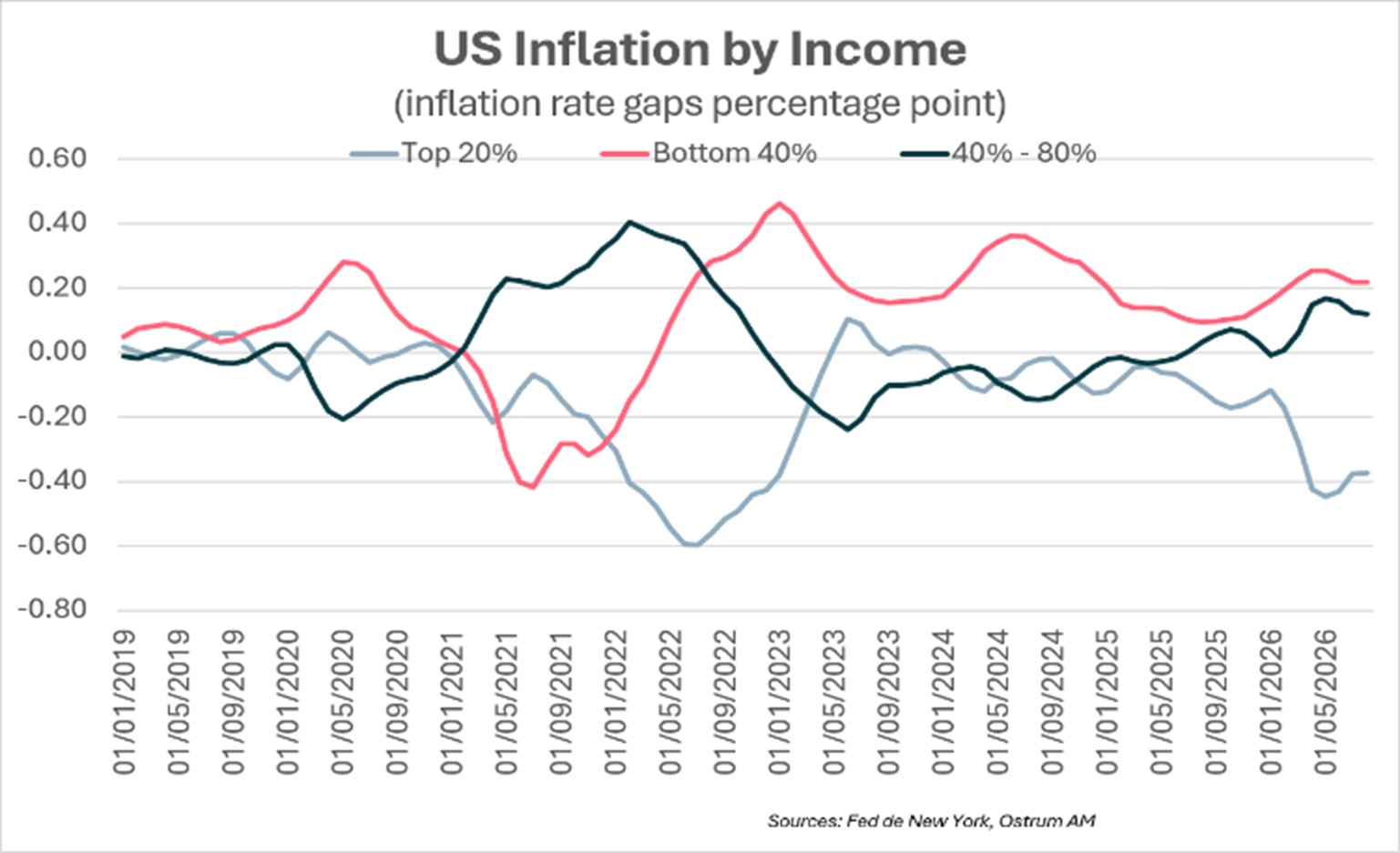
A study from the New York Fed sheds light on the asymmetric effects of inflation across household income groups. The adjacent chart shows the deviation from average inflation experienced by different household cohorts. It appears that inflation is 0.2% above average for households with incomes in the bottom four deciles. The middle class, whose incomes fall between the 5th and 8th deciles, also experience an average 0.12% above the general population. In contrast, the cost of living for the wealthiest 20% is rising more slowly (by 0.4 percentage points) than the population as a whole. These disparities stem from particularly sharp price increases in essential goods (energy, food) that carry greater weight in the consumption basket of lower-income households.
Figure of the week
350
350 bps : the spread between the U.S. Treasury bond and the Chinese government bond, an all-time high.
Market review:
- Iran/US: talks to reopen the Strait of Hormuz held on side of UN assembly meeting;
- U.S.: growth may hit 3% in the 3rd quarter;
- Bonds: Yields briefly hot 5.20% in wake of stronger US PMI;
- Swap spreads: 2-Yr swap spreads widening in response to pressure on OAT spreads.
Market review: Markets Withstand Higher Long-Term Yields
Equity markets are advancing on the back of falling crude prices and signs of an improving economic outlook.
Financial market psychology remains intimately tied to developments in the Middle East. Discussions between Iran and the United States, on the sidelines of the United Nations General Assembly, are under way regarding the reopening of the Strait of Hormuz, and markets appear willing to give these talks the benefit of the doubt. Xi's visit to Washington yielded no major announcements, nor any framework governing artificial intelligence development. The trade war truce has been extended to 10 January. Nevertheless, the rise in real rates has accelerated and early signs of stress are emerging in short-dated euro swap spreads and equity markets.
On the economic front, the latest US data point to an improvement. Third-quarter 2026 growth is expected to approach 3% on an annualized basis. Household consumption, fueled by credit, rebounded in August. Technology equipment investment — hardware and intellectual property — remains highly dynamic, even as this generates a sharp deterioration in the external balance. PMI surveys also point to a continuation of the recovery in Europe. Admittedly, eurozone growth is uneven, with France's marked underperformance in the first half, but business confidence is surprisingly resilient given the international backdrop.
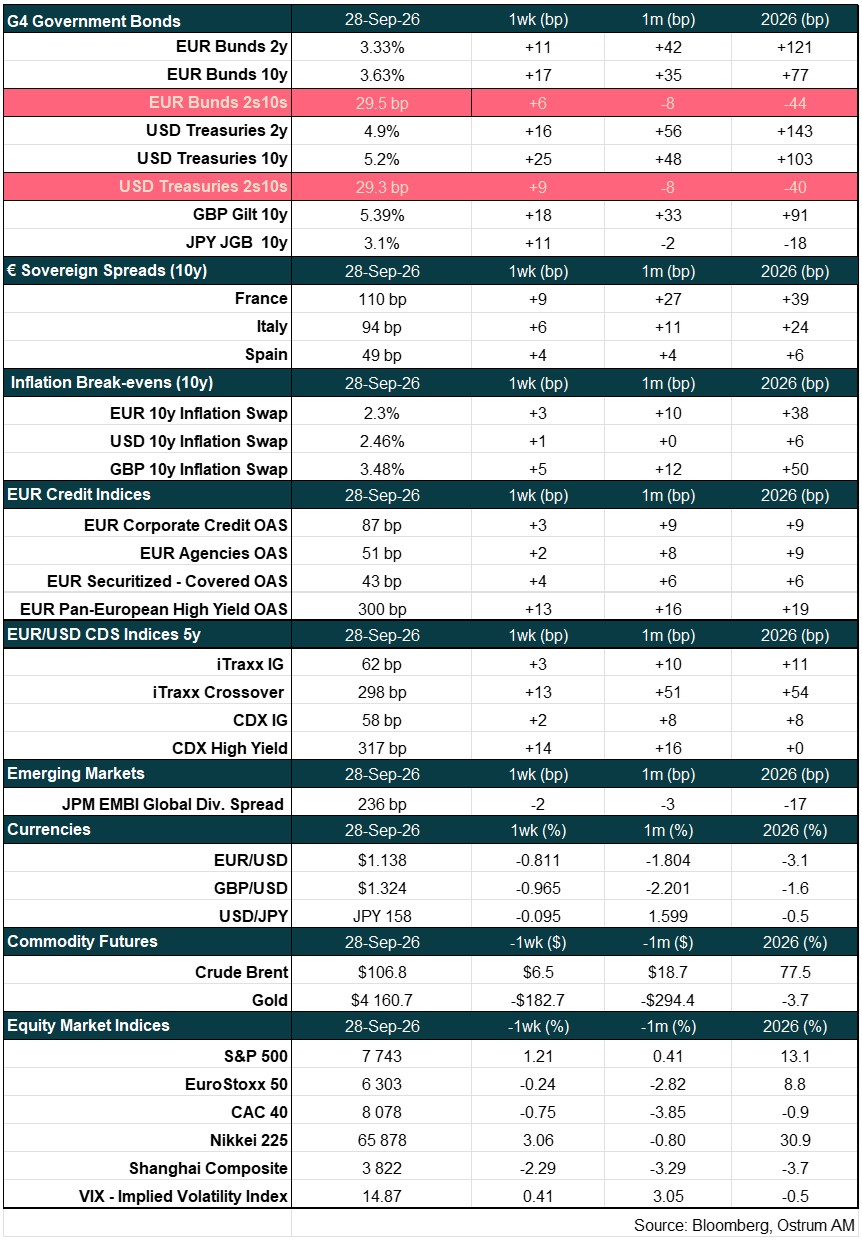
Long-term yields continue to rise. The US 10-year T-note approached 5.20%, dragging the Bund towards 3.60% and the Gilt to 5.40%. The acceleration higher is concurrent with the publication of solid advance PMIs in September. Inflation breakevens are not the culprit, particularly as Saudi Arabia appears able to resume oil exports via Yanbu more quickly than anticipated. Brent crude is trading at $105. These easing signals are contributing to a re-steepening of yield curves following central banks' hawkish pivot in recent weeks. Markets are pricing in aggressive monetary tightening, notably in the United Kingdom where the spread between the 2-year and the repo rate is at its highest since 2022. In the eurozone, the Bund trading above 3.50% has not yet had a significant impact on sovereign spreads. The OAT premium has nevertheless widened by 3 basis points, ending the week around 108 basis points.
Credit spreads are broadly stable. Swap spread widening following tensions in French bank CDS is nonetheless notable, reflecting local sovereign credit risk. The 2-year swap spread now stands at 26 basis points. At this stage, the credit premium against swaps for European investment grade remains flat at around 65 basis points. There is nonetheless a rate level likely to trigger a proportional widening of risk premia across credit markets and equities. Equity indices rebounded last week, driven by technology in Asia and the United States. Europe also advanced 1% over five sessions. A strong dollar is proving no obstacle to risk asset performance.
Axel Botte
Main market indicators
-

Axel Botte Head of markets strategy