
The strategic choice of treasurers and institutional investors
Cash is back
Since 2022, the cash management landscape has been profoundly disrupted. After a decade of negative rates – a period where holding cash was a real cost for companies and institutional investors – the European Central Bank’s monetary normalisation has dramatically changed the game. The ECB deposit rate rose from -0.5% to 4% in just a few quarters, before stabilising around 2% (2.25% since June 2026), with prospects of a gradual increase towards 2.50% by the end of 2026 (Ostrum Asset Management estimates, as of September 2026).
This new reality has transformed the perception of cash within finance departments and institutional investment teams. Liquidity is no longer seen as a dormant asset but rather as a true asset class in its own right that deserves strategic attention on par with equities and bonds. In this environment, a key question for any treasurer or institutional investor is: should I use bank deposits or money market funds to manage my liquidity ?
The treasurer’s perspective: between habits and constraints
For a long time, bank deposits have been the almost automatic answer to the question of short-term cash management. And the arguments in its favor are not lacking: yield known in advance, direct and historical relationship with the bank, absence of apparent volatility, and simplicity of operational use. For a treasurer, legibility is essential. Knowing exactly what a term deposit will return over a defined period, without suffering from accounting fluctuations, is a significant advantage, especially in terms of reporting or cash forecasting.
Furthermore, the banking relationship plays a structuring role. Companies and institutions need their banks for credit lines, foreign exchange transactions, market financing or even cash management services. Holding deposits at its banking partners fits into a pattern of commercial reciprocity that is hard to ignore. This is not just a financial decision; it is a relational and strategic decision.
However, when we strip away these relationship considerations and purely focus on financial returns and risk management, the limitations of bank deposits become apparent.
The limits of bank deposits: liquidity, concentration and return
The first limit, and perhaps the most critical from a risk management perspective, is concentration of counterparty risk. A bank deposit, by definition, exposes the entire amount invested to a single issuer: the custodian bank. In the event of stress on the banking system – even in a regulated and supervised environment – this concentration can prove problematic. The bank failures observed in recent years around the world have reminded us that this risk is not purely theoretical. Beyond the deposit guarantee, which is limited to EUR 100,000 per institution and per depositor in the European Union, the amounts pledged by companies and institutions far exceed this protective threshold.
The second constraint is liquidity. Contrary to popular belief, bank deposits aren’t always immediately available. Time deposits inherently involve a commitment over a defined period. If there is an unexpected need for liquidity, early withdrawal may be subject to financial penalties or a notice period of several days, or even several weeks, depending on the institutions and the amounts. For a treasurer who has to manage sometimes unpredictable cash flows, this rigidity can be particularly burdensome.
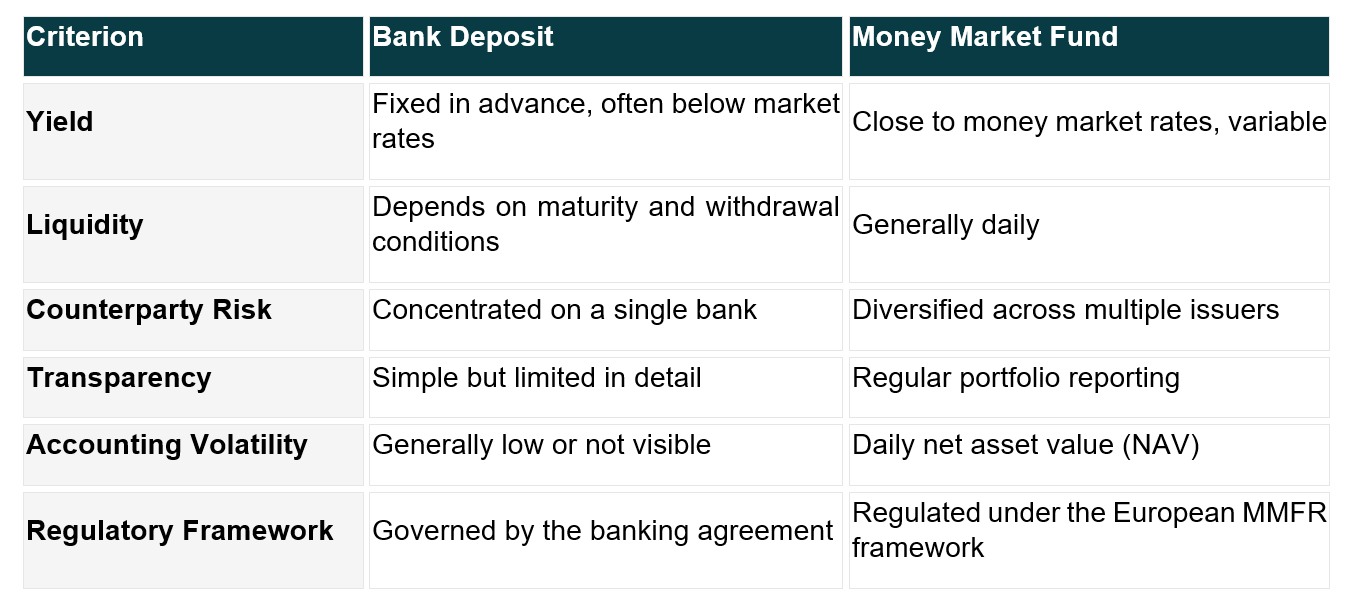
Finally, the return on bank deposits often remains below market rates. Banks, by capturing their clients' liquidity, naturally apply a margin to the rate they serve. This margin varies depending on the client profile, volumes and business relationship, but it often represents a loss of earnings compared to market rates.
Money market funds: a structured answer to modern treasury needs
Faced with these limitations, money market funds governed by the European MMFR (Money Market Funds Regulation) provide concrete and structured answers to the identified challenges.
On diversification and counterparty risk, MMFs offer a radically different solution. A money market fund is invested in a portfolio of 100 to 200 different issuers : banks, corporates, sovereigns and agencies. This spreads the counterparty risk over a large number of different actors, sectors and countries. For a treasurer, it's the assurance of not being exposed to the failure of a single institution. It is, in a sense, the intelligent pooling of many bank deposits and corporate bonds, optimised by a dedicated investment team and framed by strict regulations guaranteeing the credit quality of the assets held (money market regulation requires that investments can only be made in " high credit quality " bonds).
On liquidity, the advantage of money market funds is decisive. Nearly all of them offer daily liquidity, on T+0, without penalty and without prior notice. The net asset value is known each day, providing good visibility on the valuation of the portfolio. In an environment where cash needs can change rapidly - acquisition, delayed flows, investment opportunity - this flexibility is a major advantage. By comparison, withdrawing money from a term deposit can take several days and incur penalties that erode the initial expected return.
In terms of return, money market funds historically and structurally outperform classic bank deposits. Invested closer to money market rates - €STR, Euribor - and benefiting from volume pooling, they offer access to returns close to key rates, without the discount applied by banks on their customer deposits. In a world where every basis point counts, this advantage is far from trivial.
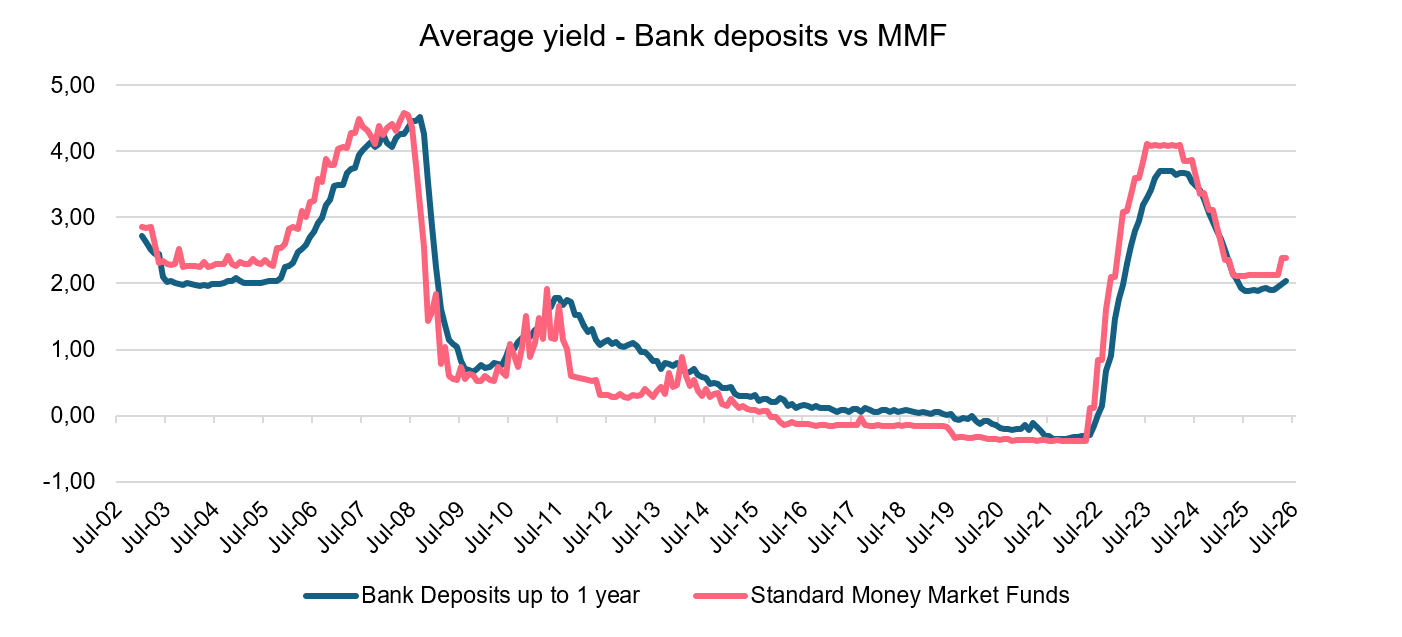
Source: ECB.Europe.EU, as of 31/072026. “Non-financial corporations deposits with agreed maturity up to 1 year”
Operationally, the development of dedicated trading platforms or more recently the tokenisation of money market funds has significantly simplified access to these funds. With just a few clicks, a treasurer can subscribe or redeem fund units, compare performance and monitor positions in real time.
Conclusion: Assumed complementarity, with an advantage for money market funds
It would be reductive to directly oppose bank deposits and money market funds, as they respond to partially different logics and can coexist within a well-constructed cash allocation. Deposits remain relevant within a banking relationship framework, offering accounting visibility without a reported mark-to-market valuation and operational simplicity.
However, when the criteria that should guide a treasurer or institutional investor's decision – return, diversification of counterparty risk, liquidity and flexibility – are objectively analysed, money market funds emerge as the structurally optimal solution.
In conclusion, while bank deposits continue to serve important operational and relationship management purposes, money market funds have become a core component of modern liquidity management: offering greater diversification, enhanced liquidity, increased transparency and, in general, a closer alignment with prevailing market conditions.
Source: data bloomberg as at 30/04/2026, Ostrum AM figures.
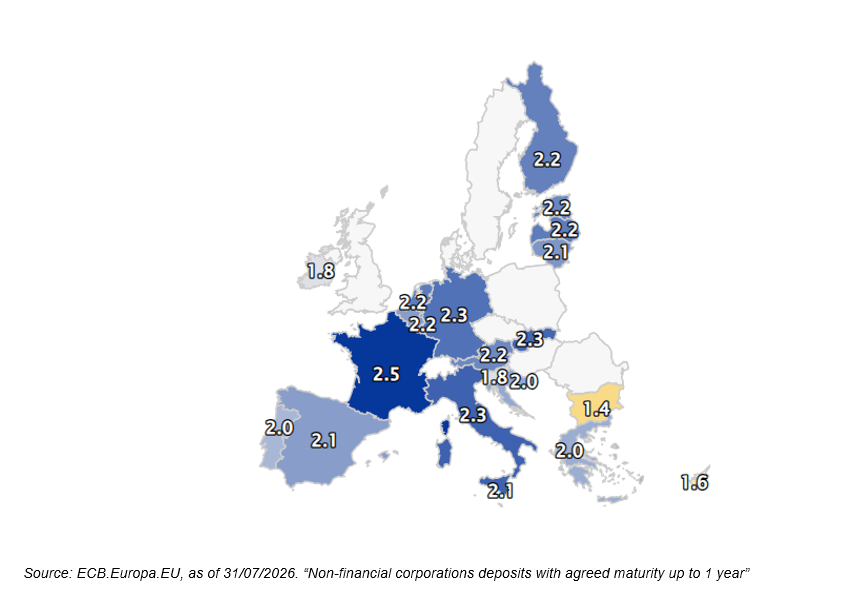
Bank deposit yield by country