

Each month we share the conclusions from the monthly strategy investment committee which provides a summary of Ostrum AM's views on the economy, strategy and markets.
Outlook at 09/18/2026.
The CIO Letter
The Fed's Hawkish Pivot Takes Hold
The restrictive turn signaled by the Fed at Jackson Hole materialized in September with a 25 basis point increase in Fed funds — a move widely expected to foreshadow further tightening as long as inflation fails to return convincingly towards target. The ECB, the Bank of Japan, and other central banks — including the RBA and RBNZ — are hardening their tone to prevent the oil price shock from spreading to the broader economy. Meanwhile, the Houthi advance towards the entrance of the Red Sea represents a fresh threat to global trade, whose growth remains surprisingly robust given the current international backdrop and climate-related constraints weighing on key arteries such as the Rhine and the Panama Canal. Activity has consequently proved resilient, particularly in Europe, despite France recording zero growth in the first half of the year. In the United States, the labor market is finally showing signs of improvement. The Federal Reserve judges the economy to be operating at full employment, notwithstanding the internal imbalances generated by the AI investment cycle. The adaptability of corporate America is reflected in the improvement in manufacturing surveys.
The global rise in long-term real rates continues, with only a moderate negative impact on risk assets so far. The upward pressure on yields stems from uncertainty over central bank behavior — the Fed's in particular — at a time when the federal fiscal position is deteriorating. The risk remains that a further rise in rates could trigger a meaningful equity market correction. The other major risk is a sharp yen rebound, which would signal the unwinding of carry trades and a repatriation of capital to Japan. The Bank of Japan holds the key after the ill-fated intervention episodes of the summer. For now, however, earnings growth has remained solid, enabling sector rotations to proceed without any discernible impact on market volatility. The robust financial health of corporates is contributing to the remarkable stability of credit spreads across both investment grade and high yield.
-

Gaëlle Malléjac CIO Ostrum AM
Economic Views
THREE THEMES FOR THE MARKETS
-
Growth
In the United States, growth remains essentially driven by corporate AI investment while consumption lacks momentum. However, a glimmer of improvement appears in the latest employment data. In the eurozone, activity has surprised favorably despite numerous headwinds. The recovery will continue. In China, activity continues to be driven by technology exports linked to strong AI-related demand.
-
Inflation
US inflation stands at 3.4% in August, mainly driven by rising energy costs. Core inflation has however been moderating to 2.4%. Crude oil prices have brought eurozone inflation to 3.2% in August, with core inflation holding steady at 2.4%. Services inflation remains stable at 3%. Chinese inflation remains low around 1%. Producer prices rose 3.8% due to energy prices and overcapacity reduction policies.
-
Monetary policy
The Jackson Hole speech foreshadowed the 25 basis point rate hike in September, which should ensure faster convergence of inflation toward the target. The ECB raised its key rates by 25 basis points in September and should proceed with another adjustment in the coming months to limit upside inflation risks. The PBOC is not under pressure, maintaining an accommodative bias to support domestic demand.
ECONOMY: UNITED STATES
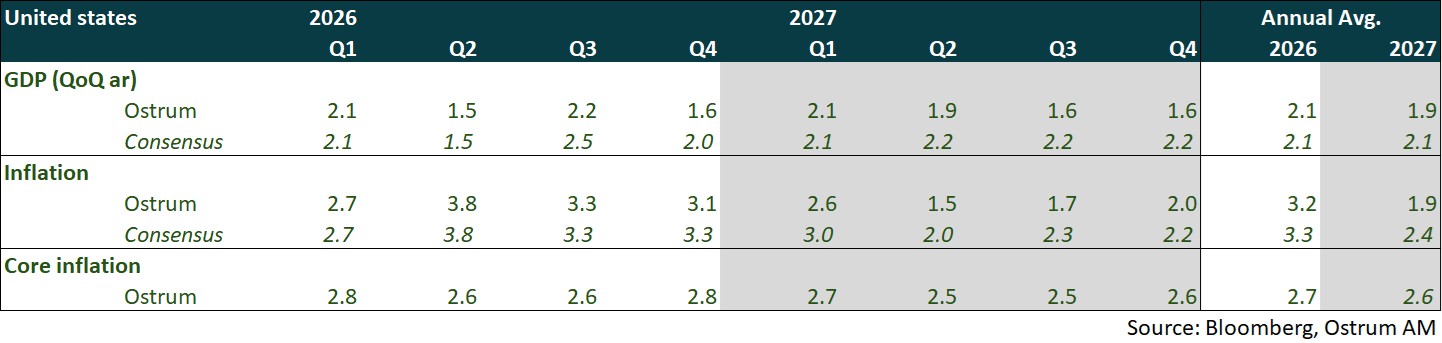
AI-driven investment demand is the sole engine of growth. Fiscal slippage poses a risk.
- Demand: Consumption is constrained by real wages and slow hiring. The trade balance is deteriorating once again with the renewal of the trade war, particularly regarding tech imports—a trend that is set to continue. Residential investment is stabilizing but offers no hope of a recovery due to supply shortages and high prices. Productive investment will remain primarily driven by AI (data centers, software, and R&D), although signs of a recovery are emerging in other sectors.
- Labor Market: The unemployment rate remains low (4.1 per cent) because of a collapse in the participation rate. Meanwhile, the rising number of bankruptcies points to underlying fragilities. Half of all sectors are currently shedding jobs, and vacant posts are translating into few actual hires. The latest data nevertheless may hint at some improvement (temporary employment notably).
- Fiscal Policy: The fiscal situation represents a major risk. Tariff refunds, Medicare and social security spending, and the mounting interest burden heavily impacted the budget balance over the summer. The administration has no strategy to reduce the primary deficit, and debt buybacks are mere paper plasters on a gaping wound.
- Inflation: Inflation is decelerating gradually—driven by housing and non-food, non-energy goods—despite repeated shocks, including energy, tariffs, and El Niño in 2027. Inflation should return towards 2 per cent next year. The surge in margins on distilled petroleum products is unprecedented.
ECONOMY: EURO AREA
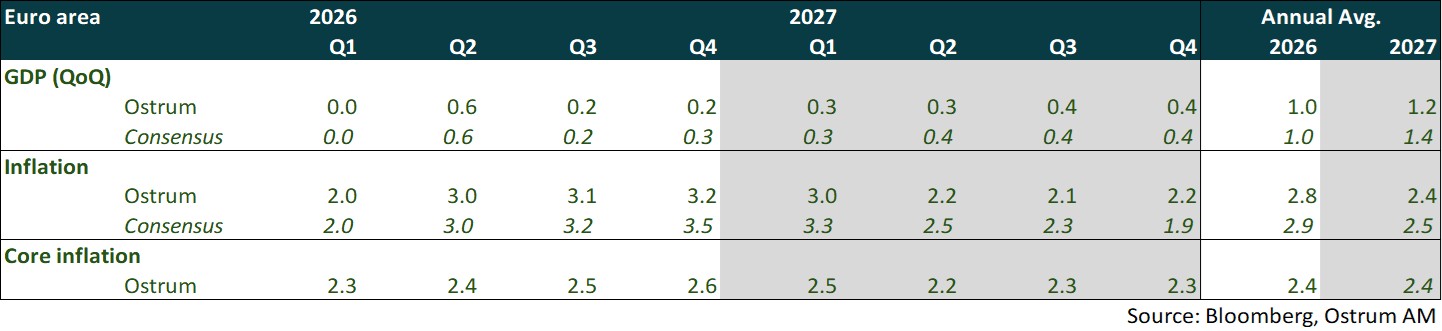
Growth has remained resilient in the face of the energy shock, supported by the strong performance of the peripheral economies, led by Spain, and by the implementation of Germany’s fiscal plans. Growth is expected to continue at a moderate pace in the second half of the year and to strengthen somewhat in 2027 as inflation eases.
- Heterogeneous growth: Growth was ultimately revised to 0.0% in Q1, from the previously reported -0.2%, reflecting an upward revision to Irish growth and, to a lesser extent, German growth. The 0.6% rebound in GDP in Q2 was driven mainly by Ireland, reflecting a correction from the multinational-related distortions seen in Q1. Spain remains the euro area's growth engine, while growth in Germany and Italy has been more subdued, and France narrowly avoided recession.
- Domestic demand: The resilience of growth should, however, be qualified by the weakness of domestic demand, with Spain being the main exception. Household consumption is slowing, reflecting the erosion of purchasing power caused by higher inflation. Businesses and households remain cautious in the face of uncertainty, weighing on both productive and residential investment. Domestic demand is expected to gradually improve in 2027 as inflation moderates, while investment should benefit from the implementation of Germany’s fiscal programs and rising defence and IA spending.
- External demand: Exports supported euro area growth in the second quarter, particularly in Germany (defence and IT) and France (aerospace). August survey data point to a continuation of this trend despite weak competitiveness and increasing competition from China.
- Fiscal Policy: Apart from Germany, which is significantly increasing spending on infrastructure and defence, fiscal space remains limited across most euro area countries. In France, the approach of the presidential election makes the adoption of meaningful fiscal consolidation measures highly unlikely.
- Inflation: Inflation accelerated to 3.2% in August, driven by higher energy prices following renewed tensions in the Middle East. Core inflation eased to 2.4%, showing no evidence so far of second-round effects on wages. Headline inflation is expected to moderate in 2027 as energy prices ease, while core inflation is likely to remain around 2.5% until the first quarter of 2027.
ECONOMY: CHINA

The economy’s structural divergence is widening. The AI boom is not spilling over into the broader economy—particularly consumption—making government support necessary.
- Activity: Severe summer weather affected July’s economic indicators. Activity is expected to rebound, as reflected in improving August PMI surveys, driven notably by exports of high-end technology products. The authorities have announced new regulations for the real estate sector, aimed at supporting the industry while limiting risks associated with unfinished projects and non-performing loans. However, these measures could weigh on investment in the short term.
- Exports: Exports (+24% YoY) remained resilient in July despite adverse weather, supported by higher prices for computers (+67% YoY) and semiconductors (+117% YoY). AI- and green technology-related exports continue to benefit from the global investment cycle in AI and the energy transition.
- Consumption: Retail sales growth slowed to 0.6% YoY in July, down from 1% YoY in June. The tax on overseas investment weighed on luxury-sector sales (−10% in July). A new plan announced on 1 September aims to increase retail sales of consumer goods to approximately $8.9 trillion by 2030, focusing on green consumption, AI-enabled healthcare, automobiles, and household appliances.
- Inflation: Inflation stood at 0.8% in August, reflecting persistent structural deflationary pressures.
Monetary Policy : FED
Kevin Warsh Saves the Fed’s Credibility
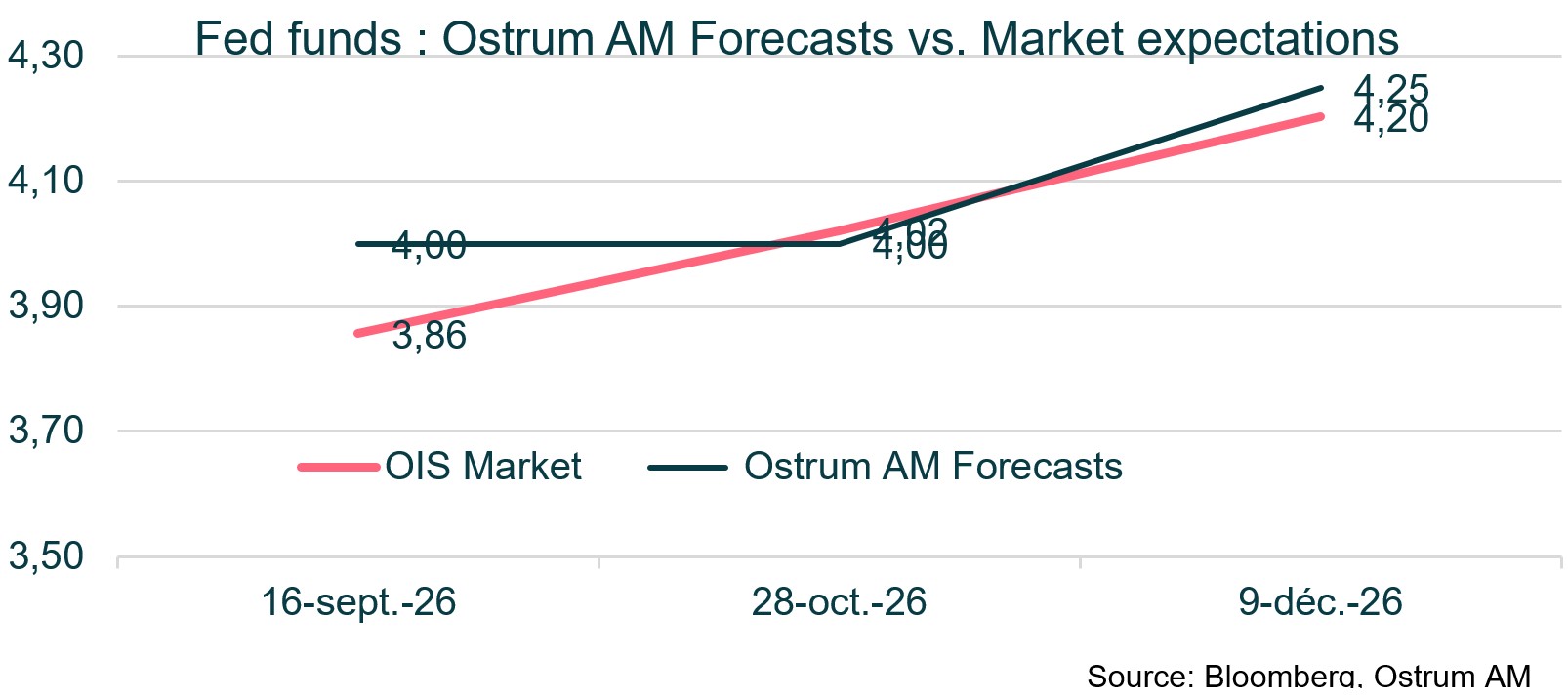
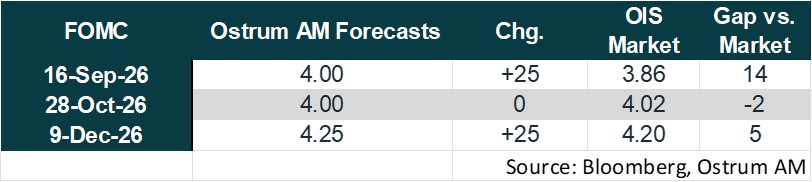
- As Kevin Warsh’s remarks at Jackson Hole in late August had suggested, the Fed raised its policy rate by 25bps on September 16, marking its first rate hike since July 2023. The decision to lift the target range for the federal funds rate to 3.75%-4.00% was unanimous.
- Economic growth continues to be viewed as solid, while the labor market remains consistent with full employment, with the unemployment rate staying low at around 4.1%.
- The decision to raise rates was driven by inflation remaining elevated for too long. The policy statement noted that this move would support a more timely return of inflation to the Fed’s 2% target.
- During the press conference, Kevin Warsh stated that financial conditions could not be considered restrictive and that the rate hike was intended to remove “a dose of accommodation.”
- The projections released following the FOMC meeting show that, on median, Fed participants expect another rate hike by year-end and thereafter to keep rates at that level through 2028. The first rate cut would not occur before 2028. These projections should, however, be interpreted with caution, given that Kevin Warsh did not participate in their preparation.
- The Fed reaffirmed its determination to restore price stability as quickly as possible. Given the upside risks still facing inflation, we expect an additional 25bps rate hike in December.
Monetary Policy : ECB
The ECB Fears the Emergence of Second-Round Effects
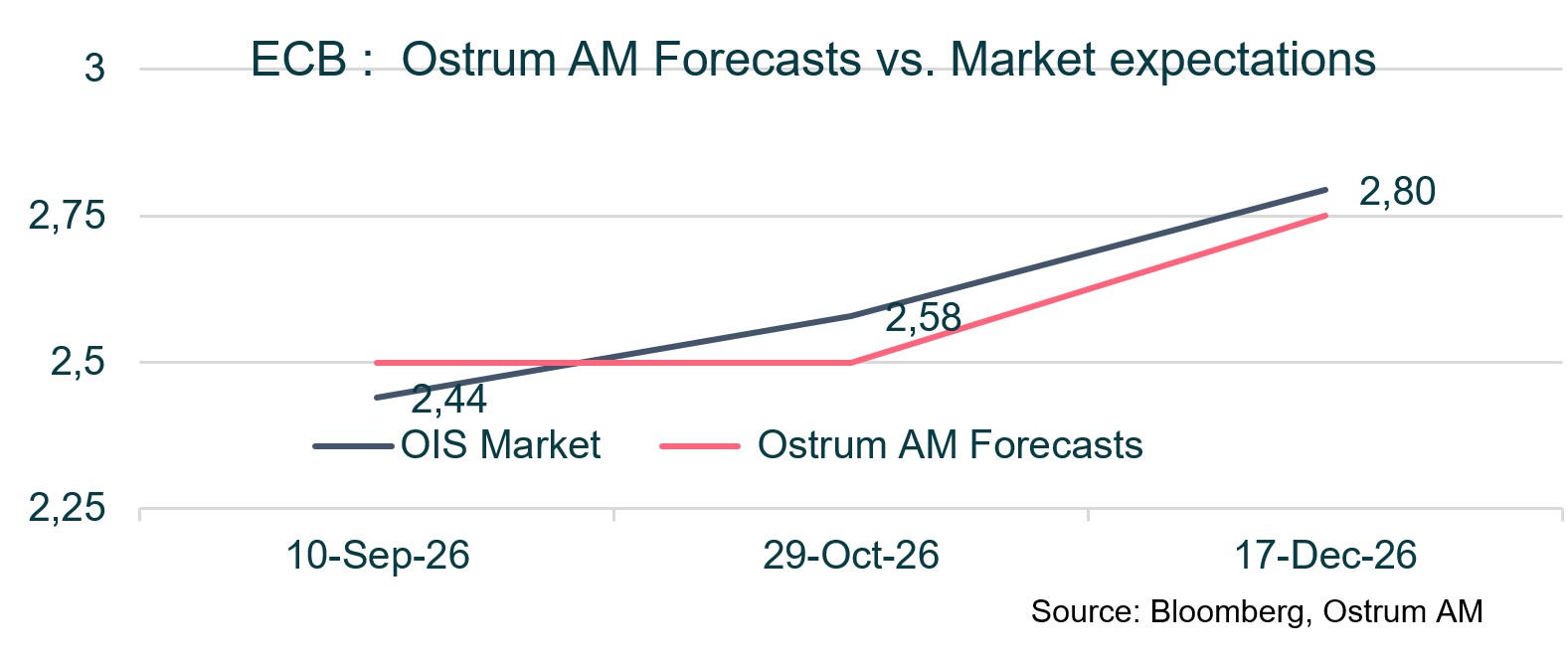
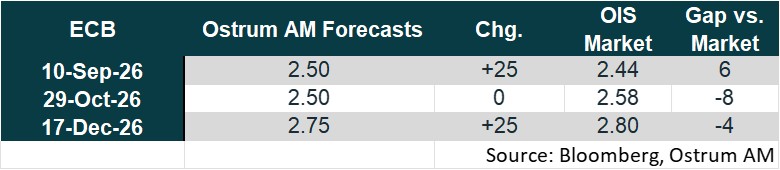
- As expected, the ECB raised its policy rates by 25bps in September, taking the deposit rate to 2.50%, following a 25bps increase in June.
- The statement accompanying the decision indicated that inflation is expected to remain well above target for an extended period of time.
- Economic growth has proven more resilient than expected in the face of the energy shock, prompting the ECB to revise its growth forecasts upward to 0.9% in 2026 and 1.4% in 2027. Growth projections were left unchanged at 1.5% for 2028.
- The continuation of the conflict in the Middle East and its impact on energy prices led the central bank to revise its inflation forecasts higher for 2027 and 2028, to 2.5% and 2.1% respectively. The 2026 projection remained unchanged at 3.0%. Core inflation was also revised upward to 2.6% in 2027 and 2.3% in 2028, while remaining unchanged at 2.5% in 2026.
- During the press conference, Christine Lagarde carefully avoided providing guidance on the ECB’s next moves, reiterating that decisions would continue to be taken on a meeting-by-meeting basis and would depend on the incoming data and information available at the time.
- The tone of the communication was hawkish, reflecting the ECB’s view that inflation risks remain tilted to the upside, while risks to growth are seen as skewed to the downside.
- C. Lagarde noted that the energy shock could intensify further and that its spillover effects on other prices and wages could prove larger than currently anticipated. In order to keep inflation expectations firmly anchored, we believe the ECB is likely to deliver another rate hike in December.
Market views
Asset classes
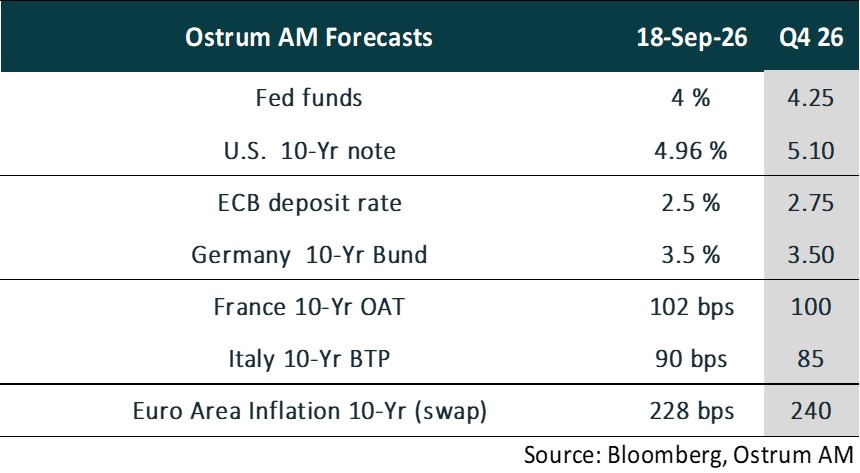
- U.S. Rates: Kevin Warsh raised rates considering the economy was operating at full employment. A second hike will occur in December according to our scenario. The 10-year should move towards 5.10%.
- European Rates: The ECB will tighten rates in December to weigh on inflation expectations. The 10-year Bund will oscillate around 3.50% through year-end.
- Sovereign Spreads: The widening move appears to be pricing in French fiscal difficulties. The spread will hover around 100 basis points at year-end. The BTP is suffering from widening pressures, compounded by rising gas prices. The Italian bond should trade at 85 basis points by year-end.
- Eurozone Inflation: Long-term inflation expectations have drifted higher under the effect of the oil shock and this should continue through year-end.
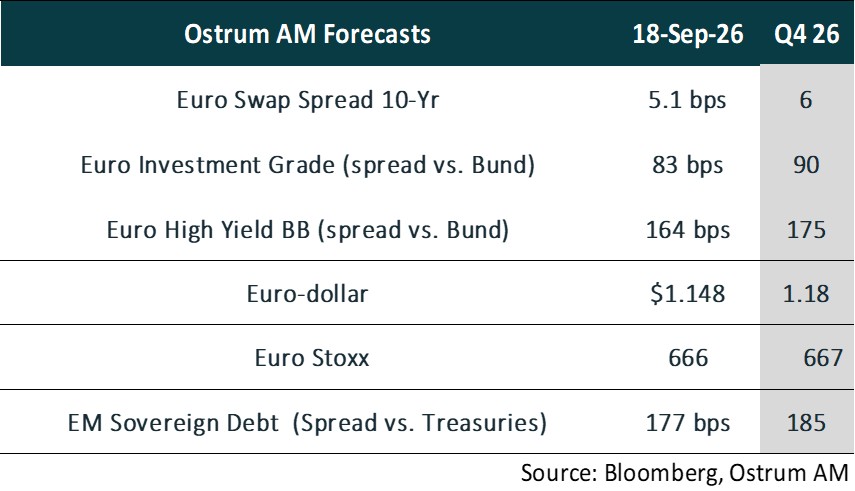
- Euro Credit: IG credit spreads have widened slightly since the start of the autumn, and this move should continue into Q4. The solid health of corporates is slowing the pace of spread adjustment.
- Euro High Yield: The default rate remains contained and below the long-term average; spreads will widen modestly.
- Exchange Rates: The structurally bearish trend for the greenback should resume as the market digests Warsh's hawkish pivot.
- European Equities: A stable equity market through year-end 2026. High margins and the contribution of the energy sector will offset valuations under pressure from rising real rates.
- Emerging Debt: The EMBIG is withstanding the Iranian crisis, even attracting flows diverted away from Treasuries. Spreads will remain tight at 185 basis points according to the new index.
-

Axel Botte Head of markets strategy
-

Aline Goupil- Raguénès Developed countries strategist
-

Zouhoure Bousbih Emerging countries strategist