

Read our market review and find out all about our theme of the week in MyStratWeekly and its podcast with our experts Axel Botte, Aline Goupil-Raguénès and Zouhoure Bousbih.
Summary
Listen to podcast (in French only)
(Listen to) Axel Botte's podcast:
- Review of the week – A busy week for central banks;
- Theme – Intervention on the yen.
Podcast slides (in French only)
Download the Podcast slides (in French only)Topic of the week: The yen’s reckoning
- Unprecedented joint intervention — US Treasury sold euros from ESF to support yen in August 2026, marking first US-Japan currency collaboration in 15 years as yen weakness beyond 160/dollar became systemic risk.
- Structural causes persist — Yen collapse driven by BoJ's ultra-loose policy versus Fed tightening, creating massive carry trade flows, while Japan's institutional investors (GPIF, insurers) maintain large unhedged foreign exposures.
- Strategic US motivations — Washington intervened to protect manufacturing competitiveness against broader East Asian currency weakness and prevent Japanese Treasury sales from destabilizing US bond markets.
- Innovative mechanics — Operation used euro sales (not dollars) to avoid dollar messaging and Fed's FIMA repo facility to generate dollars without selling Treasuries, establishing 160 yen/dollar floor.
- Success depends on BoJ action — Intervention alone insufficient; yen recovery requires meaningful BoJ rate hikes starting September 2026 to address structural outflows and normalize monetary policy differential.
The Yen's Reckoning
A rare and unconventional US-Japan joint intervention on the Japanese yen has exposed major imbalances in global currency markets — and raised fundamental questions about the sustainability of East Asian exchange rate policy.
An Unprecedented Joint Intervention
Bessent joins Japan in yen intervention
In August 2026, US Treasury Secretary Scott Bessent authorized an unusual operation: the sale of euros from the Exchange Stabilisation Fund to prop up the Japanese yen. The move marked the first joint US-Japan currency intervention in fifteen years and departed from the established playbook in several significant ways. It was simultaneously a market operation and a political statement — a signal that Washington had concluded that the yen's collapse had crossed a threshold from Japan's domestic problem into a systemic risk with global consequences.
How the Yen Got Here
The yen's slide to beyond 160 per dollar — a level described by most economists as grotesquely undervalued by any serious metric — was years in the making. The root cause was straightforward: while the Federal Reserve raised interest rates aggressively after the pandemic, the Bank of Japan clung to its ultra-loose monetary policy far longer than markets expected. The resulting interest rate differential created an almost irresistible carry trade — borrow cheaply in yen, invest in higher-yielding dollar assets — and global asset managers, hedge funds, and Japan's own institutional investors piled in enthusiastically.
The Bank of Japan's reluctance to act was not irrational. Japan carries one of the world's highest gross debt-to-GDP ratios, and its yield curve control policy had long served to subsidize government borrowing costs. Any meaningful rate rise risked pushing bond yields higher, increasing fiscal pressure on Tokyo and inflicting mark-to-market losses on Japanese regional banks heavily exposed to domestic bonds. Governor Ueda found himself caught in a trap of his institution's own making. Structural outflows compounded the problem: Japan's Government Pension Investment Fund does not hedge its vast foreign currency exposure, and Japanese life insurers have been trimming their hedges on overseas bond portfolios as hedging costs became prohibitive. The result was a slow, relentless tide of capital flowing out of yen and into foreign assets.
Why 160 Became Intolerable
160: psychological threshold
For roughly three years, the Ministry of Finance had implicitly tolerated yen weakness. A depreciating currency boosts the yen-denominated value of Japan's enormous overseas corporate earnings and inflates the domestic worth of its vast foreign asset portfolio — assets accumulated when the exchange rate stood at 80 or 90 yen to the dollar, now worth roughly twice as much in yen terms. Powerful domestic constituencies benefited from the weak currency, and political will to reverse it was limited.
But 160 yen per dollar represented something qualitatively different. At that level, the conversation shifted from "weak" to "extreme undervaluation" — a rate conferring an unfair competitive advantage on Japanese exporters while simultaneously eroding the purchasing power of Japanese households through import-driven inflation. It was a threshold that could no longer be defended as benign.
Washington's Strategic Calculus
The US wants to avoid sales of Treasuries by Japanese authorities
The United States did not intervene out of altruism. Washington had grown alarmed by a broader pattern of East Asian currency weakness extending well beyond Japan — encompassing the South Korean won, the New Taiwan dollar, and the Chinese yuan — which was collectively threatening American manufacturing competitiveness. A yen at 160 translates directly into a cost advantage for Japanese automakers competing against their American counterparts, and the cumulative effect across the East Asian manufacturing complex had become politically untenable in Washington.
There was also a bond market dimension. Japan holds approximately $1.2 trillion in foreign exchange reserves, largely invested in US Treasuries. Historical Japanese interventions have typically involved selling those Treasuries to generate the dollars needed to buy yen — a process that puts upward pressure on US bond yields. By joining the intervention and offering alternative dollar-generating mechanisms, Washington had a clear interest in ensuring Tokyo's operation did not inadvertently destabilize the US Treasury market.
The Mechanics: Two Innovations
Fed facility used in intervention
The intervention featured two notable departures from convention. First, Bessent chose to sell euros rather than dollars from the ESF. This was deliberate: a direct dollar sale would have signalled a view on the dollar itself, with wider market implications. Selling euros to generate yen-support proceeds kept the operation targeted and avoided unintended messaging about the greenback. Euro-yen rate checks — an early warning of intervention — showed transaction volumes estimated at between five and ten billion dollars.
Second, the Ministry of Finance made use of the Federal Reserve's FIMA repo facility, which allows foreign central banks to borrow dollars against US Treasury collateral without selling those securities on the open market. The facility carries above-market rates and is capped at $60 billion, but it carries zero credit risk for the Fed and allows the monetary consequences of the operation to be managed domestically. It gave Tokyo additional operational flexibility — and kept the Federal Reserve in the role of passive facilitator rather than active participant, though questions about the Fed's independence from Treasury in such arrangements remain unresolved.
The East Asian Paradox
The bigger picture is a massive Asian currency undervaluation
Perhaps the most counterintuitive feature of the current environment is that East Asian currencies are historically weak despite strong trade fundamentals. Japan runs a current account surplus of around five percent of GDP. South Korea's trade surplus has expanded massively on semiconductor exports. Taiwan's surplus has more than doubled. Yet all three currencies remain depressed.
The explanation lies in financial flows, not trade flows. Japan's net foreign assets represent roughly fifty percent of GDP, generating a structural tendency for capital to leave the country. Korean equity funds hitting domestic concentration limits are producing record outward flows. Korean retail investors have embraced leveraged foreign ETFs. Taiwan's life insurers are reducing currency hedges. The paradox — record surpluses coexisting with record currency weakness — is a financial phenomenon, not a commercial one.
Will It Work — And Does Japan's Fiscal Picture Help?
Is intervention a futile effort?
The honest verdict is that intervention alone is unlikely to be sufficient. The yen's weakness reflects structural forces that will persist until Japanese monetary policy normalizes meaningfully. The Bank of Japan must raise rates — several times, and credibly. What the Ministry of Finance has effectively done is establish a floor at 160, buying the BoJ time to act. A September rate rise is widely anticipated, but pace matters as much as direction.
One underappreciated development supports a more optimistic medium-term outlook: Japan's fiscal rehabilitation. Its primary balance is now essentially flat, its net debt-to-GDP ratio is falling, and the GPIF's high-yielding foreign portfolio means net funding costs are remarkably close to zero. The argument that Japan faces inevitable fiscal deterioration, and currency debasement no longer holds with any conviction — particularly against the backdrop of a US running a fiscal deficit of around six percent of GDP compared to Japan's approximately one percent.
For now, the Ministry of Finance is monetizing decades of reserve accumulation — selling dollars bought at 80 or 90 yen and realizing substantial capital gains. Whether that proves sufficient ultimately depends on one thing: whether the Bank of Japan can finally move fast enough to outpace the market's patience.
Conclusion
With the helping hand of the US, Japan intervened in the currency market to prop up the massively undervalued yen. The MoF intervention has drawn a line in the sand at 160 yen per dollar. The US assisted Japan’s MoF by selling euros and generating dollars via the Fed’s FIMA repo facility. Yet, undoing the capital outflows from Japan stemming from the government sector (official reserves, GPIF foreign holdings) will require decisive action from the BoJ in September for recent gains to hold.
Axel Botte
Chart of the week
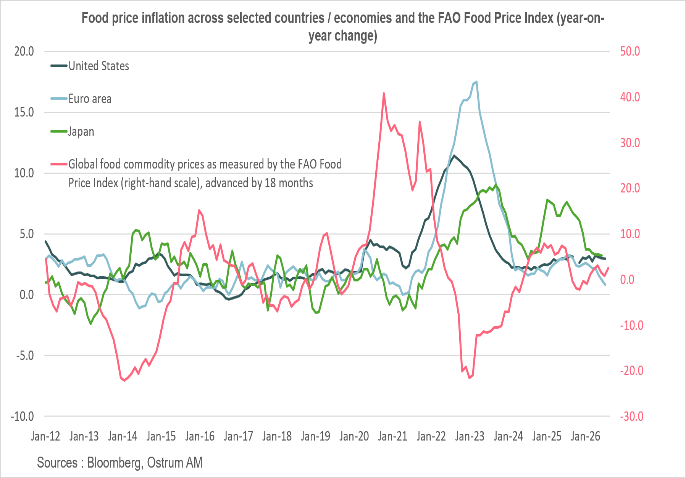
Despite the energy shock stemming from the conflict in the Middle East, food prices have generally stabilized and even moderated in the euro area. However, this is unlikely to last, as suggested by the second consecutive monthly increase in global food prices as measured by the FAO Food Price Index. The index rose by 0.6% in July and 1.9% in August, bringing annual growth to 2.5%. This increase reflects the combined effects of drought, disruptions to trade flows in the Black Sea region, which have particularly affected grain prices, and the conflict in the Middle East. Food prices are therefore expected to rise in the coming months, driven by the impact of drought and adverse weather conditions, higher fertilizer prices, and the effects of El Niño.
Figure of the week
6
U.S. average retail diesel prices rose above the $6-per-gallon on September 11, 2026.
Market review: After the ECB, the Fed will tighten its policy.
- ECB: 25 bp hike, growth and inflation revised up but with asymetrical risks;
- Fed: 25 bp is likley this year;
- Rates: the graudal rise in yields continues ahead of central bak meetings;
- Risky assets: credit, high yield and equities are cushiong the shock to yields.
Market review: After the ECB, the Fed will tighten its policy.
The ECB raised its rate by 25 basis points ahead of Fed, ECB and BoJ meetings. The stakes are enormous both for long-term rates and the yen. Renewed tensions around the Bab el-Mandeb strait linking the Mediterranean to the Indian Ocean are pushing oil towards $105. Expected inflation is adjusting, driving short-term rates higher. Meanwhile, budgets are under pressure.
The global environment has shifted towards synchronized monetary tightening initiated in Australia at the beginning of the year, then the ECB from June and now other major monetary institutions. The ECB is logically responding to inflationary risk, especially as its rate remains negative in real terms. Inflation projections are raised to 3% in 2026 and still 2.1% in two years. Growth proved stronger than expected in Q2 (+0.6%) but the ECB retains downside risks to activity. September's hike will be followed by another tightening in December or early next year if wages accelerate in line with current expectations (+2.8% in March 2027). For his part, Kevin Warsh intends to accelerate inflation's convergence towards target. He will likely raise Fed funds to 4%, especially as inflation (CPI) holds at 3.4% in August. The core index rose 0.3% in August, or 2.4% year-on-year. Despite the slow improvement in price trends, household confidence in their income evolution is near lows since 2012. After Scott Bessent's comments, the Bank of Japan will have to deliver a firm message to stabilize long-term rates and support the yen after multiple summer interventions. A 25bp hike is a given but others will have to follow.
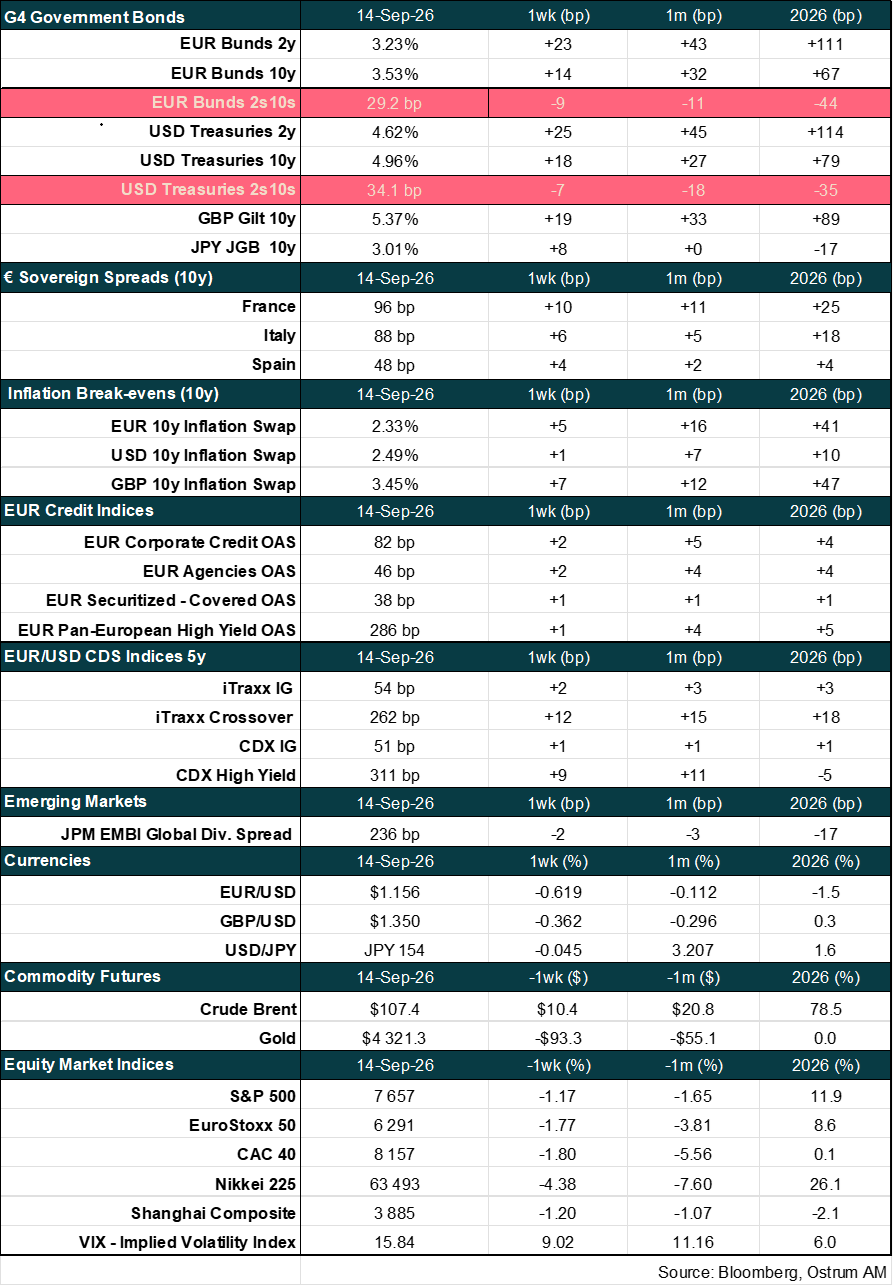
In markets, the soft bond crash has continued. Gilts are under pressure ahead of inflation, employment data and the MPC meeting. UK bond yields rose by 20bp to 5.33% last week, underperforming both German Bunds (+17bp to 3.51%) and T-notes (+14bp to 4.92%) for the week. Last Thursday's 30-year US auction (5.33%) somewhat reassured markets, with final demand being the strongest since 2021. Instead of a crash, the rise in real rate temperature reflects the possibility of a higherneutral rate compatible with price stability and an incompressible credit/term premium now. Central bank rhetoric also favours yield curve flattening.
Meanwhile, pressure is moderately increasing on sovereign and credit spreads. OATs are entering a delicate sequence with budget discussions amid a presidential campaign. The 10-year spread trades at 94bp, +12bp over a month. However, most sovereign bonds are widening against Bunds over the past week. There is probably a rate level that will occasion some distrust towards risk assets. Credit yield approaches 4%, despite spread inertia around 65bp over swaps. High yield perfectly absorbs the rate rise. European equity markets are stable. Banks, media and telecommunications while basic resources and technology lost ground.
Axel Botte
Main market indicators
-

Axel Botte Head of markets strategy