Read our market review and find out all about our theme of the week in MyStratWeekly and its podcast with our experts Axel Botte, Aline Goupil-Raguénès and Zouhoure Bousbih.
Listen to podcast (in French only)
(Listen to) Zouhour Bousbih’s podcast:
- Review of the week – AI, inflation and France, a host of risks.
- Theme – DRAM: China ‘s next “EV Moment”?
Podcast slides (in French only)
Download the Podcast slides (in French only)Topic of the week: DRAM: China ‘s Next “EV Moment”?
- U.S. restrictions on advanced semiconductors have paradoxically accelerated China's drive for self-sufficiency in memory chips;
- Backed by massive state support, China has rapidly built a domestic semiconductor ecosystem, fostering the emergence of national champions and enabling a remarkable technological upgrade across the value chain;
- The shift of established industry players towards higher value-added memory chips (HBM) to meet surging AI demand has allowed Chinese manufacturers to gain market share in standard DRAMs;
- Following its success in electric vehicles, the DRAM industry could become the next strategic sector in which China establishes itself as a dominant technological force.
DRAM: China ‘s Next “EV Moment”?
The announcement in mid-October by Chinese memory-chip maker CXMT (ChangXin Memory Technologies) of a new ultra-compact 4F2 DRAM cell architecture, together with the expected launch of its first DDR5 server memory modules by the end of 2026, sent shockwaves through Asian equity markets. South Korea’s KOSPI index fell by more than 8%, retreating to its early-April level, while Taiwan’s stock market declined by over 5%, dragged down by sector heavyweights SK Hynix, Samsung Electronics, and TSMC. While the global memory semiconductor industry is currently benefiting from the explosive growth in AI-driven demand, the rapid rise of Chinese manufacturers is reviving comparisons with the electric vehicle sector, where China has already demonstrated its ability to reshape the competitive dynamics of an entire global industry in a remarkably short period of time.
The Drivers Behind the Rise of China’s DRAM Industry
U.S. Sanctions as the Main Catalyst for China’s Technological Self-Reliance
Four years ago, the Biden administration significantly tightened restrictions on China by imposing export controls on advanced semiconductors, critical components for artificial intelligence (AI), data centers, and national defense applications.
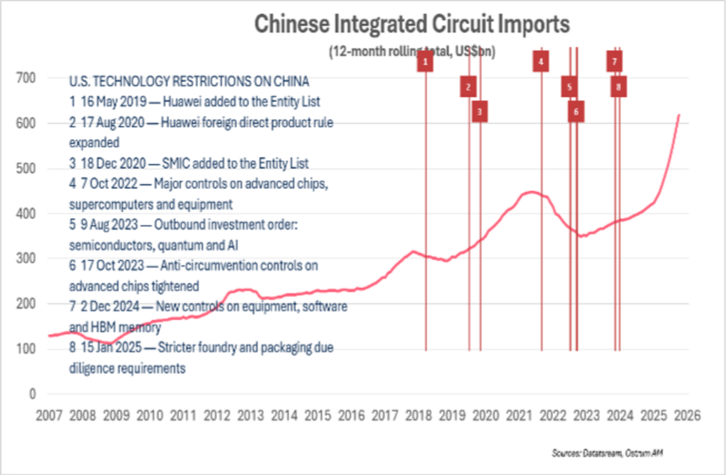
Washington’s objective was clear: to slow China’s technological advancement, particularly in the field of AI.
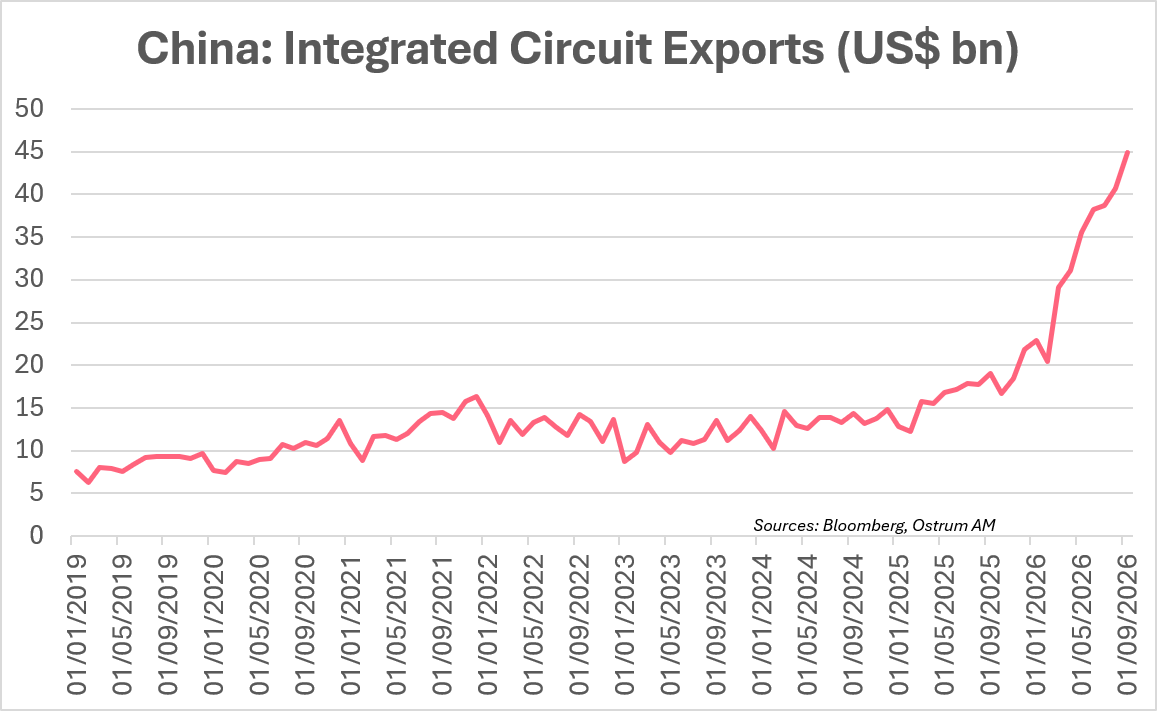
The impact of this U.S. technology squeeze is clearly visible in China’s integrated circuit imports (see chart opposite), which declined by nearly 20% between 2022 and 2023.
An Unmatched Financial Lever
Paradoxically, US restrictions have accelerated Beijing’s technological self-sufficiency drive, supported by massive state backing.
Since 2014, the China Integrated Circuit Industry Investment Fund ("Big Fund") has mobilized nearly RMB 683 billion, equivalent to around USD 100 billion, a figure that exceeds USD 150 billion when associated public and regional funds are included.
The Big Fund operates as a giant venture capital vehicle, encouraging local governments and major state-owned banks to multiply investments, thereby creating a cumulative financial firepower unmatched anywhere in the world. By comparison, the US CHIPS and Science Act has mobilized USD 52.7 billion, while the European Chips Act amounts to USD 43 billion.
The sector can also rely on the powerful funding channel provided by equity markets. In July, CXMT’s landmark listing in Shanghai rose USD 8.6 billion, with proceeds earmarked for expanding production capacity and accelerating the development of next-generation memory chips. The transaction also highlights that the technological race is increasingly being determined by the ability to mobilize capital on a very large scale.
Rapid Technological Progress and Move Up the Value Chain
China has achieved a significant technological and industrial upgrade in recent years.
The country now accounts for roughly 30% of the global export market for standard memory chips, up from 22% in 2015, narrowing the gap with South Korea, the global leader in the sector.
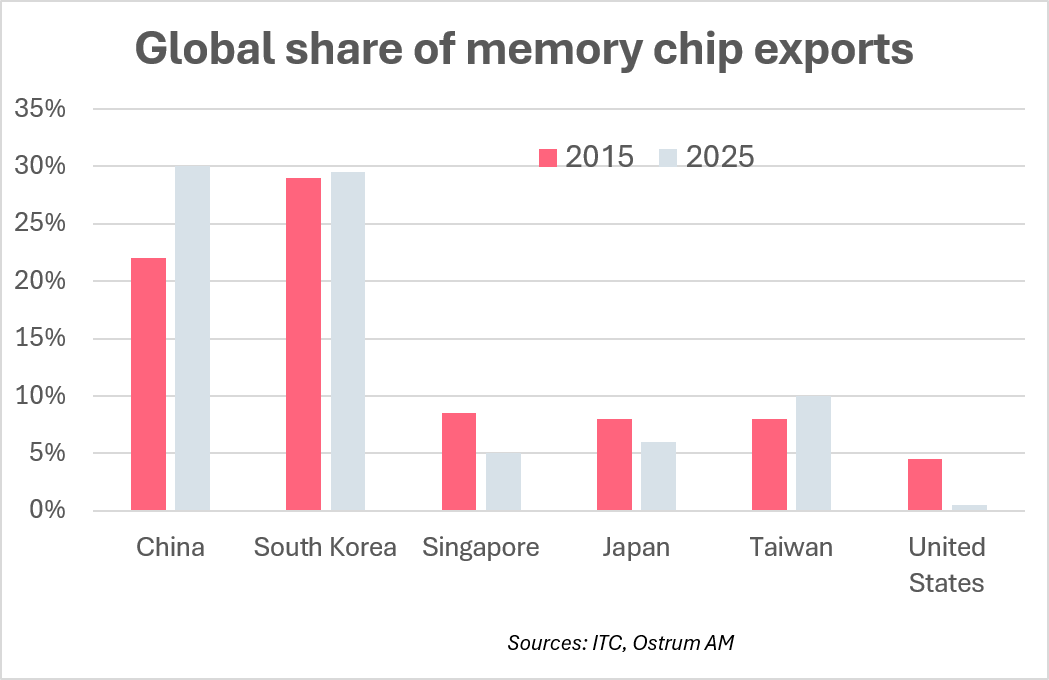
These semiconductors are critical components for vehicles, industrial equipment, and consumer electronics.
Chinese companies are now capable of producing them at scale, raising concerns among their global competitors.
Moreover, Chinese manufacturers are no longer confined to lower-end products and have also made substantial progress in advanced memory semiconductors.
CXMT has rapidly become the world’s fourth-largest DRAM producer, with its market share rising from 4% to 10% in just two years, as illustrated in the accompanying chart.
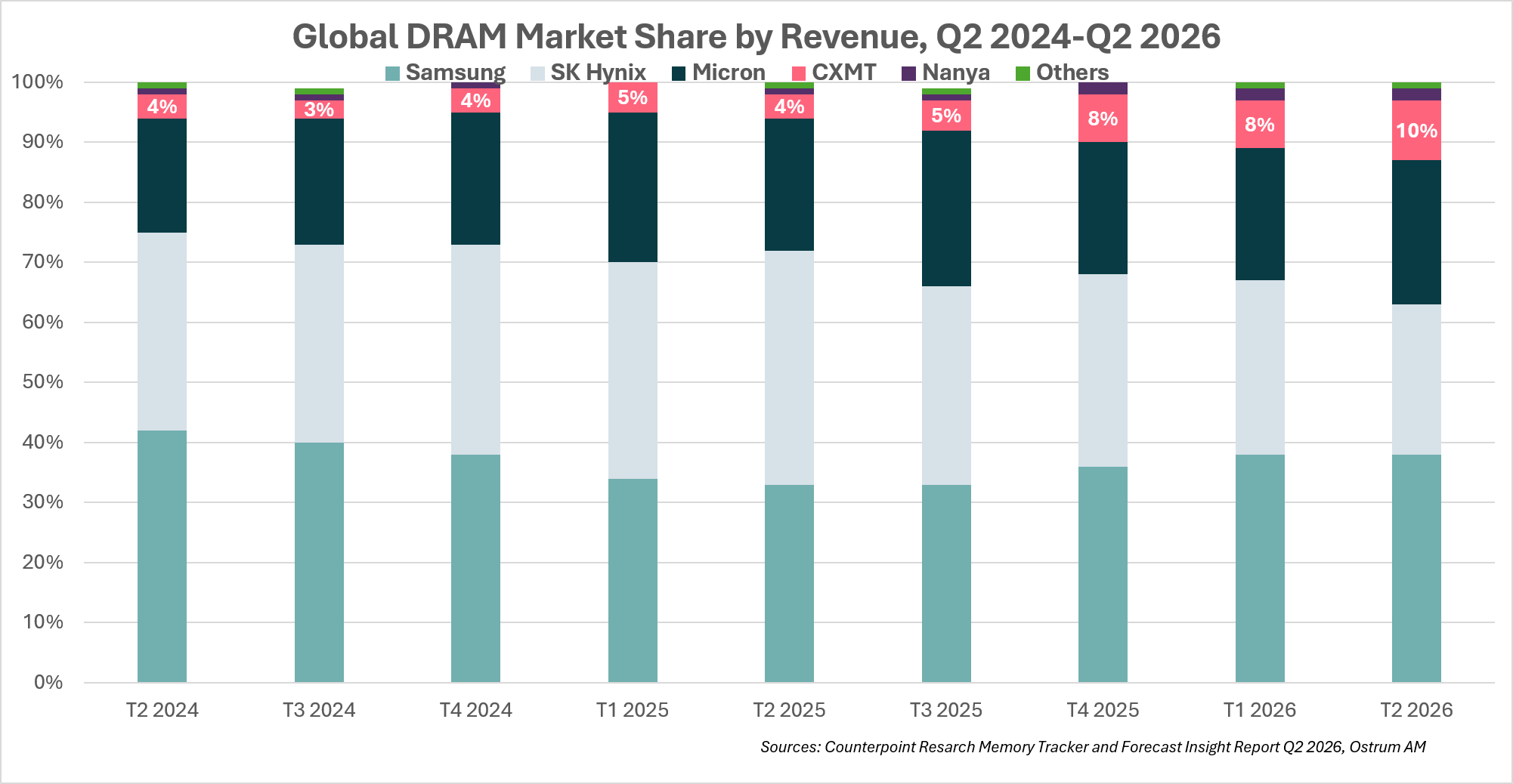
The company is already producing its fifth-generation DRAM, which can increase output per silicon wafer by 50%, dramatically lowering production costs.
The Global DRAM Shortage: A Strategic Opportunity for China
Explosive AI-driven demand for memory has triggered a global DRAM shortage, as leading semiconductor manufacturers have redirected production capacity toward higher-margin HBM (High Bandwidth Memory) chips.
The result has been a sharp surge in prices, particularly for legacy-generation memory products, as illustrated in the accompanying chart. In June 2026, DDR4 prices were 1.4 times higher than DDR5 prices, an unusual market dynamic reflecting acute supply constraints.
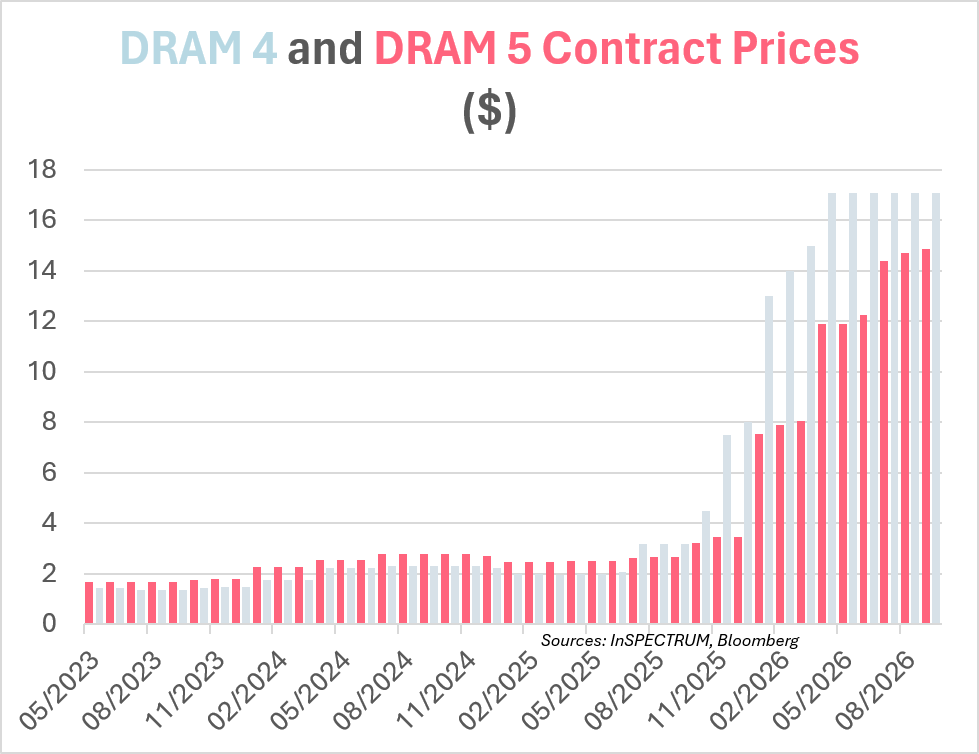
This has had a direct impact on producer prices across the global computing hardware industry.
Apple has already sought approval from the Trump administration to import Chinese-made semiconductors for its smartphones, a request that was ultimately denied.
China has been a key beneficiary of these tight market conditions. Its integrated circuit exports surged in 2026, reaching USD 45 billion in September, representing an increase of nearly 18% since June.
Geopolitical and Industrial Implications
A Growing Economic Threat to South Korea and Taiwan
The emergence of low-cost Chinese competitors poses a significant challenge to South Korea and Taiwan, the two global leaders in the memory semiconductor industry. The profitability of South Korea’s flagship technology companies, Samsung Electronics and SK Hynix, remains heavily dependent on standard memory chips, suggesting potentially significant economic repercussions.
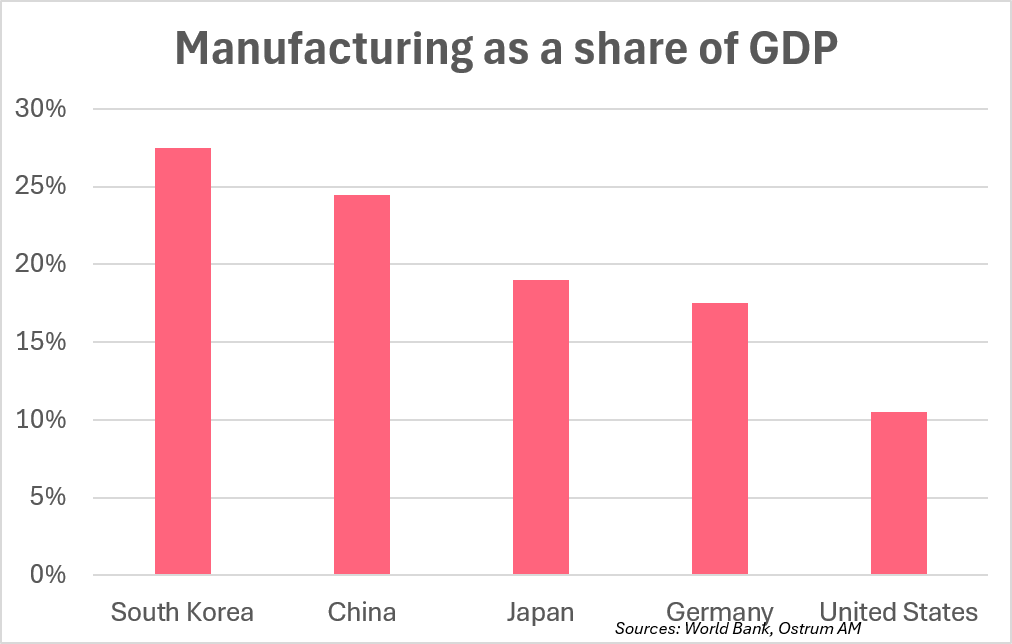
South Korea’s economy has historically relied on semiconductor exports to support its manufacturing sector, which accounts for 27.5% of GDP, a larger share than in China, as illustrated in the accompanying chart.
The Ongoing Reshaping of the Global Semiconductor Industry
According to projections by Yole Group, China is on track to become the world's leading semiconductor foundry hub, with its share of global foundry capacity expected to rise from 21% in 2024 to 30% by 2030, surpassing Taiwan.
By contrast, the United States accounts for 57% of global demand for silicon wafers, the essential substrate used in semiconductor manufacturing yet possesses only around 10% of global domestic production capacity. As a result, the country remains highly dependent on Taiwan, Japan, and China for semiconductor supply. This imbalance highlights the scale of the structural shifts currently underway across the global semiconductor industry.
Parallels with the Electric Vehicle Industry
Although the United States and Europe have imposed substantial tariffs to restrict the entry of Chinese electric vehicles into their domestic markets, China has successfully captured much of the rest of the global market, particularly in Southeast Asia, Africa, and South America, by offering vehicles at prices roughly half those of competitors. As a result, 75% of the world's electric vehicles were manufactured in China in 2025.
A similar pattern could emerge in the memory semiconductor industry. While US trade restrictions may limit Chinese access to certain markets, they are unlikely to prevent a global decline in memory-chip prices. Unlike advanced logic semiconductors, DRAM products are largely standardized and interchangeable, making them particularly vulnerable to price competition driven by expanding Chinese production.
Conclusion
The rapid rise of China's memory semiconductor industry bears striking similarities to the trajectory previously observed in the electric vehicle sector: a strategically important market, substantial state support, and a determination to reduce technological dependence on foreign suppliers.
While US sanctions have temporarily constrained access to the most advanced semiconductor technologies, they have also accelerated the development of a domestic semiconductor ecosystem and driven a remarkable technological upgrading of Chinese manufacturers. At the same time, the explosive growth in AI-related demand for DRAM has created a unique window of opportunity for China to strengthen its position in this emerging strategic industry. Following electric vehicles, the global semiconductor industry could therefore become the next sector to undergo a profound transformation driven by China's industrial and technological ambitions. We believe this will be a major investment theme for 2027.
Zouhoure Bousbih
Chart of the week
To cushion the supply shock caused by the closure of the Strait of Hormuz, the United States drew heavily on its oil inventories, including more than 170 million barrels from its Strategic Petroleum Reserve.
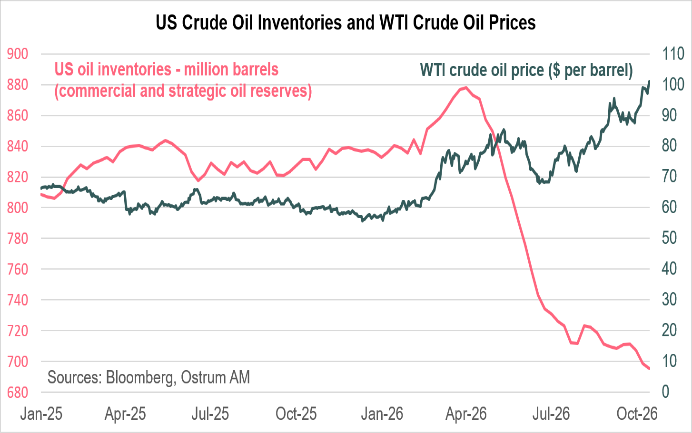
US crude oil stocks have therefore fallen sharply since the spring, declining from a peak of close to 800 million barrels to around 700 million barrels in October.
This inventory drawdown, combined with persistent supply disruptions, continues to put strong upward pressure on crude prices. Brent rebounded this week, briefly approaching $117 per barrel, amid a hardening of US rhetoric that continues to sustain a significant geopolitical risk premium in the oil market.
Figure of the week
175
The 10-year OAT-Bund spread widened to 175 bps last week, its highest level since 2011.
Market review: A multitude of risks
- U.S.: Homebuilder confidence falls to 2012 lows;
- Bonds: T-note yields break below 5%, reclaims safe haven status;
- France: OAT spreads spike to 175 bps;
- Equities: AI stocks under increasing pressure.
A multitude of risks
The Bund and the T-note are benefiting from uncertainty surrounding the AI sector, while oil prices are climbing sharply. France’s spread has widened to its highest level in 15 years.
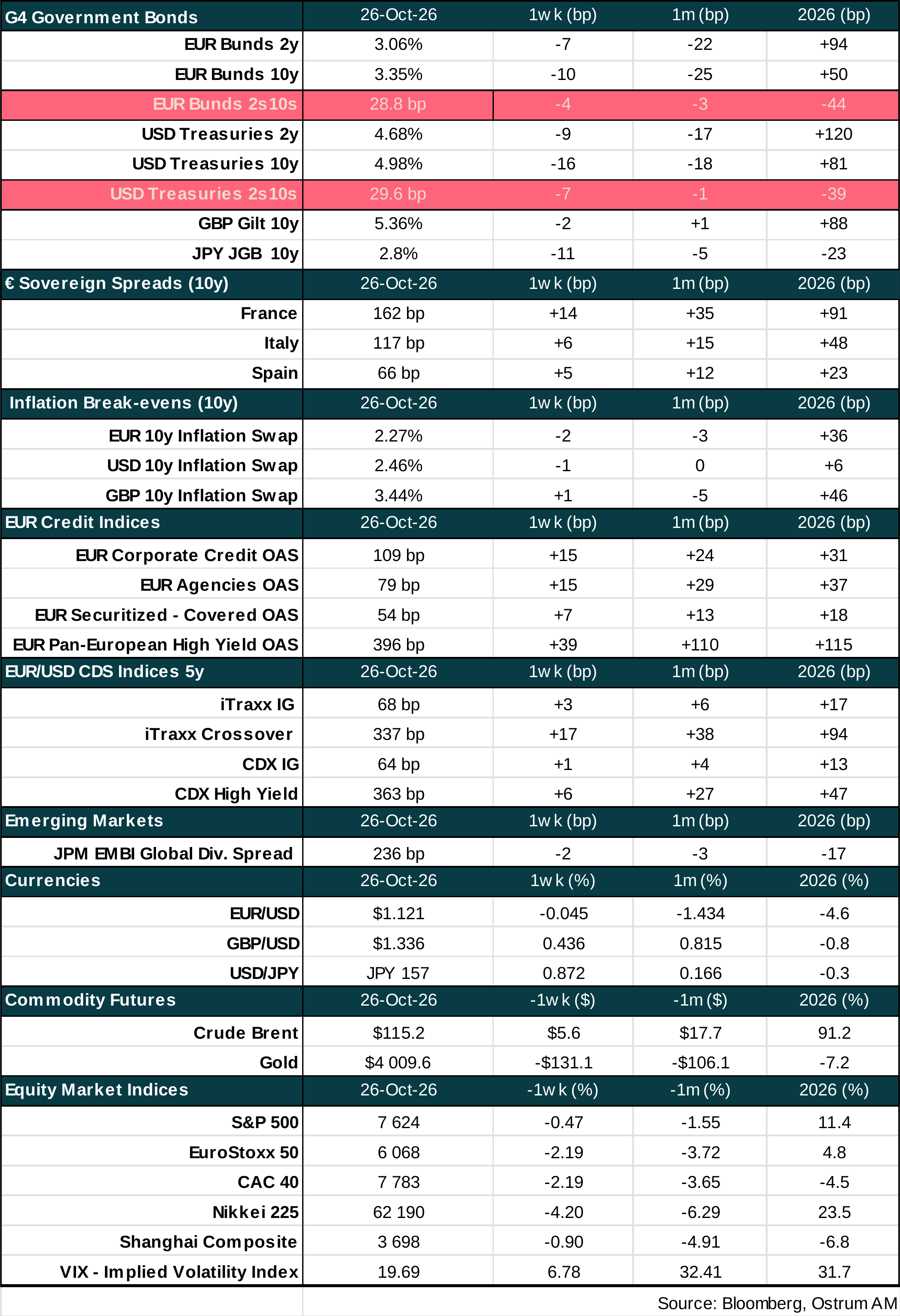
One lesson from recent weeks is that the Bund and the T-note are once again acting as safe havens: the former amid pressure on OATs, the latter as US AI-related stocks sell off. Neither gold nor the dollar has benefited from the renewed risk aversion. Yield curves have flattened sharply, while housing data point to a worrying downturn. Falling yields stand in contrast to oil’s rebound towards $115 a barrel.
The US economy is likely to grow at close to 3% in the third quarter. Yet the strength of business investment masks clear weaknesses. The housing sector is sliding again: homebuilder confidence, as measured by the NAHB index, has fallen to 29, its lowest level since 2012. Housing starts are declining, while pending home sales are down 12.6% year on year. The increasingly pronounced K-shaped growth pattern, together with domestic and external imbalances, leaves the economy vulnerable. The eurozone picture is mixed. France is losing ground amid a political and fiscal crisis. Its October PMIs have fallen back below 50, while the eurozone and German composite indices — at 51.9 and 52.8 respectively — remain consistent with a continued recovery. The latest oil shock is nevertheless a significant drag on growth. Household inflation expectations stand at 3.1% over one year and 2.9% over three years.
In financial markets, the Bund and the T-note are again the most sought-after assets during periods of stress. The 10-year Bund has broken below 3.40%, while the US Treasury yield is trading below 5%. Curves have flattened sharply, although higher crude prices no longer appear to be fuelling expectations of monetary tightening. Energy is the main source of inflationary pressure, but expensive oil is also recessionary — and may ultimately prove disinflationary. Central banks are therefore likely to hesitate before raising rates to excessively restrictive levels. France remains under pressure: its spread has widened to 175 basis points, levels last seen during the 2011 crisis. Moody’s left France’s sovereign rating unchanged at Aa3, despite uncertainty regarding fiscal consolidation ahead of the 2027 presidential election. French stress has pushed other spreads wider, including Italy’s BTP spread, at 124 basis points, and Belgium’s OLO spread, at 110 basis points. Swap spreads reflect pressure on banks, particularly at the two-year maturity.
Credit spreads have widened moderately, to around 78 basis points over swaps. High yield has been more volatile in both Europe and the US, with spreads widening by about 20 basis points over the week. Equity volatility remains elevated, particularly in AI-heavy Asian markets. South Korea’s Kospi has fallen a further 2%, while the Nikkei has lost 4% amid a rebound in the yen. Eurozone equities have also declined, especially cyclical and banking stocks. Healthcare was the only sector to post a significant rebound.
Axel Botte
Main market indicators
-

Axel Botte Head of markets strategy