

At the start of the last quarter, equity markets continued to rise despite a turbulent environment: crisis in the Middle East, sovereign debt tensions and rise in long-term interest rates. Ostrum AM's scenario from last November is largely borne out: continued rise, volatile first half, year driven by the rebound in profits, even if the paths taken were not those anticipated.
In an uncertain environment, earnings growth has become the main performance driver, while valuation multiples are contracting. The question is no longer about the direction of the markets but about the strength of the drivers: investment cycle in AI, record profitability, markets’ ability to absorb the rise in interest rates.
Source: Ostrum Asset Management, October 2026. The analyses and opinions expressed in this document represent the view of the named authors. They are issued on the date indicated, are subject to change and should not be interpreted as having any contractual value.
Markets: a resilient global economy, driven by AI
World trade and profits: a boost from the United States
World trade is accelerating in 2026 (+7.5% in June) despite the trade war, international conflicts and climate constraints. This resilience owes much to the AI boom: global semiconductor sales have more than doubled in a year and technology goods are escaping the latest announced tariffs. Starting in the United States, the momentum spread to Asia, with Taiwan and South Korea leading the way, and then to Europe, where German infrastructure plans are beginning to flow into the economy. It is also reflected in company accounts: revenues and profits have accelerated sharply in companies in the major US, European, Japanese and Chinese indices, with remarkably resilient margins.
The AI investment cycle: unprecedented funding
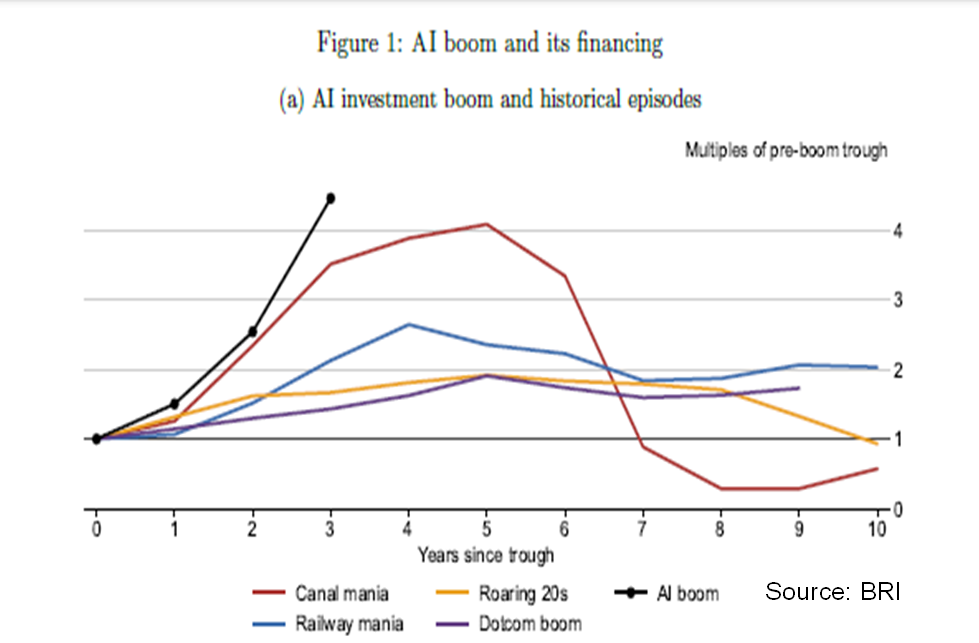
The investment cycle in AI is unprecedented. According to a BIS study, spending has grown faster than during previous technological revolutions (channels, railways, 1920s, internet bubble) and the current cycle is on track to surpass them all, with over $700 billion in hyperscaler investments in 2026. For the moment, it is the material side that is benefiting from this momentum, while the expected productivity gains remain barely visible: they will depend on the diffusion of AI in the processes of established companies. The internet episode calls for caution: an additional productivity growth point per year between 1995 and 2005, but at the cost of a bubble, a recession and tighter credit conditions along the way.
The funding method also distinguishes this cycle from previous ones. A significant portion of data centers is financed by US private credit, through special purpose vehicles in which hyperscalers are the tenants, allowing them not to fully recognise this commitment in their accounts. Nvidia, for its part, plays the role of banker to the sector: trade receivables and equity stakes in its customers reflect a circular financing pattern, while its free cash flow has declined despite substantial profits. Hyperscalers are now major players in the bond market, with maturities of up to 40 years and even more for Alphabet, with a 100-year bond in sterling: the US economy needs to import around $1 trillion in capital.
Prices and profits: signs of overheating
The risk of overheating cannot be ruled out. PMI and ISM purchasing managers' surveys are up sharply in the United States, Europe and China, but with very high prices paid, supply chain bottlenecks in electronics that some companies consider more severe than during the post-Covid period, and commodities under pressure: copper, affected by both the energy transition and AI, is trading above $14,000 per tonne, compared to $6,500 to $8,000 for a long time.
This dynamic is driving K-shaped growth, which is good for capital. The share of profits in US GDP is 12%, up from 6-8% for decades and around 9% before the 2008 financial crisis, with no rebalancing since the 2010 recovery. The recent earnings acceleration came from technology and energy, whose prices were boosted by the Iranian crisis and Ukrainian strikes on Russian refineries.
Rates: a well-integrated tightening
This brings us to monetary policy. Markets are pricing in multiple rate hikes (the Fed is expected to be around 4.6% and the ECB around 3.1% by mid-2027), after the Fed's 25 basis point hike on 16 September (3.75%-4.00%), the first since 2023, which few had seen coming. The rise of about one percentage point in ten-year real rates since the beginning of the year does not come from a term premium or higher inflation expectations, but from a revaluation of the short-term rate path: in a disrupted world with limited resources, higher real rates may be needed for longer. This tightening is now well priced in; it would take a US ten-year real rate well above 3% (1.9% today) to become a net headwind for equities. More than a threshold, it's a climate that counts: a poorly received debt auction can be enough to trigger a risk aversion phase.
Equities: earnings driving the rally, key areas of vigilance
Performance: results, the driver of growth
Equity markets have been rising for nearly five years, at a rate of around 10.5% per year for the eurozone, while ten-year European sovereign bonds are down by around 2.5% per year: a difference of 13 points per year, which illustrates the insensitivity of equities to the rise in long-term interest rates. Over one year, global markets excluding China continued to rise: around +33% in Japan, close to +20% in the Eurozone and the United States, compared with a decline of about fifteen percent in China; this time it was earnings growth that did most of the work, with the multiple weighing on performance, especially in the United States where it was the highest. However, the summer was marked by profit taking in Asia: the Kospi has lost nearly 18% since the end of June, after a gain of more than 65% since January.
The performance differences are largely due to the passport and the sector composition of the indices. Austria (banks) and the Netherlands (semiconductors, with ASML) posted gains of more than 40% over one year, Finland was once again driven by Nokia, while France and Germany brought up the rear, at around 7% and 8%. In terms of sectors, technology equipment, semiconductors, energy (whose rise merely reflects the rise of the forward curves of oil, gas and refining margins) and banks dominate. Conversely, sectors exposed to Chinese consumers or competition (luxury, automotive, healthcare equipment) and those threatened by disruption from AI (business services, retail, media, IT services) are down. AI is therefore a central theme, both on the rise and on the decline.
Earnings and valuations: solid momentum, reasonable multiples
For the first time in four years, profits are growing in the Eurozone. The expected earnings per share growth, around 14% at the beginning of the year, is now close to 20% for 2026, thanks to banks, semiconductors and energy, with oil accounting for just under 60% of this revision. Yet, expected profits are usually revised downwards, and the eurozone has not recorded any growth in 2023, 2024 and 2025. The pace of revisions has reached a level that was only exceeded in two episodes in ten years, and companies are approaching third-quarter earnings with confidence: with growth of around 10% expected for next year, the risk of major disappointments seems limited.
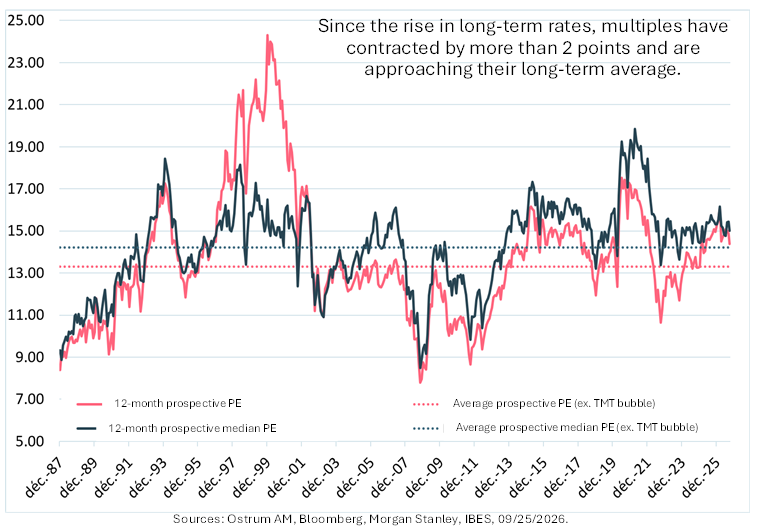
At first glance, valuations do not appear to be a particular concern. The 12-month P/E has lost about one point since the beginning of the year, and more than two points since the rise in long rates, approaching its long-term average. In relation to the expected earnings growth in 2026-2029, valuations are, excluding technology, automotive and energy, in line with expectations of 5% to 15% per year: the automotive sector reflects high uncertainty, and the energy sector the idea that the situation in Ormuz will not normalise quickly, while visible growth stocks (semiconductors, technology, software, cosmetics) are trading at a premium. Banks, finally, have fallen sharply since the sovereign debt crisis, despite earnings upgrades: they are trading at around 11 times earnings, but on restored profitability levels, above 20% in Italy, with capital around three times higher than in 2006.
Europe and France: a recovery potential yet to be confirmed
After two waves of inflows related to diversification away from the US and German fiscal stimulus, flows into European equity funds have been subdued since the Ormuz conflict, before returning to near average levels. The eurozone could, however, become attractive: more diversified, underowned, cheaper and less exposed to AI disappointments, it offers earnings growth of around 10% per year over 2026-2029, and the earnings revision momentum in continental Europe is turning around versus most other markets.
The French market illustrates the fragility of this relay. It underperformed by around 25% over three years, partly due to the OAT-Bund spread, but not only: on 2028 earnings, French companies are lagging behind the euro zone by around 20 growth points. The index is underweight in technology and banks, and overweight in consumer sectors (luxury, automotive, food and beverage) where earnings are under pressure. The 10-15% discount seen on most sectors could, however, offer catch-up potential if the earnings momentum of consumer stocks recovers.
Profitability: the main point of vigilance
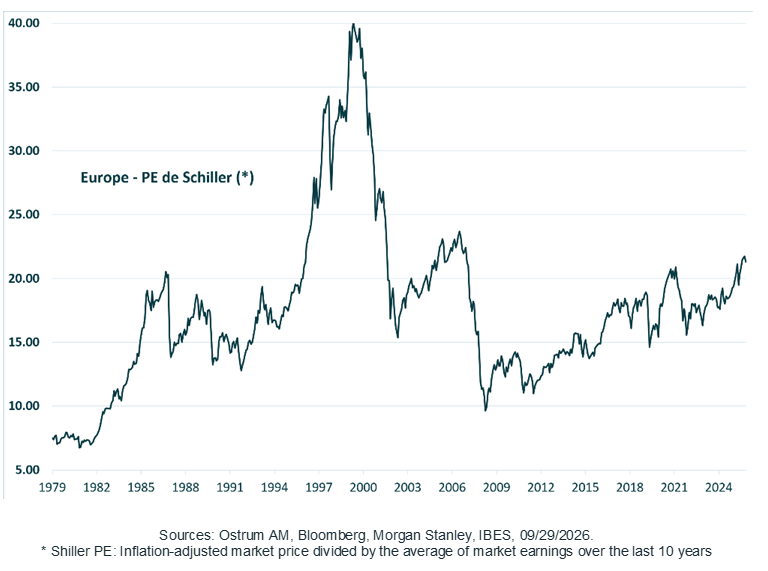
Profitability is the main focus. Net margins of listed companies in the eurozone have never been so high: they have almost doubled since the financial crisis. Meanwhile, the Shiller PE, which relates the price to the average earnings of the last ten years, stands close to 21x; at this level, the markets' performance over the next three years was only really positive in 1996-1997, in the midst of the technology bubble. If this profitability were to normalise, due to the cycle, the need to correct public deficits or increased competition, valuations would look much tighter.
Conclusion: volatility, but no trend break
For the end of the year, equity markets are likely to remain volatile without a change in trend. Double-digit earnings growth should not be in jeopardy, the rate hike is already largely priced in and the support from flows should continue, with the rebalancing towards Europe continuing. The fourth quarter, traditionally favourable, is opening without any sign of a turnaround, but caution is more than usual: the central scenario envisages stable but volatile markets, without a trend reversal.
This caution is due to well-identified risks: an unresolved crisis in Ormuz, a bond tension that has not been fully experienced, with credit spreads and interest rate volatility starting to tighten, the French budget situation, and growing questions about the economic model of the AI value chain, while the major stocks in the sector account for more than 40% of US capitalisation, a level comparable to the peaks of past bubbles. Conversely, a détente in the Middle East would lower energy prices and inflation, and erase some of the expected rate hikes, which would be positive for equities.
In this context, balanced portfolios between sectors and themes are recommended for the coming quarters, without excessive anchoring in the major themes of 2026, for which the level of optimism is high and could be disappointed. Four topics remain to be watched: rates and the economy, AI and its open questions, France (both macro and micro) and corporate profitability.
-

Axel Botte Head of Market Strategy
-

Frédéric Leguay Head of Fundamental Euro Equity Investments