Read our market review and find out all about our theme of the week in MyStratWeekly and its podcast with our experts Axel Botte, Aline Goupil-Raguénès and Zouhoure Bousbih.
Listen to podcast (in French only)
(Listen to) Axel Botte’s and Aline Goupil-Raguénès podcast:
- Review of the week – AI revives volatility, US employment remains strong.
- Theme – Upcoming pressures on food prices in the euro area.
Podcast slides (in French only)
Download the Podcast slides (in French only)Topic of the week: Upcoming pressures on food prices in the euro area
- While inflation in the euro area has accelerated markedly since the beginning of the year, food inflation has slowed significantly. It has nevertheless begun to strengthen since September;
- Food prices are expected to rise further over the coming months, reflecting the fading of previous favorable effects and the gradual pass-through of the energy shock and extreme weather conditions;
- For now, price pressures are concentrated at the early stages of the production chain, particularly in energy and fertilizer prices. These pressures are expected to gradually feed through the production chain over the coming quarters;
- The impact of exceptional heatwaves and drought on agricultural production is beginning to be felt in the prices of unprocessed food products, particularly vegetables;
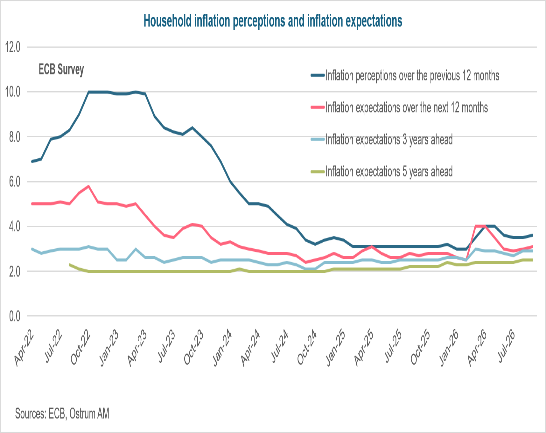
- Higher food inflation is likely to weigh more heavily on households’ perceptions of inflation and their short-term inflation expectations, given its key role in shaping them;
- The ECB will pay particularly close attention to these developments and adjust its monetary policy accordingly to fulfil its price stability mandate. We expect the ECB to raise interest rates by 25 basis points in December 2026, and possibly again in March 2027.
Upcoming pressures on food prices in the euro area
While inflation in the euro area has accelerated markedly since the beginning of the year, food inflation has slowed significantly. This divergence is unlikely to persist, owing to the fading of favorable effects and the forthcoming impact of the energy shock and the extreme weather conditions experienced over the summer. Food prices are closely monitored by the ECB given their importance in consumers’ perceptions of inflation and their key role in shaping inflation expectations. A recent ECB article highlights the underlying pressures and transmission mechanisms at play.
Striking contrast between food prices and inflation
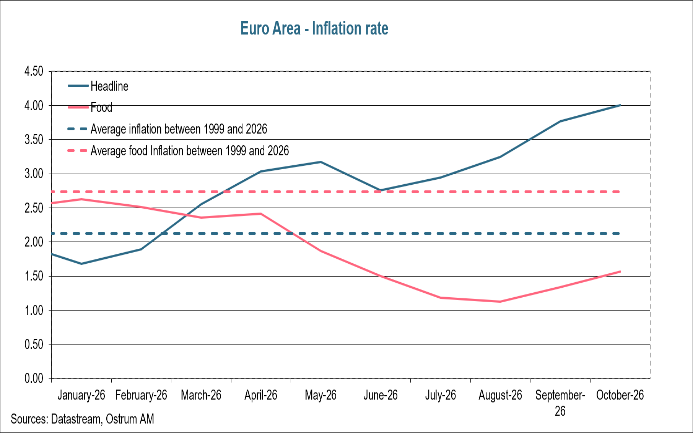
Food inflation has moderated since the beginning of the year.
Euro-area inflation has accelerated sharply since the beginning of the year, rising from 1.7% in January 2026 to 4.0% in October, according to Eurostat’s preliminary estimate. This increase largely reflects the surge in energy prices following the conflict in the Middle East: energy inflation reached 20.8% in October, compared with a 4.0% year-on-year decline in January 2026 due to a base effect.
Food inflation, by contrast, slowed over the period, falling from 2.6% at the beginning of the year to 1.1% in August, its lowest level since 2021, before edging up to 1.6% in October. It therefore remains well below its long-term average of 2.7% over the 1999-2026 period.
Lower contribution to inflation from certain products whose prices rose significantly in 2025.
Several factors have contributed to the moderation in food inflation this year.
The first is the lower contribution to inflation from certain products, such as coffee, chocolate, fruit and dairy products, following their strong contribution in 2025. Prices for these products rose sharply in 2025, partly as a result of severe adverse weather conditions affecting some major producing countries, including Brazil, Indonesia and Vietnam for coffee, and Côte d’Ivoire and Ghana for cocoa. The heatwave in the summer of 2025 also pushed up unprocessed food prices. The contribution of beef prices to food inflation has also moderated, after being higher in 2025 due to a structural decline in supply combined with robust demand.
Consumer prices are also still benefiting from the pass-through of past favorable conditions to food prices. Agricultural yields were generally strong last year, with above-average harvests of cereals and oilseeds. Global prices for several commodities, including coffee, tea, cocoa and sugar, have also declined after rising sharply.
Upcoming pressures on food prices
- Impact of the energy shock
Energy prices affect food prices through several channels, including transportation, fertilizer, packaging and processing costs. Oil and gas prices have risen sharply following the conflict in the Middle East and disruptions in the Strait of Hormuz, which accounted for nearly 25% of global seaborne oil trade and close to 20% of liquefied natural gas (LNG) trade. Qatar’s energy facilities have also been targeted by Iranian strikes. Qatar is the world’s second-largest LNG producer.
Brent crude prices have consequently risen by almost 35% since the conflict began in late February, reaching $98.3 per barrel on 6 November, after briefly approaching $120. In Europe, natural gas prices surged from €32/MWh on 27 February to €103.9/MWh on 30 October, before easing back to €86/MWh, still representing an increase of almost 170%.
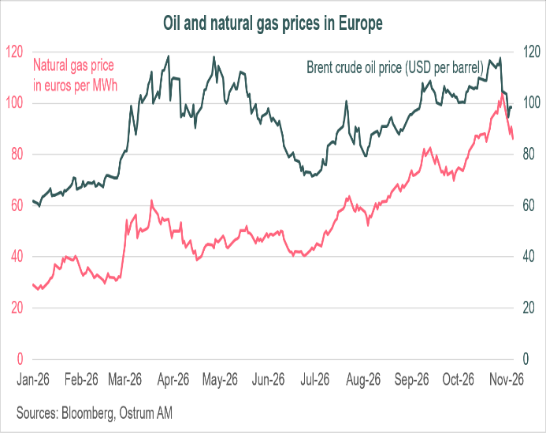
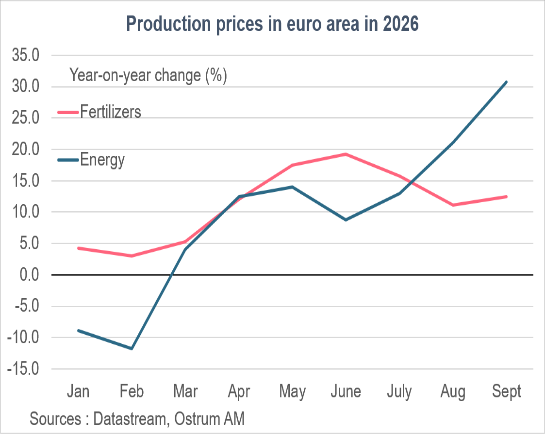
So far, the impact of the energy shock has been felt upstream in the production chain, particularly in energy and fertilizers…
… its effects will take several quarters, if not years, to feed through the entire production process.
At this stage, the energy shock is having a significant impact on production costs at the upstream end of the production chain. This is reflected in higher producer prices for energy and fertilizers. Oil affects food prices through transportation costs and other indirect costs, while natural gas is a key feedstock in the production of fertilizers, accounting for 70-80% of the production cost of urea or ammonia. Given the importance of natural gas as an input in food production, higher gas prices translate into increased production costs for crops such as cereals, oilseeds, fresh vegetables and potatoes, as well as higher heating costs for greenhouse-grown produce. The Strait of Hormuz is also a strategic shipping route for fertilizers: before the conflict, more than 30% of global urea trade and around 20% of global ammonia and sulphate trade passed through the strait. Disruptions to these supply flows have therefore contributed to the increase in fertilizer prices.
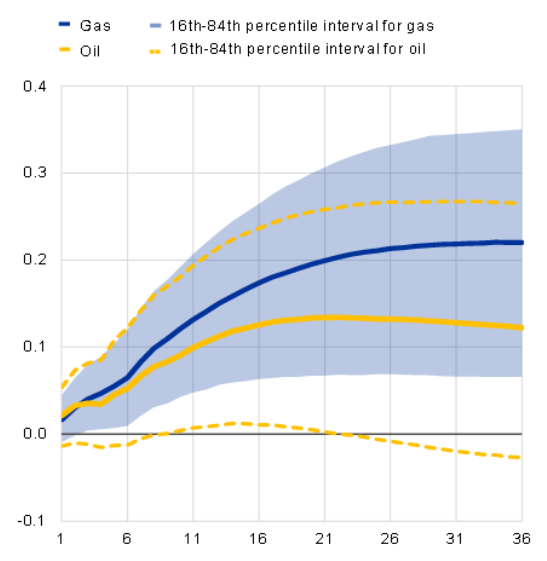
At later stages of the production chain, the increase in energy prices has not yet translated into higher production costs. The indirect effects of an energy shock on food prices can be significant, but may take several years to fully materialize, as illustrated by the ECB chart below. These effects are expected to gradually feed through the production chain over the coming quarters.
- Impact of the shock from this summer’s extreme weather conditions
Europe experienced an exceptionally severe and persistent heatwave over the summer, together with a major drought. These extreme weather conditions occurred at a critical stage of the growing season, reducing crop and fodder production across Europe and putting pressure on food supply chains.
According to the European Commission’s September estimates, yields for several major summer crops fell sharply below their five-year averages: 15% lower for soybeans, 14% for green maize, 8% for grain maize, 7% for potatoes and 11% for sugar beet. In countries most severely affected by these extreme weather conditions, some livestock farmers were forced to reduce herd sizes due to a sharp decline in the availability of animal feed (grass and fodder).
This summer’s extreme weather conditions are beginning to be reflected in fresh produce prices.
The effects of the weather-related shock are starting to feed through to food prices. Food inflation rose from 1.1% in August to 1.3% in September and 1.6% in October. This pick-up has been entirely driven by unprocessed food, with inflation rising from 2.7% in August to 4.0% in September and 4.6% in October. In September, the increase was largely driven by higher vegetable prices (6.4% year on year in September, compared with 2.7% in August), which are particularly sensitive to weather conditions. A detailed breakdown is not yet available for October. By contrast, processed food inflation, which accounts for the largest share of the food basket, remained subdued, at 0.4% in September and 0.5% in October. Food prices are expected to continue rising over the coming months, reflecting the impact of this summer’s extreme weather conditions in Europe, compounded by the forthcoming effects of El Niño. The ECB estimates that weather conditions could add between 0.3 and 0.8 percentage points to food inflation over the coming year.
According to the ECB’s September projections, food inflation is expected to peak at 3.4% in Q3 2027.
Overall, the fading of past favorable factors that had contained food price increases, together with the gradual pass-through of the energy shock and extreme weather conditions along the production chain, is expected to lead to a marked acceleration in food inflation over the coming months. In its September projections, the ECB expects food inflation to peak at 3.4% in the third quarter of 2027, before easing thereafter.
Why the ECB closely monitors food prices
- Importance of food prices in shaping households’ inflation perceptions and expectations
Food expenditure is largely made up of essential goods and accounts for a significant share of households’ consumption basket used to calculate the Harmonised Index of Consumer Prices (HICP), Food is a basic necessity, accounting for nearly 20% of the household consumption basket, and is purchased frequently.
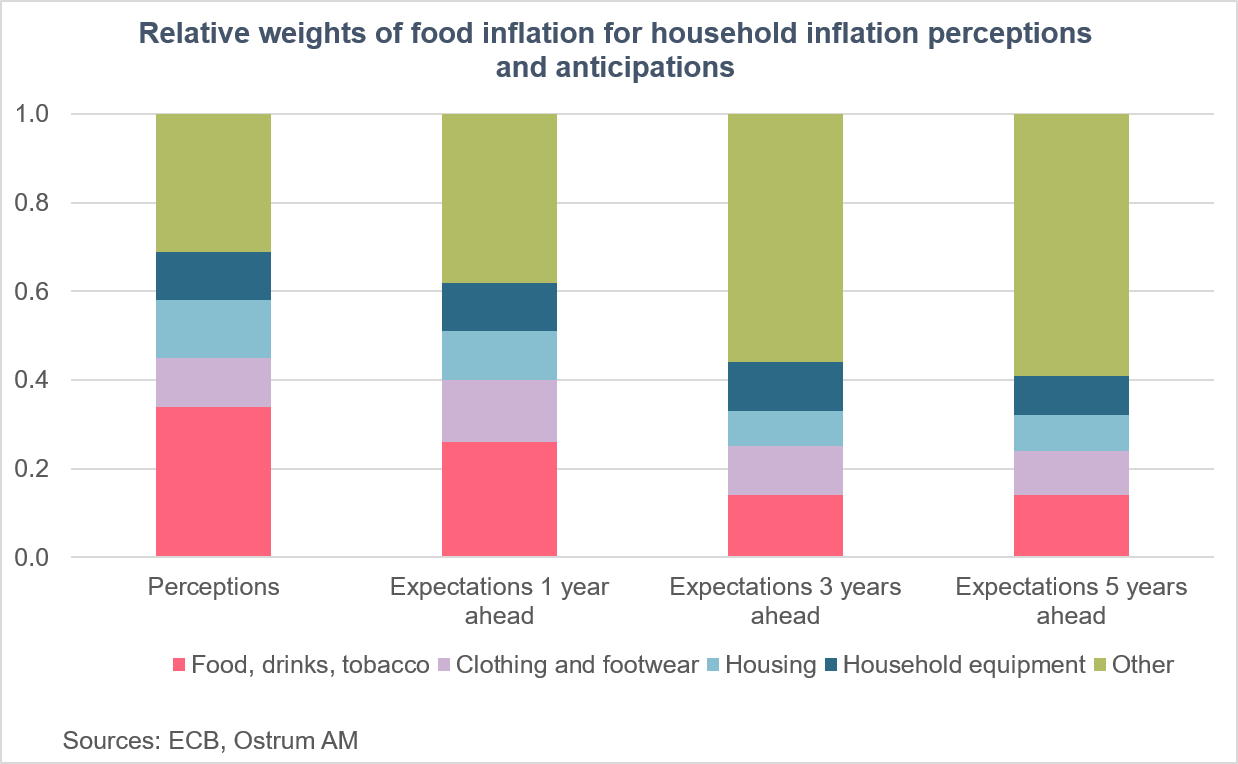
Food expenditure is largely made up of essential goods and accounts for a significant share of households' consumption basket used to calculate the Harmonised Index of Consumer Prices (HICP), representing close to 20% in the euro area, twice the weight of energy. Households purchase food products frequently and therefore quickly notice changes in their prices. They tend to pay closer attention to food prices than to the prices of other goods. As a result, food prices play a disproportionately important role in shaping households’ perceptions of inflation and their inflation expectations. The ECB’s Consumer Expectations Survey helps illustrate the magnitude of this effect. It shows that food inflation plays a relatively greater role in households’ perceptions of overall inflation and in their one-year-ahead inflation expectations. Its influence is smaller at longer horizons.
Lower-income households are more exposed to food price increases.
Risk of second-round effects on inflation.
Changes in food prices have an even greater impact on lower-income households, as they spend a larger share of their income on essential goods and services such as food, energy and housing. They are therefore more exposed to increases in these prices. When food prices rise, lower-income households experience a higher effective inflation rate than higher-income households. This can fuel demands for higher wages and generate second-round effects on inflation, potentially leading to broader price pressures, including on services and underlying inflation, and ultimately to higher and more persistent inflation. The ECB therefore pays particularly close attention to food prices, given its price stability objective of ensuring that inflation returns to its 2% target over the medium term.
Food remains expensive
A wide and persistent gap between the food and non-food price indices.
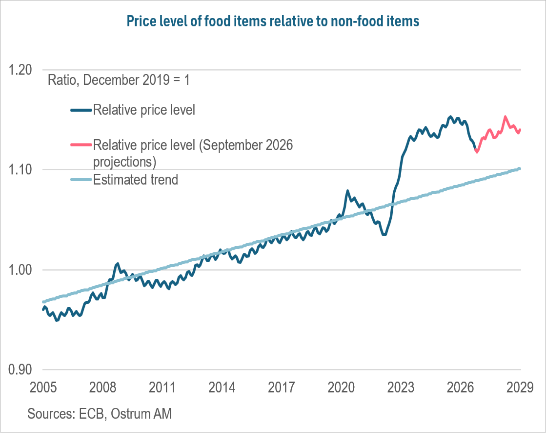
Despite the slowdown in food inflation since the beginning of the year, the relative level of the food price index remains well above that of non-food products, as shown in the chart below. The ratio between the two indices rose sharply from 2022 onwards, reflecting the strong post-Covid recovery, followed by the consequences of the war in Ukraine, including the energy shock and supply disruptions affecting certain agricultural commodities. As a result, the ratio has moved significantly above its long-term trend (shown in light blue in the chart), and this gap has proved persistent. In October, food prices in the euro area were almost 30% higher than at the end of 2021.
Although real wages have returned to pre-crisis levels, the cost of the food basket has risen.
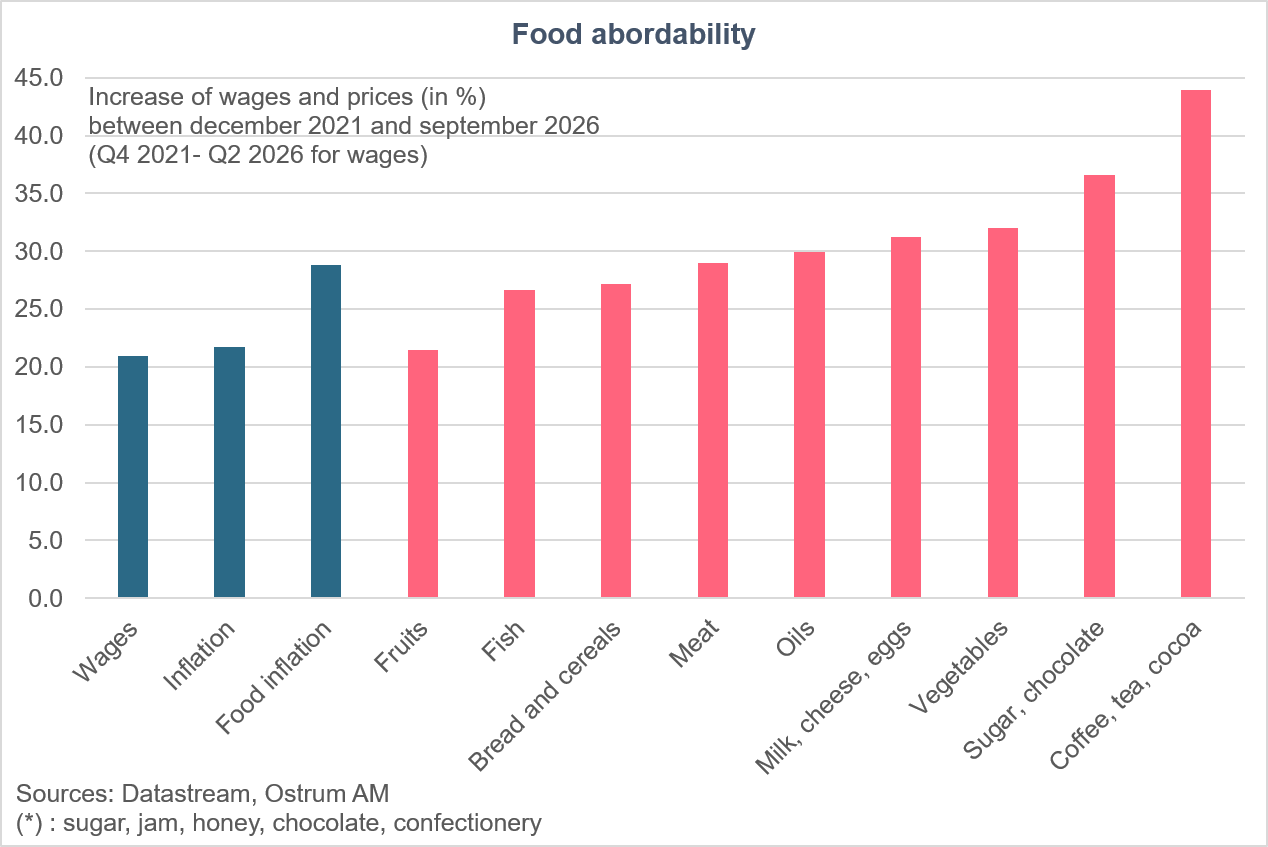
The ECB paper also highlights an important point. While wages adjusted with a lag to the sharp rise in inflation, allowing real wages to return to their pre-crisis level, the cost of the food basket has risen, as shown in the chart below. This is particularly true for frequently purchased products such as coffee, chocolate, vegetables, milk and meat. This helps explain why 55% of Europeans consider affordable food prices to be a top priority, according to the Eurobarometer published on 22 September.
Conclusion
Food prices are expected to rise over the coming months as past favorable effects fade and the energy shock and extreme weather conditions gradually feed through. For now, price pressures remain concentrated at the upstream end of the production chain, particularly in energy and fertilizer prices. These pressures are expected to gradually propagate along the production chain over the coming quarters. The effects of this summer’s exceptional heatwaves and drought are already starting to feed through to unprocessed food prices. Higher food inflation is likely to push up households’ perceptions of inflation and their short-term inflation expectations. The ECB will therefore pay particularly close attention to these developments and adjust its monetary policy accordingly to safeguard price stability. We expect the ECB to raise interest rates by 25 basis points in December 2026, and possibly again in March 2027.
Aline Goupil-Raguénès
Chart of the week
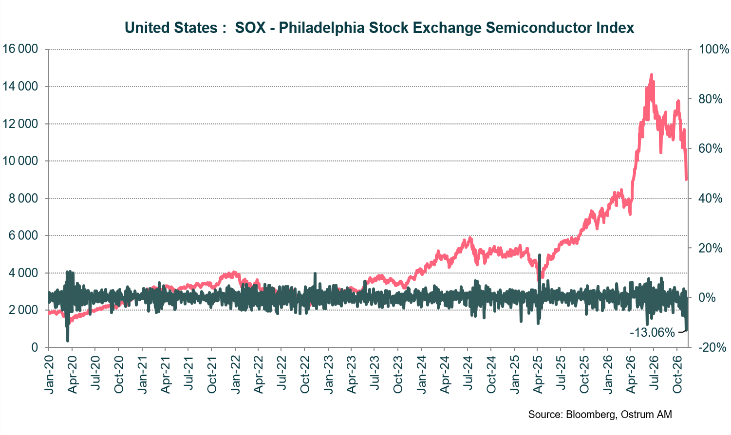
The Philadelphia Semiconductor Index fell by more than 13% on Thursday, 5 November, its steepest one-day drop since 2020. Semiconductor stocks are now down 38% from their 22 June peak and 31% from 6 October.
Concerns over AI are mounting, for a variety of reasons, including cautious communication from the hyperscalers, lengthening data centre construction timelines and the political shift in favor of the Democrats after the US midterm elections.
The sell-off in the US index has spread to Asia, where Japanese, South Korean and Taiwanese markets have also suffered sharp declines.
Figure of the week
70
According to Polymarket, the probability of Donald Trump being impeached before 2028 is estimated at 70%.
Market review: AI Reignites Volatility
- United States: Employment rises by 165k in October, unemployment edges down to 4.1%;
- BoE: Unanimous rate hike with upward revision to inflation forecasts;
- Rates: Equity volatility supports bonds, especially as oil drops $15 over the week;
- Equities: Semiconductor index plunges, warning shot for US and Asian indices.
AI Reignites Volatility
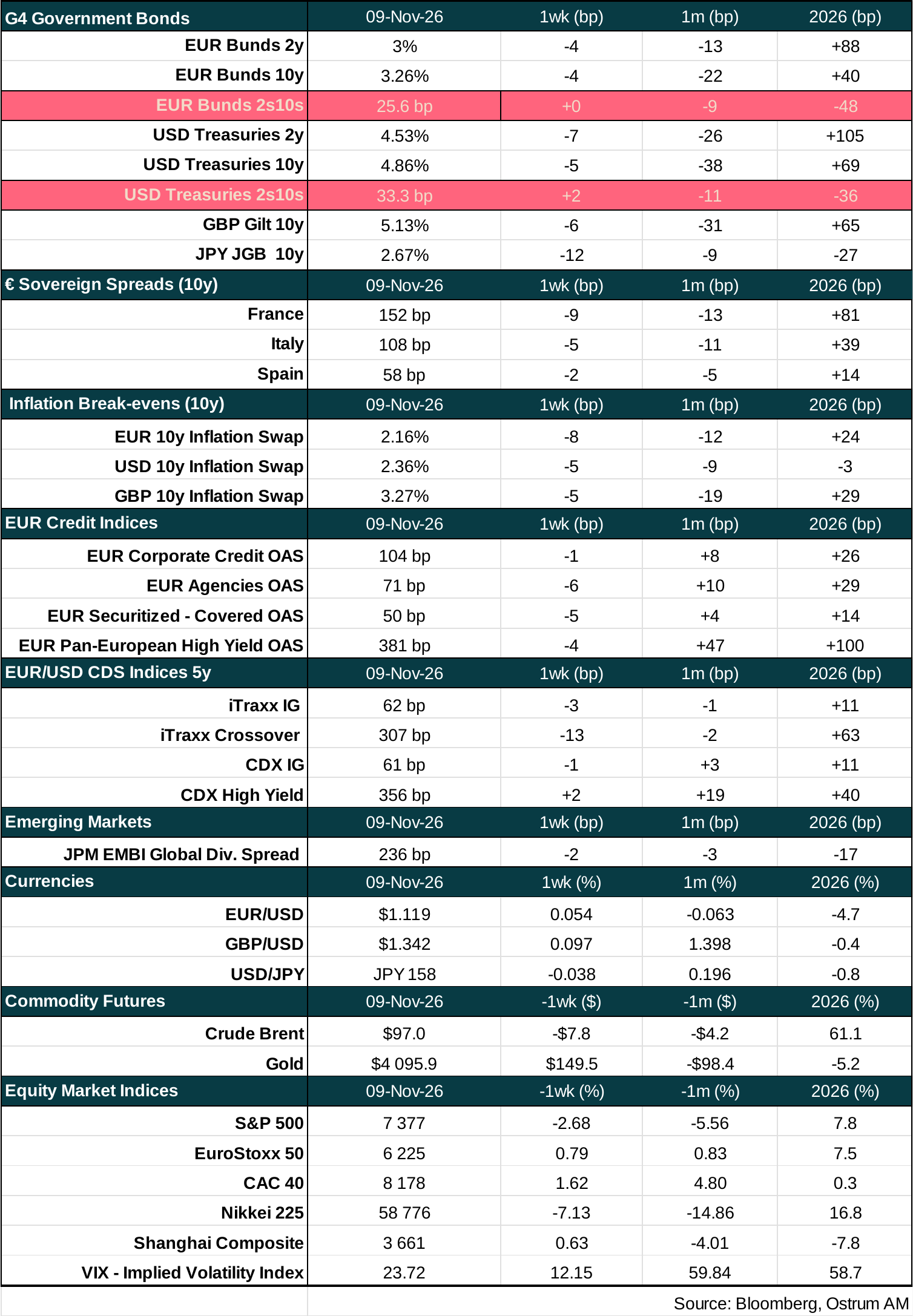
Technology stocks suffered a "Black Thursday" as the change in political control revived concerns over the AI investment cycle. Bond yields are lower. Oil has slipped back below $100.
Markets initially welcomed the outcome of the midterm elections, before worries over the AI investment cycle triggered the sharpest one-day fall in semiconductor stocks since 2020. Yields fell in response to the equity sell-off, despite solid US economic data.
On the economic front, the US economy added 165,000 jobs in October and, for once, all the labour market surveys point in the same direction. Job openings recovered to 7.5mn in September, and the unemployment rate fell by 0.1 percentage points to 4.1 per cent. The participation rate has now improved by half a point from its July trough, to 61.4 per cent. The underemployment rate, which includes discouraged jobseekers and those working part-time involuntarily, rose sharply to 7.9 per cent (+0.3 points). Data-center construction is boosting construction employment, while manufacturing is also buoyant, in line with October's ISM survey. In Europe, inflation remains very high at 4 per cent in October, according to the flash estimate. Energy is the main source of pressure, while food inflation has also turned higher (1.6 per cent). Core inflation has been stable at around 2.5 per cent for a year. In the UK, the Bank of England raised its policy rate by 25 basis points to 4 per cent after sharply revising up its inflation outlook, which is now expected to reach 5 per cent by the middle of next year. Yet despite very low real rates, Andrew Bailey believes a series of rate rises is "not inevitable".
Volatility has surged in equity markets. The VIX implied volatility index closed Thursday at 28. The "blue wave" that overturned the majorities in the US Congress initially lifted stocks, before a sharp reversal led by technology shares and, in turn, Asian bourses. The SOX semiconductor index suffered its worst session in six years, falling 13 per cent. The Nikkei lost 11 per cent over the week, as did South Korea's Kospi. Europe, less exposed to the AI theme, held up thanks to financials (the "value" and "dividend" factors), transport and non-cyclical consumer stocks. Treasuries benefited from AI-related risk aversion, despite a late-week bounce after the US jobs report. The 10-year T-note trades at 4.87 per cent, having fallen by more than 40 basis points over the past month. Beyond the equity sell-off, a fall in oil of almost $15 in a few days has pushed yields lower by reducing inflation breakevens. The Bund has dropped below 3.30 per cent, while tensions have eased somewhat on sovereign spreads, with the OAT spread tightening by 12 basis points to 153 basis points. Swap spreads narrowed by about 5 basis points over the week. Credit ended the week without clear direction. In currency markets, the Brazilian real trades at around 5.50 to the dollar. The yen remains weak (158), and sterling has gained little from the Bank of England's unanimous rate rise.
Axel Botte
Main market indicators
-

Axel Botte Head of markets strategy