Read our market review and find out all about our theme of the week in MyStratWeekly and its podcast with our experts Axel Botte, Aline Goupil-Raguénès and Zouhoure Bousbih.
Summary
Listen to podcast (in French only)
(Listen to) Axel Botte’s podcast:
- Review of the week – Multiple risks and market divergence.
- Theme – EU-China Relations: Heading towards a cold trade peace?
Podcast slides (in French only)
Download the Podcast slides (in French only)Topic of the week: EU-China Relations: Heading Towards a Cold Trade Peace?
- The 9 October agreement signals a shared determination to prevent a further escalation in trade tensions, without fundamentally altering the structural rivalry between Beijing and Europe.
- Economic interdependence has become increasingly asymmetric: China’s move up the value chain is reducing its reliance on European inputs, while the EU remains heavily dependent on Chinese supplies across several strategic sectors.
- The agreement is above all a pragmatic compromise, enabling both sides to safeguard their core interests without any genuine strategic rapprochement.
- This equilibrium remains fragile. Technological competition, the EU’s expanding defensive trade toolkit and persistent geopolitical divergences will continue to fuel tensions. De-escalation lowers the risk of a major rupture but does not eliminate the structural drivers of conflict.
EU-China Relations: Heading Towards a Cold Trade Peace?
China’s continued move up the global value chain is having a twofold impact on European economies. China has become more deeply integrated into European production chains, while increasingly replacing imports from Europe with domestically produced alternatives. This reflects Beijing’s “dual circulation” strategy, which seeks to strengthen industrial self-reliance while preserving openness to international trade. For Beijing, the European Union is therefore increasingly becoming a key export market for Chinese goods rather than an indispensable source of technology transfers, as it was in the 1980s and 1990s. China’s trade surplus with the EU reached a record of more than $33bn in October, exceeding its surplus with the United States, despite European efforts to reverse the trend. Brussels has adopted a multidimensional approach towards China, viewing it simultaneously as a partner, a competitor and a systemic rival. Yet the EU is also seeking to reduce this growing trade imbalance and safeguard the niche industrial segments in which Beijing remains dependent on European expertise and supplies. In October, the two sides reached an agreement in principle aimed at easing trade tensions and rebalancing bilateral trade. This represents an important first step towards enabling the two major economic blocs, which together account for one-third of global GDP and international trade, excluding intra-bloc flows, to reconcile their respective economic autonomy strategies while preserving stability in their relationship.
The Specific Features of the EU-China Trade Relationship
A pronounced trade imbalance...
Trade between China and the European Union (EU) has expanded significantly in recent years. The EU has become China’s second-largest trading partner, behind the ASEAN countries. Bilateral trade reached $828bn in 2025, accounting for 13.5% of China’s total foreign trade, making the EU a critical market for Beijing.
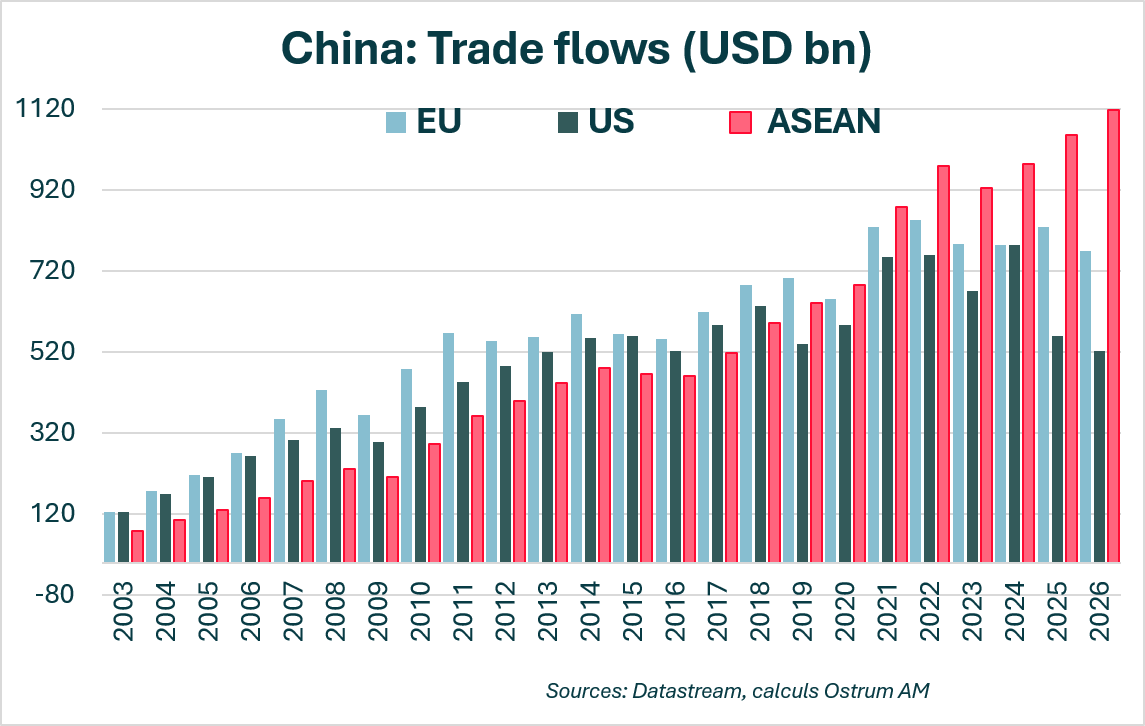
Over the first ten months of 2026, trade flows had already reached nearly $770bn, up 13% compared with the same period in 2025.
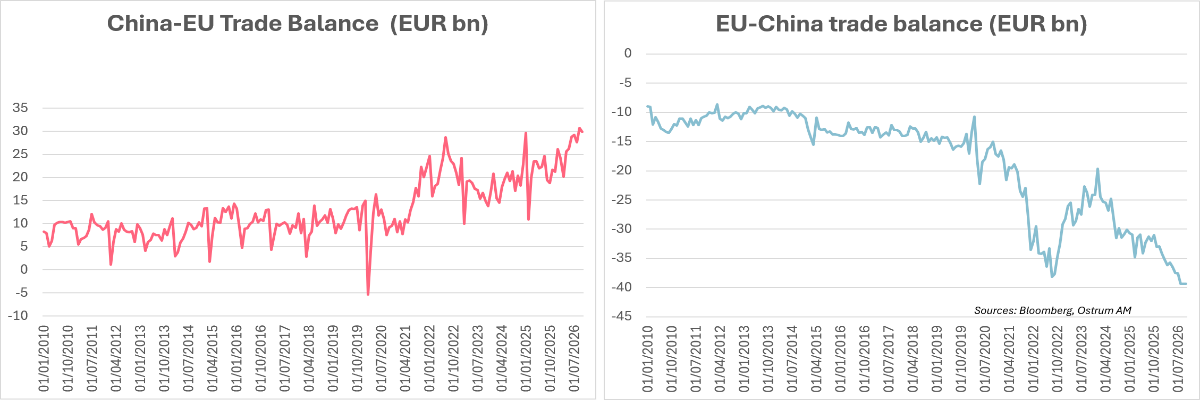
Despite the scale of these flows, the trade relationship remains markedly unbalanced.
China recorded a record $33bn (€30bn) trade surplus with the EU in October, while, from the European perspective, the trade deficit with Beijing has continued to widen, exceeding €38bn, according to the latest available Eurostat data for August. China is now the EU’s third-largest trading partner.
...reflecting China’s role as a systemic rival
This growing trade asymmetry reflects the EU’s heavy reliance on strategic Chinese products, including telecommunications equipment and data-processing machinery.
The charts below, based on MERICS data, show that the EU is dependent on China for more than 400 imported products, compared with just 56 products for which China depends on the EU.
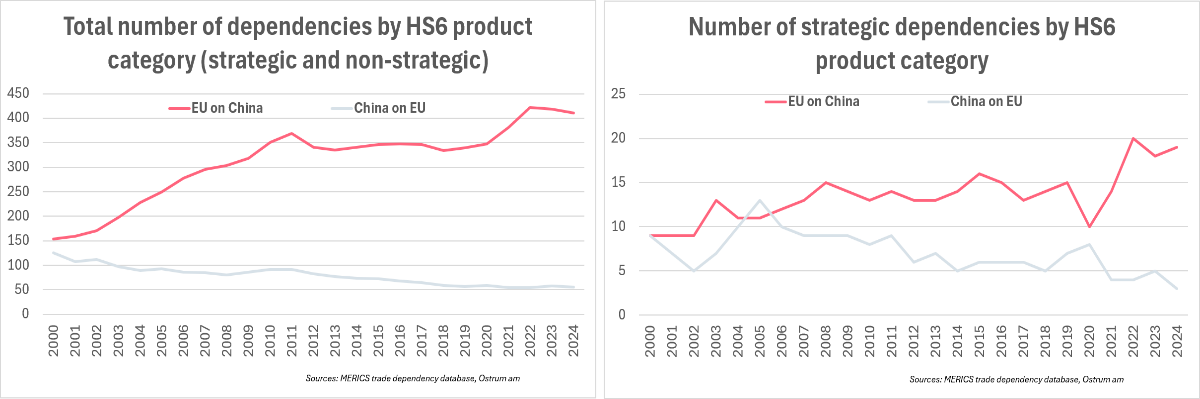
The imbalance is equally pronounced for strategic goods: the EU relies on China for 19 strategic imported products, while China depends on the EU for only three.
China has therefore become increasingly embedded in European production and supply chains, reinforcing Brussels’ characterization of Beijing as a systemic rival.
China’s “Dual Circulation” Strategy Is Intensifying Competitive Pressure on European Industry
Beijing now leads in 57 of the 64 critical technologies tracked by ASPI, underpinned by its “dual circulation” strategy. This approach prioritizes greater industrial self-reliance through “internal circulation”, while continuing to export Chinese value added through “external circulation.”
Against this backdrop, the EU is increasingly becoming a target market for Chinese goods. Beijing’s drive for self-sufficiency has led to the introduction of policies favoring domestic players, particularly in technology, making the Chinese market less accessible to foreign exporters. China has progressively replaced European inputs with domestically produced alternatives, contributing to the erosion of parts of Europe’s industrial base and increasingly threatening the remaining niche segments in which European companies retain a competitive edge.
However, “dual circulation” also entails securing imports of technologies and expertise that China still lacks to support its economic development. China therefore remains reliant on European know-how in areas such as aerospace, advanced transportation and ultra-high-precision industrial equipment. This includes Dutch lithography systems used in the production of advanced semiconductors, as well as European expertise in fine chemicals and specialized pharmaceuticals, particularly biotechnology.
The 9 October 2026 Agreement: A Calculated Move by Beijing
The 9 October agreement in principle between China and the EU is aimed at easing tensions and preventing an outright trade war. It focuses primarily on two key areas: hybrid vehicles and rare earths, allowing both Brussels and Beijing to safeguard their core interests.
A limited compromise on hybrid vehicles
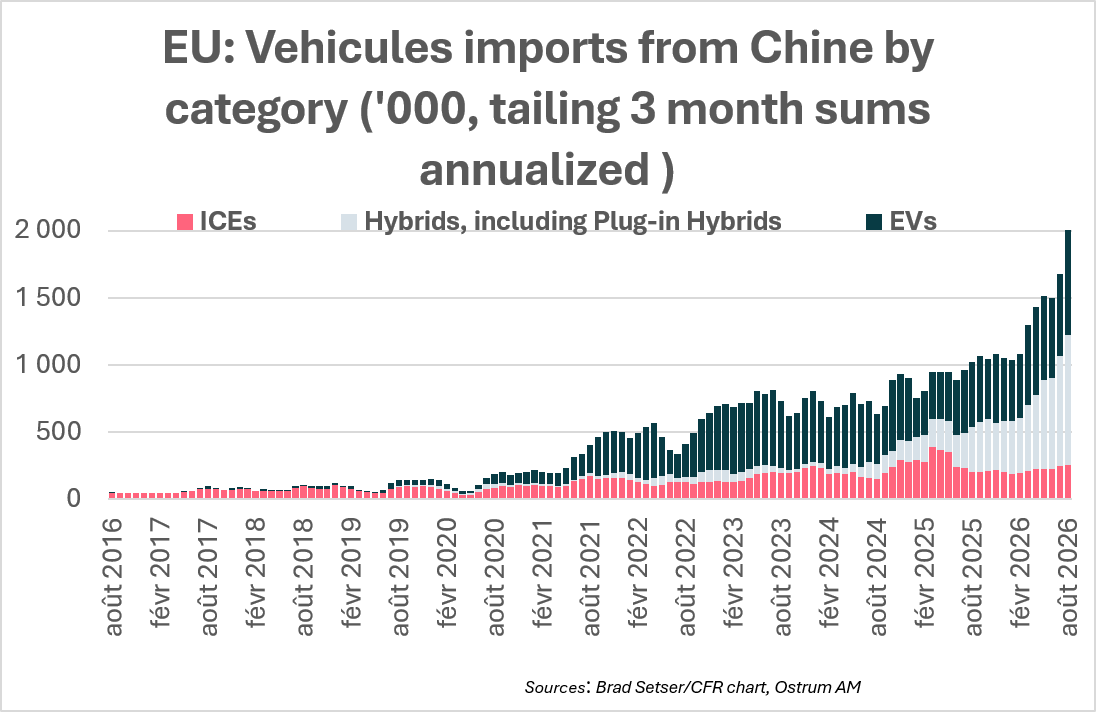
A major component of the agreement concerns export restrictions, particularly on hybrid vehicles, with an annual quota of 350,000 units, set to increase by 6% per year through 2030. This is above the 300,000 vehicles China exported to Europe last year.
Vehicle imports from China have reached an annualized pace of 2 million units, driven by strong growth in hybrid and electric vehicles.
The quota will provide European carmakers, particularly those in Germany and Slovakia, with some breathing room, while enabling China to avoid an escalation of punitive trade measures.
Beijing would rather accept the EU’s export quota system, which preserves limited access to the European market, than risk losing access altogether because of prohibitive tariffs.
China also favours quotas over import restrictions, which would be more difficult to reconcile with World Trade Organization (WTO) rules. Indeed, export restrictions would apply to all exporters, not just China, meaning that Brussels would also have to negotiate sizeable quotas with other trading partners.
Securing rare-earth supplies and intellectual property
In return, China has committed to maintaining a fast-track procedure for granting rare-earth export licenses to the EU, a critical issue for Europe’s energy transition.
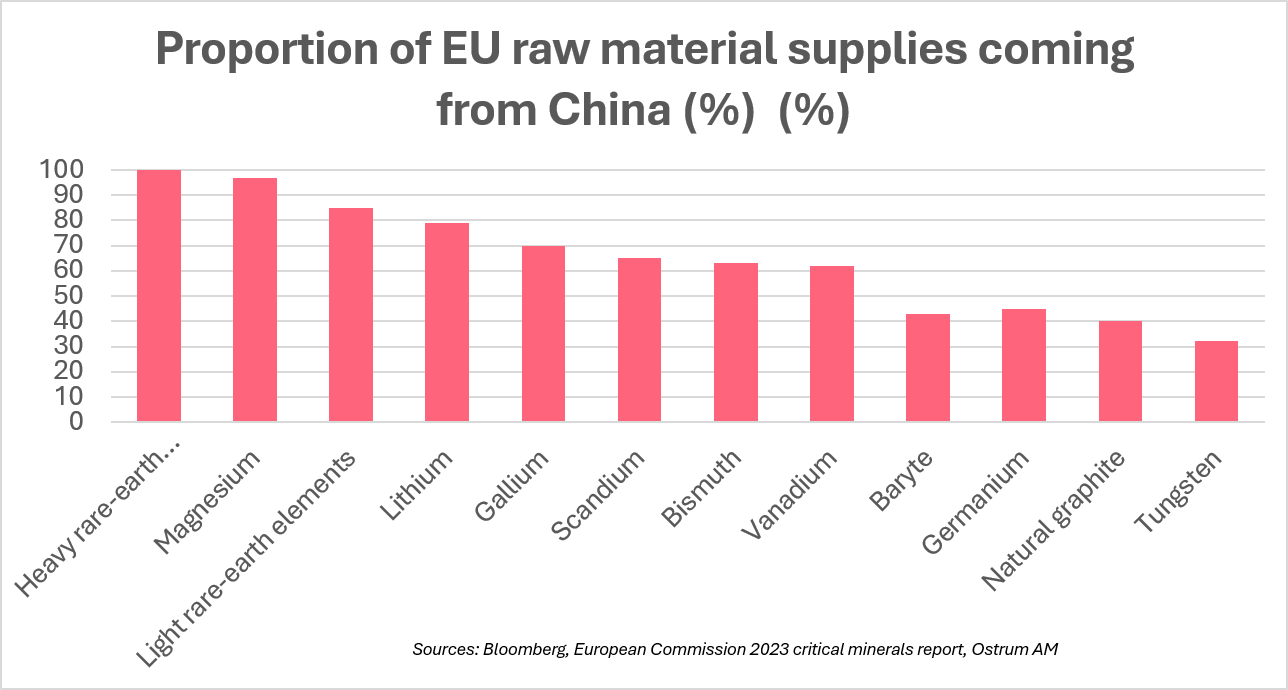
At the same time, Beijing is signaling that it retains considerable leverage in trade negotiations and remains prepared to use it to defend its economic interests.
The agreement also addresses intellectual property protection and WTO reform.
Towards an institutionalized dialogue
The next round of talks is scheduled for March 2027, underscoring both sides’ willingness to avoid an outright trade war and instead rely on dialogue and negotiation to manage disputes between the two blocs.
Structural Fault Lines and Persistent Challenges
The 9 October agreement appears to reflect risk management rather than any genuine strategic rapprochement. Both sides are stepping up technical arrangements to prevent an outright trade war while safeguarding their core interests.
The resulting coexistence therefore remains fragile, particularly as several structural fault lines and challenges persist.
The EU’s Technological Competitiveness and Green Transition
China’s growing technological capabilities are putting Europe’s niche industrial sectors under increasing pressure. The EU therefore faces the challenge of strengthening its own competitiveness while continuing to cooperate with Beijing in areas where their interests converge, particularly on global climate issues.
The EU’s Defensive Trade Toolkit
Brussels has progressively hardened its stance by introducing trade defence instruments, launching anti-subsidy investigations and pursuing an industrial policy aimed at ensuring a level playing field. China’s move up the value chain no longer threatens only the European automotive industry, but increasingly extends across a broad range of sectors, raising concerns that Brussels could adopt a more restrictive trade stance.
Rising social tensions and upcoming electoral deadlines could further harden the EU’s trade policy towards China, increasing the risk of confrontation.
Disagreement Over China’s Economic Model
Beijing refuses to negotiate over its subsidized industrial overcapacity, which the EU sees as a key driver of European deindustrialization. China responded in a 40-page report with a clear warning: it is prepared for confrontation, willing to absorb the economic costs and ready to retaliate to defend its strategic interests.
Geopolitical Divergences
Persistent disagreements over international issues, economic security and digital standards continue to undermine mutual trust, preventing the emergence of a durable political relationship.
Conclusion
EU-China relations are undergoing a major realignment. Beijing’s shifting economic priorities and drive to strengthen its industrial self-reliance are forcing Brussels to safeguard its strategic interests without severing the vital trade ties that bind the two economies.
The agreement in principle reached last October reflects this pragmatic balancing act. For Beijing, it represents a calculated compromise designed to preserve access to Europe’s large and affluent market, rather than risk losing it altogether because of prohibitive tariffs.
Ultimately, the durability of this new equilibrium will hinge on the effective implementation of these commitments at the March 2027 meeting of European ministers and, above all, on Europe’s ability to address its own competitiveness challenge while continuing to cooperate with China in areas of shared interest, notably global climate issues.
Zouhoure Bousbih
Chart of the week
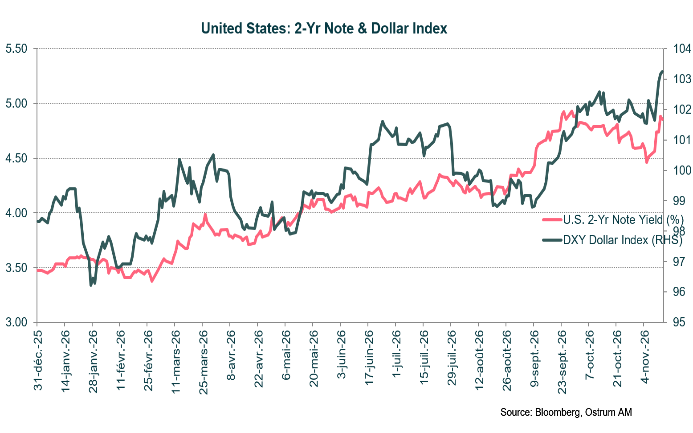
The US 2-year yield surged 35 basis points last week following the release of October CPI.
While energy price increases appear set to ease with the slump in crude, housing is no longer a source of disinflation, and the knock-on effects of the AI boom are pushing up prices across several goods categories.
Markets are therefore pricing in a tightening of monetary policy, which is supporting the greenback. The dollar index (DXY) is appreciating against every currency (except for the yuan) as short-term rate expectations are revised higher.
Figure of the week
1.86
$1.86 trillion, the fall in Nvidia's market capitalization since October 6.
Market review: Multiple risks and market divergence
- United States: Consumer prices up 0.4% in October;
- Currencies: Dollar strength across the board;
- Rates: Yield curves flattened sharply as Fed outlook reassessed;
- Equities: Markets shrug off Nvidia, post weekly rebound.
Multiple risks and market divergence
Equities shrug off the Nvidia saga as inflation drives a sharp flattening of yield curves. The dollar strengthens on expectations of a Fed rate rise in December.
Financial markets are being pulled in several directions. Nvidia’s position raises questions both about the effectiveness of US export restrictions and about the future of a leader in a sector central to US digital sovereignty. Markets have absorbed the shock, even as inflation revives expectations of higher US interest rates. The dollar is strengthening as yield curves flatten. Spreads, by contrast, are steady.
The US economy continues to perform broadly in line with its potential. ADP’s weekly data point to monthly job creation of about 80,000. Inflation is therefore the Federal Reserve’s main concern, and it is likely to raise rates after its December FOMC meeting. Recent remarks from several FOMC members — Waller, Goolsbee and Hammack — suggest that a 50 basis-point increase could even be under discussion. Consumer prices rose 0.4 per cent in October. Housing is no longer a source of disinflation, despite existing-home sales running at fewer than 4mn a year. Investment in AI is putting pressure on commodity prices, with those pressures spreading through the economy. The Fed’s challenge is to avoid overreacting to a supply shock at the expense of sectors facing weaker demand.
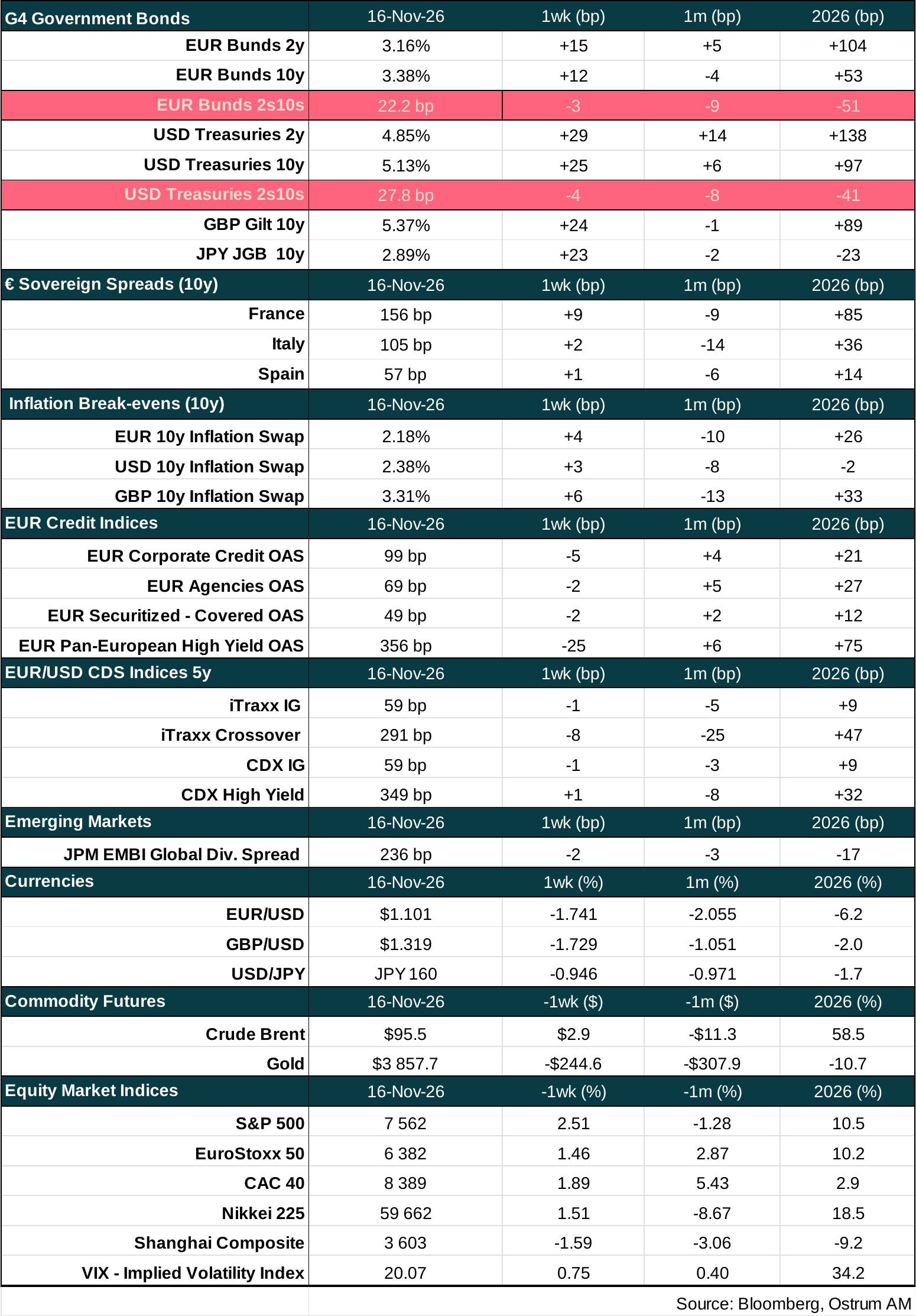
In financial markets, US inflation triggered a sharp flattening of yield curves. Two-year yields rose 35 basis points over the week to 4.85 per cent. Falling oil prices have done little to contain expectations of monetary tightening. The 10-year Treasury yield is trading above 5.10 per cent. In Europe, the Bund, near 3.40 per cent, and the Gilt, at 5.33 per cent, are following the lead of the US market. Bailey may be forced to continue adjusting rates. The ECB, where the race to succeed Lagarde is likely to be between De Cos and Knot, will also raise interest rates, while keeping a close eye on French spreads, which have fallen back below 150 basis points.
Sharp volatility in interest rates has had no significant effect on spreads. BTPs ended the week 3 basis points tighter. The rise in bond yields has been driven chiefly by real rates, while breakevens have widened slightly. The European investment-grade credit market has stabilised above 80 basis points over swaps. High-yield spreads have tightened by about 15 basis points. Equity markets rebounded strongly after the previous week’s warning shot over AI. Jensen Huang’s departure as Nvidia chair benefited other companies in the sector, and the S&P 500 gained more than 3 per cent over the week. Europe followed suit, with a slightly smaller weekly rise. Results have been broadly positive, despite some disappointments, particularly in luxury goods. Financials and cyclical stocks, including technology, led the market.
In foreign exchange, the dollar strengthened against every major currency, pushing the yen back towards 160. Once again, expectations of a Fed rate rise stand in contrast to the less clear signals from the Bank of Japan.
Axel Botte
Main market indicators
-

Axel Botte Head of markets strategy