Each month we share the conclusions from the monthly strategy investment committee which provides a summary of Ostrum AM's views on the economy, strategy and markets.
Outlook at 10/16/2026.
The CIO Letter
Growing imbalances
The World economy has shown considerable resilience in the face of a series of supply shocks, including fallouts from the ongoing conflicts in the Middle East and Ukraine and the strong AI investment cycle. If anything, World trade is accelerating. Corporate earnings are growing very rapidly whilst consumer confidence remains weak in major economies. The U.S. economy, whilst growing near potential, remains very imbalanced. The same is true of China where domestic demand keeps contracting outside of the high technology complex. The scope for fiscal support is limited. In Europe, growth is gathering pace in Germany whilst France is stagnating in the midst of a political crisis.
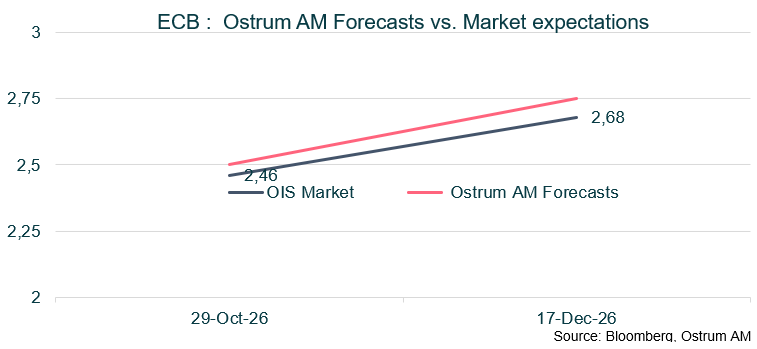
Against this backdrop, central banks continue to monitor risks to the inflation outlook. The ECB may raise rates to 2.75% in December, but second-round effects of energy price increases are nowhere to be found at present. The Fed will also tighten policy, though financial conditions have tightened to some extent since the September FOMC. The BoJ must act to ensure yen firming. Long-term rates hover near our year-end targets at 3.50 % on 10-Yr Bunds but slightly above our 5.10% target on U.S. yields. The run-up in French spreads sparked some flight-to-quality bids on Schatz and a reduction in expected rate hikes. Alike increasing spreads in part of the credit markets (AI names, CCC high yield in the U.S.), a sovereign debt crisis in Europe would inevitably derail the recovery, unless the ECB steps in to restore financial stability in a timely manner. Credit spreads in general have widened modestly, in the wake of wider swap spreads and sovereign stress. Equities, however, are still underpinned by strong corporate profitability, particularly in technology and energy. Higher real yields will remain a headwind for some time to come.
-

Gaëlle Malléjac CIO Ostrum AM
Economic Views
THREE THEMES FOR THE MARKETS
-
Growth
Rebound in manufacturing activity. In the United States, activity is accelerating, as reflected in the PMI and ISM manufacturing surveys, including in non-tech industries. However, the labour market remains sluggish. In the euro area, manufacturing activity is strengthening. However, the sharp rise in long-term interest rates is expected to weigh on activity, particularly in France. In China, activity picked up in September, driven by the non-tech sector and reflecting fiscal support.
-
Inflation
Renewed inflationary pressures. US CPI inflation rose to 3.7% in September, mainly driven by energy costs. Core inflation stood at 2.6%. Euro area inflation accelerated to 3.8% in September, driven by energy prices. Core inflation stood at 2.5%, while services inflation remained stable at 3%. China’s inflation stood at 0.9% in September. Producer price inflation picked up again to 5% year-on-year, driven by rising energy and AI-related prices.
-
Monetary policy
Upward pressure on long-term yields and high energy prices are complicating the task of central banks. The Fed minutes suggest another rate hike before year-end. We expect a hike in December. The ECB must balance financial instability risks but is expected to raise its policy rate in December. The PBOC is reluctant to cut its policy rate, viewing the slowdown in credit growth as structural and linked to the rise of AI.
ECONOMY: UNITED STATES
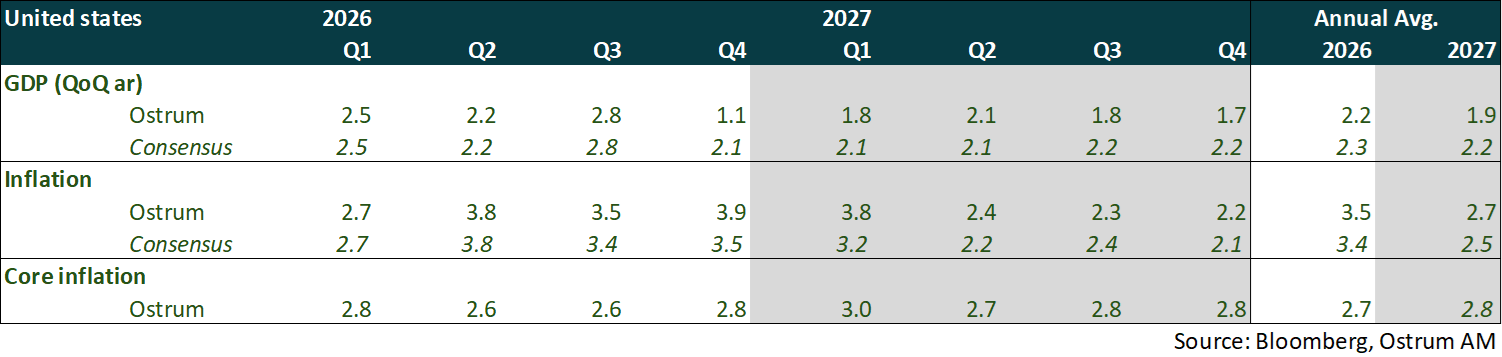
The AI boom maintains growth near potential amid growing imbalances and historic gap between business and consumer confidence.
- Demand: The U.S. K-shaped economy is set to grow above 2%. Aggregate demand is dominated by AI investment which has grown to make up around 5% of GDP currently. However, slow hiring, high energy costs and subdued wage growth weigh on household confidence and middle-class consumption. Many households have fallen behind on bill payments. The trade deficit has exploded in the 3rd quarter and is unlikely to self-correct unless a recession occurs.
- Labor Market: The unemployment rate remains low (4.2 per cent) mainly due to a collapse in the participation rate. Meanwhile, the rising number of bankruptcies points to underlying fragilities. Half of all sectors are currently shedding jobs, and vacant posts are translating into few actual hires (around 50k per month on average).
- Fiscal Policy: The fiscal situation represents a major risk. The federal deficit is close to 5.8 % of GDP. Tariff refunds, Medicare and social security spending, and the mounting interest burden heavily impacted the budget balance last fiscal year. The mid-term election outcome is unlikely to move the needle much as regards the fiscal stance.
- Inflation: Inflation remains too high relative to the Fed's target. Disinflation has slowed under the effect of price shocks induced by the AI boom and a lesser deceleration in housing costs. However, inflation should decline next year.
ECONOMY: EURO AREA
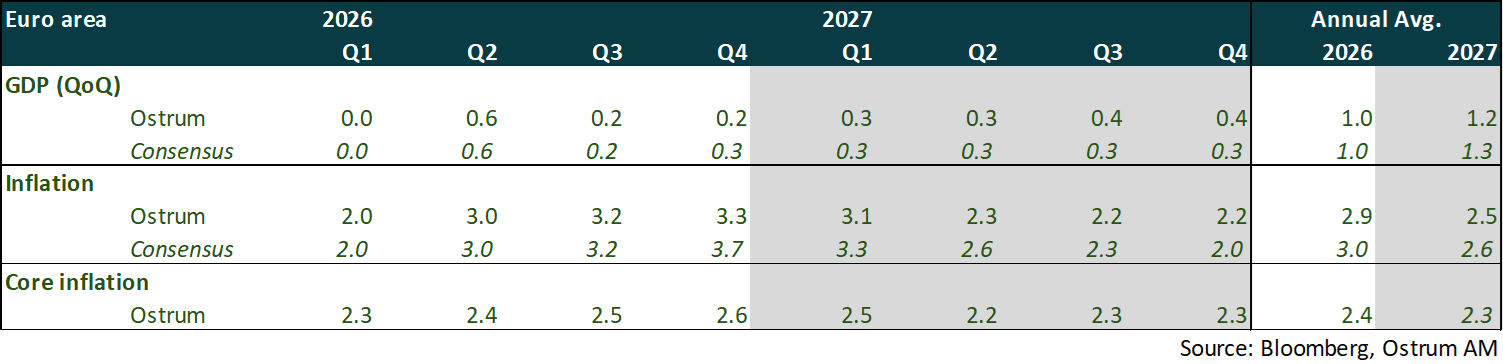
Growth is proving resilient in the face of the energy shock, supported by strong performance in the peripheral economies, led by Spain, and by the implementation of Germany’s fiscal plans. France stands out for its lack of momentum at a time when urgent fiscal consolidation measures need to be taken.
- Heterogeneous growth: Excluding Ireland, euro area growth stood at 0.3% in both Q1 and Q2. Spain remains the main growth engine, while growth in Germany and Italy is moderate and France narrowly avoided recession. Survey indicators point to sustained growth in Q3.
- Domestic demand: The resilience of growth should, however, be qualified by the weakness of domestic demand, with Spain being the main exception. Household consumption is slowing, reflecting the erosion of purchasing power caused by higher inflation. Businesses and households remain cautious in the face of uncertainty, weighing on both productive and residential investment. Domestic demand is expected to gradually improve in 2027 as inflation moderates, while investment should benefit from the implementation of Germany’s fiscal programs and rising defense and IA spending.
- External demand: Exports supported euro area growth in the second quarter, particularly in Germany (defense and IT) and France (aerospace). August survey data point to a continuation of this trend despite weak competitiveness and increasing competition from China.
- Fiscal Policy: Germany is ramping up infrastructure and defense spending, while fiscal space remains limited in most other euro area countries. In France, urgent fiscal consolidation measures are needed, with the public deficit revised up to 5.4% of GDP in 2026.
- Inflation: Inflation accelerated to 3.8% in September, driven by a sharp increase in energy prices (+18.8%) amid renewed tensions in the Middle East. Core inflation remained broadly stable at 2.5%, showing no clear signs of second-round effects on wages at this stage. Headline inflation is expected to moderate in 2027 as energy price pressures ease, while core inflation should remain around 2.5% until the first quarter of 2027.
ECONOMY: CHINA

Growth prospects are expected to improve thanks to stabilizing Sino-US relations and new targeted support measures.
- Activity: Activity picked up in September following the weather-related weakness over the summer. The non-tech sector supported activity, reflecting a recovery in exports to the United States. The contraction in investment reflects the structural transition of the Chinese economy associated with the rise of AI (reducing the need for physical assets) and deleveraging in the property sector.
- Exports: The $30bn–$30bn trade agreement with the United States is expected to benefit labor-intensive sectors (toys and textiles) but will have only a marginal impact on Chinese exports, which remain driven by high-tech products. More broadly, lower tariffs are expected to lead to a partial reconfiguration of global value chains (ASEAN). Export prices rebounded sharply to nearly 16% year-on-year, returning to 2022 levels and reflecting a combination of supply shocks linked to AI and energy.
- Consumption: Excluding cars, retail sales rose by 2.5% year-on-year in September. Car retail sales fell by 18.5% year-on-year. Consumption remains weighed down by the property crisis and a deteriorating labour market. The authorities intend to deploy fiscal resources directly to support housing demand.
- Inflation: Inflation edged up to 0.9% in September from 0.8% in August, driven by higher energy prices. Core inflation (excluding energy and fresh food) remained stable at 1%. Meanwhile, producer price inflation accelerated to 5% year-on-year from 3.8% in August, its highest level since 2022, reflecting rising crude oil, coal and AI-related prices. Inflation measures confirm the renewed cost pressures on businesses identified in the PMI surveys.
Monetary Policy : FED
Kevin Warsh Saves the Fed’s Credibility
- The Fed raised its policy rate by 25bps on September 16, marking its first rate hike since July 2023. The decision to lift the target range for the federal funds rate to 3.75%-4.00% was unanimous.
- Economic growth continues to be viewed as solid, while the labor market remains consistent with full employment, with the unemployment rate staying low at around 4.1%.
- The decision to raise rates was driven by inflation remaining elevated for too long. The policy statement noted that this move would support a more timely return of inflation to the Fed’s 2% target.
- Financial conditions have tightened recently, which could be a point of attention for the Fed, making a rate hike in October unlikely.
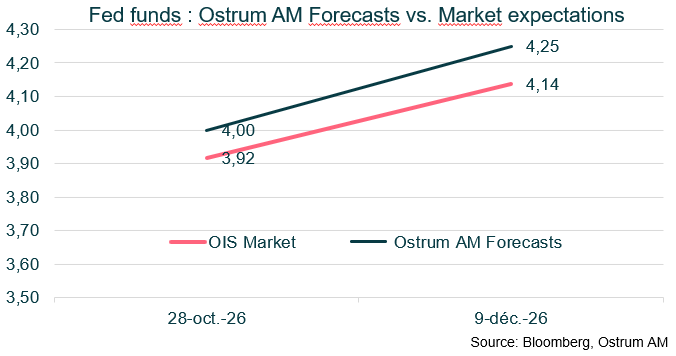
The Fed says it is determined to ensure price stability as quickly as possible. Given the upside risks weighing on inflation, we anticipate a further rate hike of 25 basis points in December.

Monetary Policy : ECB
The ECB Fears the Emergence of Second-Round Effects
- As expected, the ECB raised its policy rates by 25bps in September, taking the deposit rate to 2.50%, following a 25bps increase in June.
- The statement accompanying the decision indicated that inflation is expected to remain well above target for an extended period of time.
- Economic growth has proven more resilient than expected in the face of the energy shock, prompting the ECB to revise its growth forecasts upward to 0.9% in 2026 and 1.4% in 2027. Growth projections were left unchanged at 1.5% for 2028.
- The continuation of the conflict in the Middle East and its impact on energy prices led the central bank to revise its inflation forecasts higher for 2027 and 2028, to 2.5% and 2.1% respectively. The 2026 projection remained unchanged at 3.0%. Core inflation was also revised upward to 2.6% in 2027 and 2.3% in 2028, while remaining unchanged at 2.5% in 2026.
- The energy shock could worsen further and the impact on other prices and wages could be greater than anticipated. In order to properly anchor inflation expectations, we believe the ECB should raise rates again in December. Second-round effects remain nevertheless limited at this stage.
- The central bank is also closely monitoring the risks of financial instability linked to tensions on French debt. It has tools available (TPI, OMT) to maintain the effectiveness of its monetary policy.

Market views
Asset classes
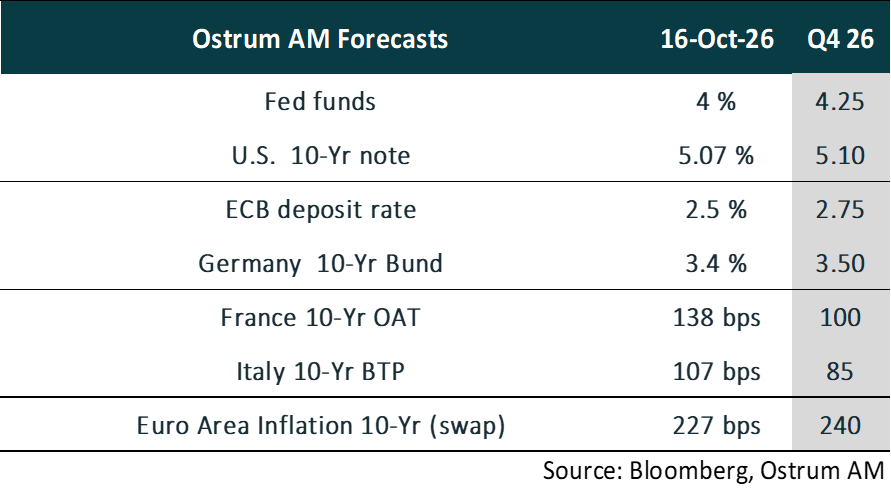
- U.S. Rates: Kevin Warsh raised rates on inflation risks considering the economy was operating at full employment. A second hike will occur in December according to our scenario. The 10-year should move towards 5.10%.
- European Rates: The ECB will tighten rates in December to weigh on inflation expectations. The 10-year Bund will oscillate around 3.50% through year-end.
- Sovereign Spreads: The violent widening move in OAT spreads has dragged other sovereign spreads higher. The spread will remain under pressure. The BTP should gradually ease towards 85 basis points by year-end.
- Eurozone Inflation: Long-term inflation expectations have drifted higher under the effect of the oil shock and this should continue through year-end.
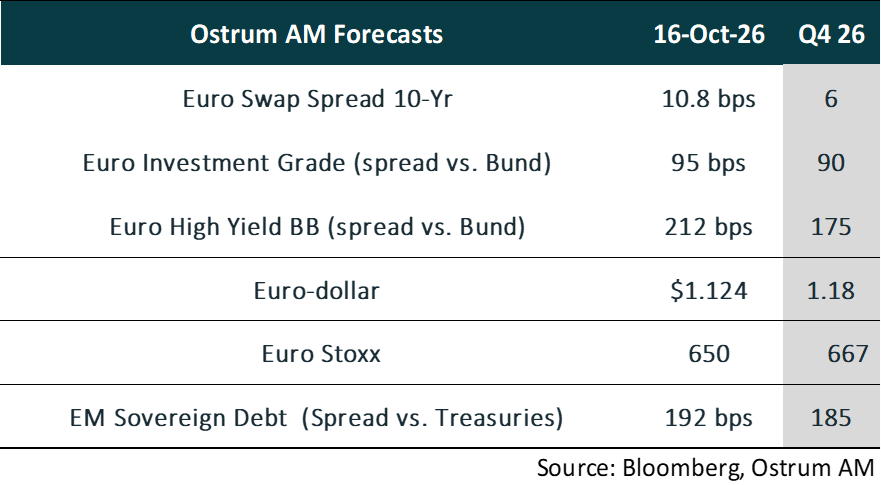
- Euro Credit: IG credit spreads have widened slightly since the start of the autumn, and this move should continue into Q4. The solid health of corporates is slowing the pace of spread adjustment.
- Euro High Yield: The default rate remains contained and below the long-term average; spreads will widen modestly.
- Exchange Rates: The structurally bearish trend for the greenback should resume as the market digests Warsh's hawkish pivot.
- European Equities: A stable equity market through year-end 2026. High margins and the contribution of the energy sector will offset valuations under pressure from rising real rates.
- Emerging Debt: The EMBIG is withstanding the Iranian crisis, even attracting flows diverted away from Treasuries. Spreads will remain tight at 185 basis points according to the new index.
-

Axel Botte Head of markets strategy
-

Aline Goupil- Raguénès Developed countries strategist
-

Zouhoure Bousbih Emerging countries strategist