
Read our market review and find out all about our theme of the week in MyStratWeekly and its podcast with our experts Axel Botte, Aline Goupil-Raguénès and Zouhoure Bousbih.
Listen to podcast (in French only)
(Listen to) Aline Goupil-Raguénès’ podcast:
- Review of the week –Between Oil and AI concerns, US durable goods orders, and Eurozone PMIs;
- Theme – After Hormuz, a new threat to oil markets: the Bab el-Mandeb strait.
Podcast slides (in French only)
Download the Podcast slides (in French only)Topic of the week: After Hormuz, a New Threat to Oil Markets: The Bab el-Mandeb Strait
- As hostilities between the United States and Iran continued in the Middle East last week, the Iran-backed Houthi rebels in Yemen announced a maritime blockade targeting Saudi ports in the Red Sea;
- Due to the closure of the Strait of Hormuz, Saudi Arabia redirected a large share of its oil exports from the port of Ras Tanura, located on the Gulf and normally routed through the Strait of Hormuz, to the Yanbu terminal on the Red Sea coast, using the East–West crude oil pipeline that links the country's eastern and western regions;
- This threat of a maritime blockade by the Houthis comes at a time when the factors that helped mitigate the energy shock are gradually diminishing;
- Oil demand has already declined significantly, spare production capacity in other countries has been brought online, and only 110 million barrels remain available from the 400 million barrels of emergency stocks released under the auspices of the IEA;
- Following the closure of the Strait of Hormuz, any disruption to maritime traffic through the strategically important Bab el-Mandeb Strait would likely lead to a significant increase in energy prices.
After Hormuz, a New Threat to Oil Markets: The Bab el-Mandeb Strait
As U.S. and Iranian strikes continued across the Middle East last week, the Iran-backed Houthi rebels in Yemen announced a maritime blockade of Saudi ports in the Red Sea. Following the closure of the Strait of Hormuz, any disruption to shipping through the strategically important Bab el-Mandeb Strait could lead to a significant increase in energy prices. This threat comes at a time when the factors that have helped cushion the impact of the energy shock are gradually diminishing.
The Bab el-Mandeb Strait: A Strategic Chokepoint
The Bab el-Mandeb Strait is a strategic maritime passage linking the southern Red Sea to the Gulf of Aden. Although around 100 kilometres long, the strait narrows to just about 20 kilometres between Djibouti and Eritrea on its western shore and Yemen on its eastern shore.
It is one of the world's busiest shipping routes, providing a vital link between Asia and Europe through the Red Sea and the Suez Canal. Nearly 10% of global seaborne trade passes through the Red Sea.
Houthi maritime blockade of Saudi ports
On 20 July, the Houthis announced a maritime blockade of Saudi ports. The move followed an attack on Sana’a airport, which is under Houthi control, by the internationally recognised Yemeni government backed by Saudi Arabia. The aim was to prevent the landing of an Iranian aircraft carrying a Houthi delegation returning from Tehran. In retaliation, the Houthis launched an attack on Abha International Airport in southern Saudi Arabia. These developments threaten the ceasefire that has been in place between Saudi Arabia and the Houthis for more than four years. Iran has also instructed the Houthis to stand ready to close the Bab el-Mandeb Strait should the United States carry out further attacks on Iranian energy infrastructure and bridges.
The tensions in the Red Sea come as the Strait of Hormuz has once again been closed following the resumption of military strikes between Iran and the United States over control of the waterway. US strikes were conducted over thirteen consecutive nights in an effort to weaken Iran’s ability to disrupt navigation through the Strait of Hormuz. In retaliation, Iran targeted US military bases located across the Gulf region. The strikes ceased on Friday and over the weekend, but the lull remains fragile: US forces have stated that they remain ready to intervene while leaving room for negotiations. While some easing of tensions between Iran and the United States has been observed since Friday, the Houthis have meanwhile launched drone and missile attacks against Saudi energy infrastructure near the ports of Jizan and Yanbu, prompting retaliatory strikes from Saudi Arabia.
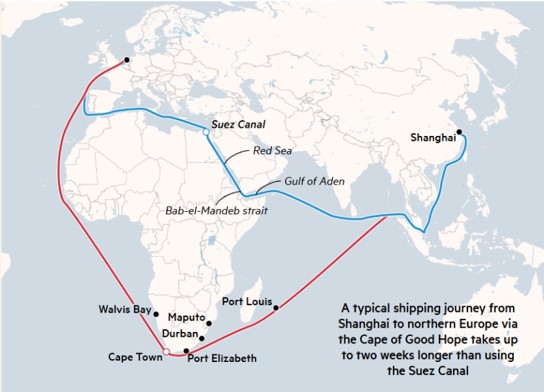
The Houthis had already effectively disrupted traffic through the Bab el-Mandeb Strait from November 2023, following the outbreak of the Gaza war, by targeting commercial vessels. As a result, shipping companies were forced to reroute around the Cape of Good Hope, adding 10 to 15 days to transit times compared with the Suez Canal route. This led to supply chain disruptions and higher transportation costs.
Saudi Exports Under Threat
Due to the closure of the Strait of Hormuz, Saudi Arabia has redirected a large share of its oil exports from Ras Tanura, located on the Strait of Hormuz, to the Red Sea port of Yanbu via the East-West Pipeline (shown in orange on the map below). Saudi Arabia is now exporting nearly 4.9 million barrels of crude oil per day through Yanbu, compared with total exports of around 7 million barrels per day before the conflict, representing roughly 70% of its pre-conflict daily oil export capacity. Nearly half of these exports transit through the Bab el-Mandeb Strait on their way to Asian markets, with China, Japan and South Korea being the main buyers.
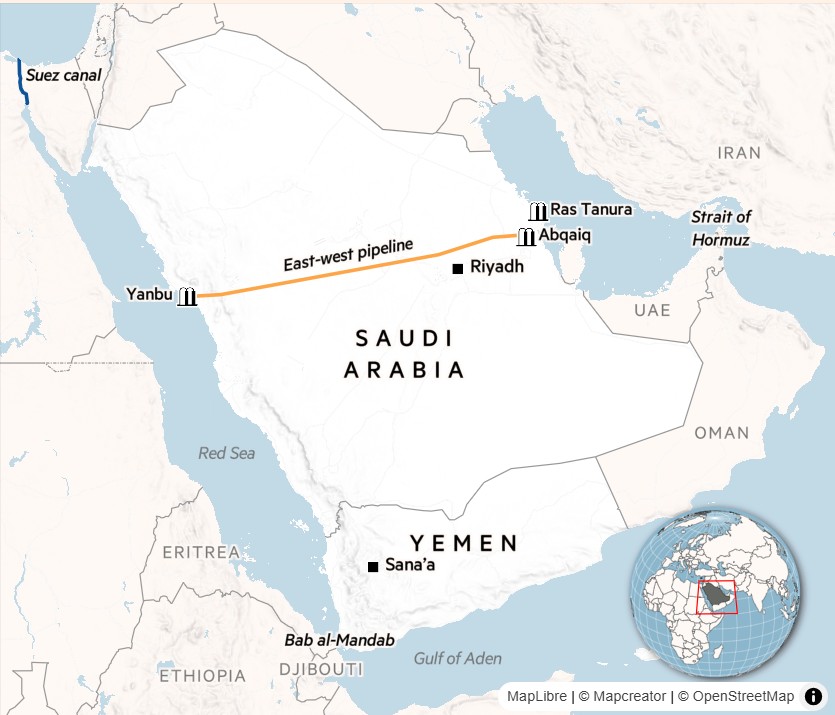
Since the announcement of the maritime blockade of Saudi ports and the Houthi attacks on two Saudi oil tankers, shipping traffic in the Red Sea has slowed markedly. Some Saudi crude exports to Asia could be rerouted via the Suez Canal and around the Cape of Good Hope, but this would significantly lengthen transit times—by nearly four weeks—and raise transportation costs.
In addition, the Suez Canal is too shallow to accommodate fully loaded supertankers carrying up to 2 million barrels of crude oil, which account for the majority of tankers operating from the Yanbu terminal. As a result, these vessels would need to sail only partially loaded in order to transit the canal, creating another important bottleneck in the supply chain.
The Buffers Against the Energy Shock Are Eroding
According to the International Energy Agency (IEA), the global economy is experiencing the largest oil supply shock in history. By the end of May, more than 1.1 billion barrels of crude oil had failed to reach the market. This supply shortfall already exceeds those recorded during the first oil shock of 1973, the Iran-Iraq War, or the Gulf War.
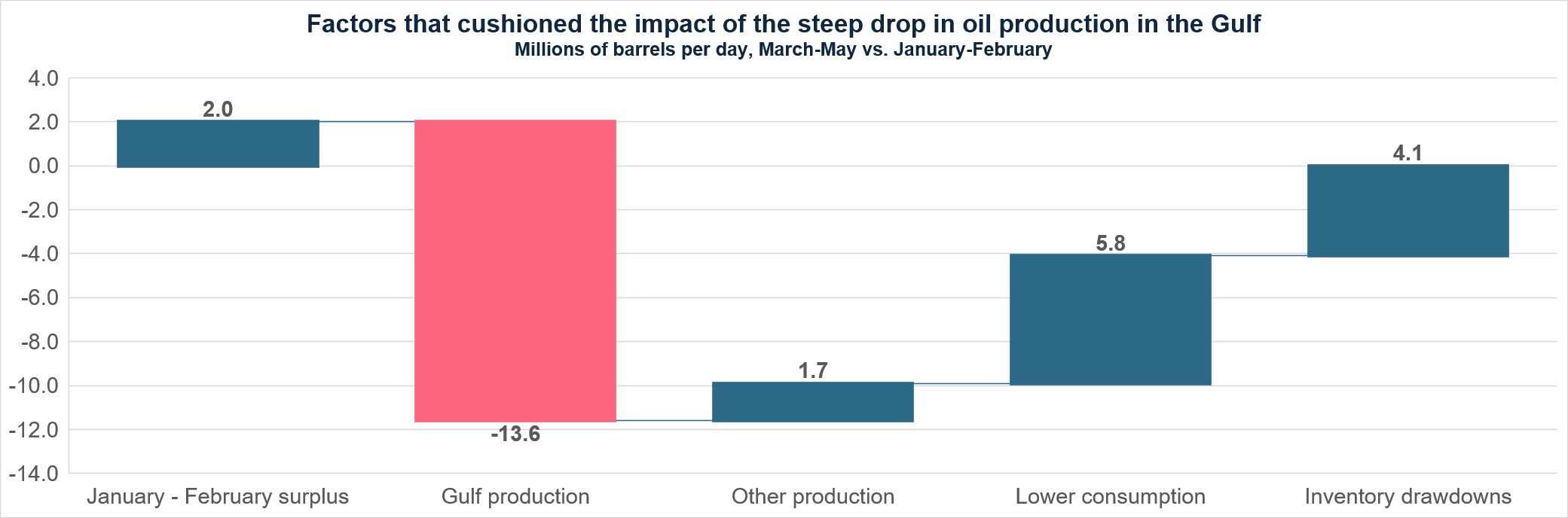
Yet the increase in oil prices has remained relatively limited. This reflects the combination of several mitigating factors that have helped cushion the impact of the shock. A recent IMF analysis highlights the extent to which these buffers have softened the effect on global energy markets.
- The first mitigating factor was that, prior to the conflict, the global oil market was oversupplied by nearly 2 million barrels per day between January and February.
- The second factor was weaker demand, particularly from Asia. As oil prices rose, economies increasingly turned to alternative energy sources, including renewables and coal. China, for instance, reduced its crude oil imports by nearly 50%.
- The third factor was the increase in oil production from other countries, which rose by almost 2 million barrels per day compared with 2025 levels. This was driven primarily by the United States, followed by Venezuela and Russia.
- Finally, inventory drawdowns supplied an additional 4.1 million barrels per day between March and May. This included both China's commercial inventories and strategic petroleum reserves.
The scope for further cushioning the energy shock is now more limited, given the substantial decline in demand that has already occurred and the deployment of spare production capacity in other countries. The IEA noted last week that emergency stock releases remain ongoing. Of the 400 million barrels made available, 290 million have already been released by member countries. Nevertheless, IEA countries still hold substantial strategic reserves, including more than 1 billion barrels owned directly by governments.
Conclusion
The Bab el-Mandeb Strait has become a critical route for Saudi oil exports to Asia since the closure of the Strait of Hormuz. The threat of a Houthi maritime blockade targeting Saudi vessels in the Red Sea poses a significant risk to global crude oil supplies, given that Hormuz remains closed. This threat comes at a time when the factors that have helped cushion the initial energy shock are being steadily exhausted. Oil demand has already fallen sharply, spare production capacity in other countries has largely been brought online, and only 110 million barrels remain available from the 400 million barrels of emergency stocks released under the IEA-coordinated program.
Aline Goupil-Raguénès
Chart of the week
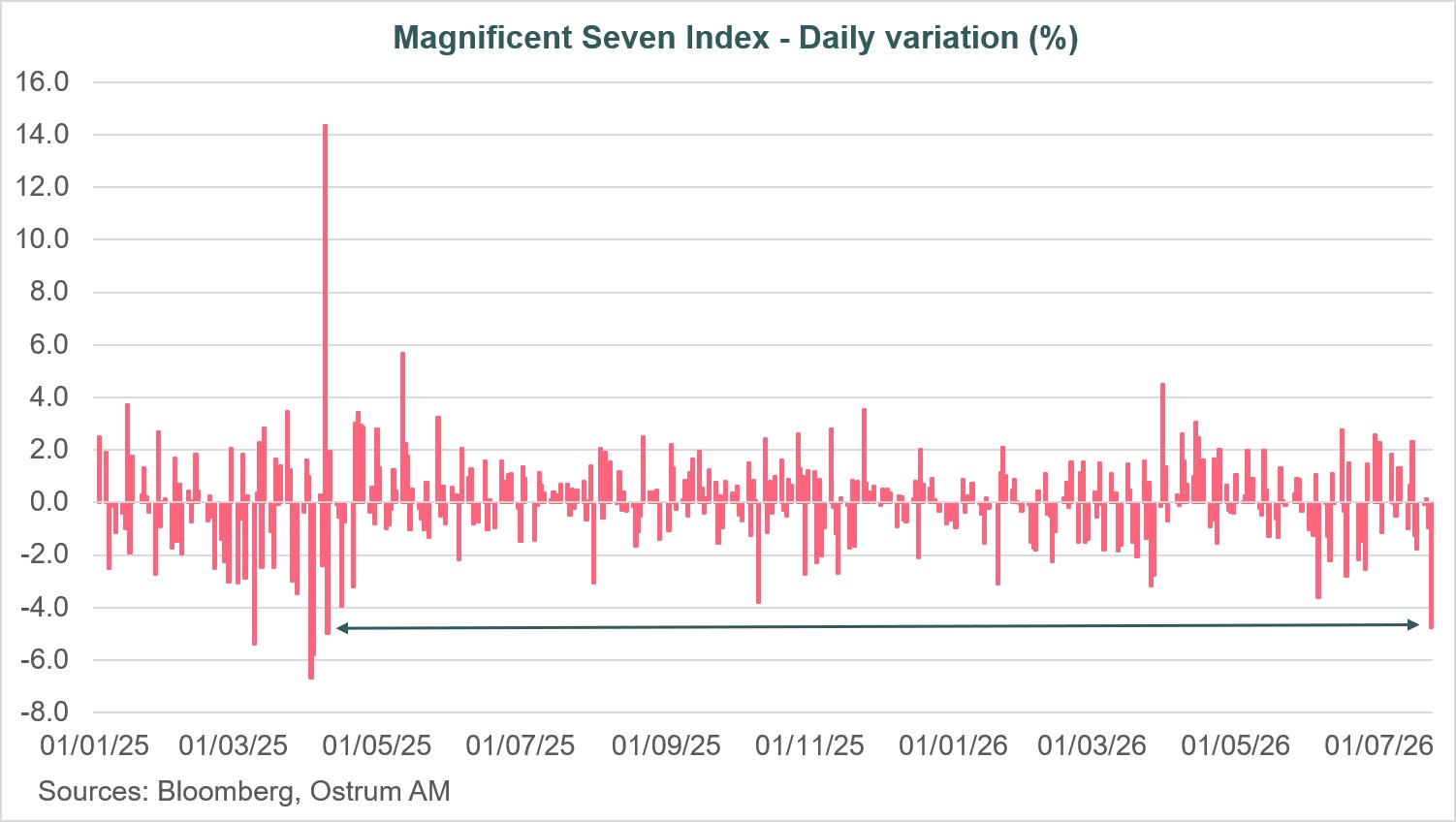
The “Magnificent Seven” index, which tracks the seven largest U.S. technology companies, recorded its steepest daily decline (-4.8%) on Thursday since the market turmoil triggered by Donald Trump’s reciprocal tariff announcement in April 2025. The sell-off followed the release of earnings results from Alphabet and Tesla. Alphabet delivered solid results, particularly in its Cloud business, but investors penalized the stock after the company raised its 2026 AI-related capital expenditure guidance to between $195 billion and $205 billion, up from the previously announced $190 billion. Alphabet also reported negative free cash flow in the second quarter for the first time. Tesla, meanwhile, posted weaker-than-expected results, announced higher investment plans going forward, and reported its first negative free cash flow in two years. These announcements prompted investors to question the profitability and future returns of the massive amounts being invested in artificial intelligence.
Figure of the week
60
Sixty U.S. trading partners have been hit with additional tariffs ranging from 10% to 12.5%. These measures replace the temporary 10% tariffs that had been introduced following the U.S. Supreme Court’s rejection of the reciprocal tariffs.
Market review: Brent at $100 and Rising Concerns Over AI Investment Profitability
- Middle East: Houthi attacks on two Saudi vessels pushed Brent crude above $100 per barrel on Thursday;
- ECB: No change, as expected, with the door left open to a rate hike in September;
- Bonds: Rising oil prices triggered a sell-off in bond markets, before yields retreated on Friday;
- Equities: Concerns are mounting over the future profitability of the massive investments being made in IA.
Brent at $100 and Rising Concerns Over AI Investment Profitability
Tensions in the Middle East intensified last week after Houthi rebels attacked two Saudi oil tankers in the Red Sea. In response, Donald Trump threatened Iran and the Houthis with a massive military strike. Energy prices surged, putting significant upward pressure on bond yields before easing on Friday. Meanwhile, equity markets came under pressure amid growing concerns over the profitability of the massive investments being made in artificial intelligence.
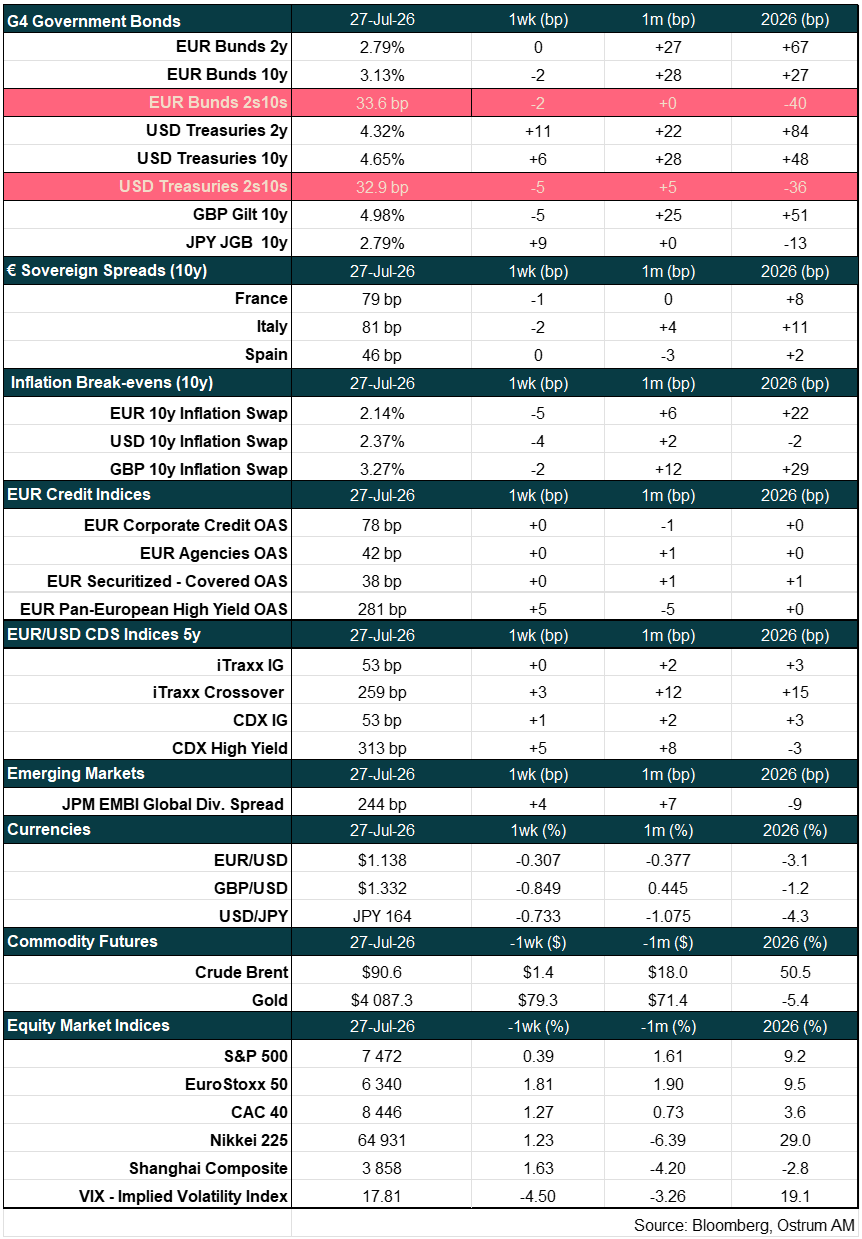
As the United States and Iran continued exchanging strikes, the Houthis announced a maritime blockade of Saudi ports on the Red Sea. They followed through on the threat by targeting two Saudi oil tankers on Thursday morning. In response, Donald Trump threatened Iran and the Houthis with a massive military strike, triggering a sharp rise in energy prices. Brent crude climbed above the $100 per barrel mark on Thursday before easing somewhat on Friday amid the absence of further attacks. European natural gas prices reached their highest level since January 2023, approaching €64/MWh. Investors consequently revised upward their expectations for inflation and further central bank rate hikes. This led to significant pressure on bond markets before a partial rebound on Friday. U.S. Treasury yields caught up with their European counterparts, with the 10-year yield rising by 13 basis points over the week and reaching its highest level since January 2025 on Thursday at 4.70%. Germany’s 10-year Bund yield rose by 5 basis points during the week, following a 6-basis-point increase the previous week, and closed Thursday at 3.20%, its highest level since 2011. France’s 10-year government bond yield reached 4.02% on Thursday, its highest level since 2008. Against this risk-off backdrop, euro sovereign spreads widened slightly on Thursday before retracing the move by the end of the week. As expected, the ECB left interest rates unchanged while keeping the door open to a rate hike in September.
On the macroeconomic front, the improvement in PMI indicators in both the euro area and the United States in July should be interpreted with caution, as it does not yet reflect the recent surge in energy prices. U.S. trade tariffs also returned to the spotlight. After raising tariffs by 25% on certain Brazilian products, the United States announced an additional 50% tariff on $20 billion worth of Canadian goods, effective from 19 August. Additional duties of 10% to 12.5% were also imposed on 60 trading partners over concerns about insufficient action against the use of forced labour in the production of imported goods. These measures replace the temporary 10% tariffs introduced after the U.S. Supreme Court struck down the reciprocal tariffs. Finally, following the fine imposed by the European Union on Google, Donald Trump threatened the EU with additional tariffs. European investment-grade credit spreads remained broadly stable, while high-yield spreads widened by 5 basis points. The S&P 500 posted a modest decline of 0.6%, whereas the Euro Stoxx 50 gained 0.8%. The “Magnificent Seven” index recorded its sharpest decline since the market turmoil triggered by the announcement of reciprocal tariffs.
Aline Goupil-Raguénès
Marchés financiers
-

Axel Botte Head of markets strategy
-

Aline Goupil-Raguénès Developed countries strategist