Read our market review and find out all about our theme of the week in MyStratWeekly and its podcast with our experts Axel Botte, Aline Goupil-Raguénès and Zouhoure Bousbih.
Listen to podcast (in French only)
(Listen to) Axel Botte’s podcast:
- Review of the week – Inflation or Deflation?
- Theme – Snap General Election in Spain.
Podcast slides (in French only)
Download the Podcast slides (in French only)Topic of the week: Snap General Election in Spain
- After two government decrees aimed at addressing the housing crisis were rejected, Prime Minister Pedro Sánchez announced snap general elections to be held on 29 November;
- Housing is expected to be a key issue in the election campaign. Spain faces a significant imbalance between housing supply and demand. According to the Bank of Spain, the cumulative housing deficit between 2021 and 2025 is estimated at 750,000 dwellings;
- According to most opinion polls, the centre-right People's Party (PP) is expected to emerge as the clear frontrunner, although it is unlikely to secure an outright majority. To form a government, it would therefore need to enter into a coalition with Vox;
- Spanish economic growth is expected to remain robust regardless of the election outcome. Over the medium term, a key issue will be the direction of migration policy should the People's Party (PP) form a coalition government with Vox;
- Stricter measures aimed at curbing migration flows, which have been a key driver of Spain’s economic dynamism, could weigh on labour force growth and job creation, while exacerbating labor shortages in sectors such as tourism, construction and agriculture.
Snap General Election in Spain
Following the rejection of two government decrees aimed at addressing the housing crisis, Prime Minister Pedro Sánchez called snap general elections for 29 November. Housing is set to be a key issue in the campaign, reflecting persistent supply shortages in the Spanish housing market. While Spain’s economic growth is expected to remain robust regardless of the election outcome, a key medium-term issue will be the future direction of migration policy should the People's Party (PP) form a coalition with Vox.
Housing Crisis as the Trigger for Snap Elections
The eviction of 87-year-old María del Carmen Abascal from the apartment she had lived in for 71 years sparked a wave of mass protests across Spain, turning her into a symbol of the country’s housing crisis. Her death on 7 October brought the issue to the forefront of political debate ahead of the upcoming elections. The eviction followed years of legal proceedings. In 2018, real-estate investment firm Urbagestión acquired the property and sought a sharp increase in rent. According to Madrid’s tenants’ union, the company initially proposed a monthly rent of €2,650, before lowering it to €1,650. Both amounts were far beyond the means of the retired tenant, whose rent had previously been capped at around €500 per month.
In response to growing public backlash, Prime Minister Pedro Sánchez's minority government introduced two decrees in Parliament. The first sought to suspend evictions for vulnerable tenants and restrict low-cost property acquisitions by investment funds. The second aimed to increase taxes on tourist rentals while capping and regulating rent increases.
Both decrees were rejected by Parliament, prompting the Prime Minister to dissolve it on 5 October and call snap general elections for 29 November. They had been scheduled to take place no later than 22 July 2027. Following the dissolution, both bills were ultimately approved by an interim legislative body.
A Housing Supply Shortage Relative to Demand
- Strong House Price Growth
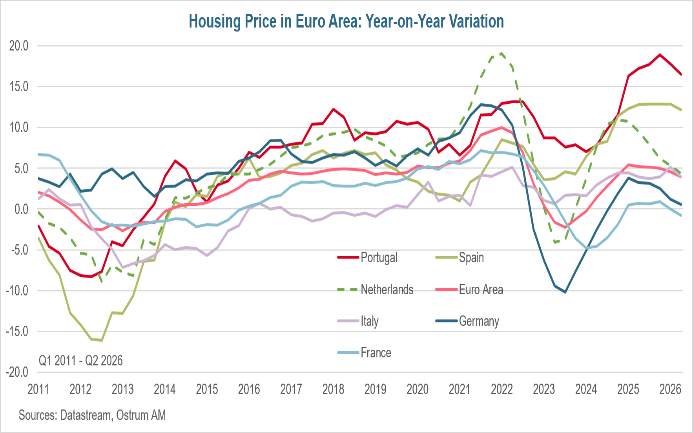
Spain is among the euro area countries experiencing the strongest increases in residential property prices. Annual house price growth has remained in double-digit territory for seven consecutive quarters, reaching 12.1% in Q2 2026, with significant disparities across cities and regions. Since 2014, price increases have been most pronounced in areas concentrating economic activity and population, notably Madrid and Barcelona, as well as in regions where demand from non-residents is particularly strong, including the Mediterranean coast, the Balearic Islands, and the Canary Islands.
Price growth has been stronger in the existing-home market (+12.9% according to INE, Spain’s national statistics office), which accounts for the bulk of transactions, than in the new-build segment (+7.4%). The surge in prices is not limited to owner-occupied housing. Rental costs have also risen sharply, reaching an average of €15.1 per square metre in September 2026, up 5.6% year-on-year, following an increase of 8.5% in 2025.
- Robust Demand
The rise in house prices reflects strong demand, supported by higher real disposable household income, a resilient labour market, and the easing of financial conditions following the ECB's rate cuts between June 2024 and June 2025. This has been accompanied by rapid population growth driven by strong net migration inflows. Demographic changes have led to the formation of new households, boosting demand for both rental and owner-occupied housing. According to the Bank of Spain, 240,000 new households were created in 2025. In some regions, demand has also been fuelled by non-resident buyers and by the expansion of the short-term tourist rental market.
- Supply Responding Too Slowly
Housing supply has struggled to keep pace with demand due to a range of structural constraints. These include a shortage of build-ready land, slow project execution, and inefficiencies in urban planning and permitting procedures. Labour shortages in the construction sector and rising building costs have further constrained supply. As a result, housing completions have remained subdued since 2014. In 2025, fewer than 100,000 dwellings were completed, well below the pace of new household formation.
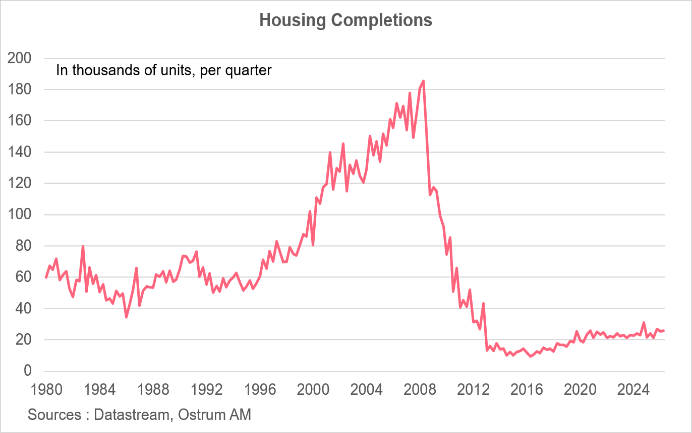
Spain therefore faces a pronounced housing supply shortfall. The Bank of Spain estimates the cumulative housing deficit at 750,000 dwellings between 2021 and 2025 and projects that it could reach one million by 2028.
By calling snap general elections for 29 November, Pedro Sánchez is seeking to capitalise on public dissatisfaction with the housing crisis and on the rejection of his housing measures by opposition parties (PP and Vox) as well as by a former ally, Junts. The policy divide is clear. The governing PSOE advocates greater public-sector intervention, rent controls, and an expansion of social housing, while the opposition People’s Party (PP) focuses on measures aimed at boosting housing supply and providing tax incentives.
What Do the Polls Say?
In the July 2023 general election, the centre-right People's Party (PP) emerged as the largest party with 33% of the vote, narrowly ahead of the Spanish Socialist Workers' Party (PSOE) on 31.7%. However, the PP failed to secure a governing coalition with Vox, allowing Pedro Sánchez to remain Prime Minister by forming a coalition with Sumar and several regional nationalist parties. The minority government has since been weakened by growing public discontent over the cost-of-living crisis, a series of corruption scandals involving members of the PSOE as well as relatives of Pedro Sánchez, and criticism of the government's handling of a major migrant influx into Ceuta, the Spanish enclave on the North African coast, in late July. Under normal circumstances, the next general election would not have been held until July 2027.
According to most opinion polls, the PP remains the clear frontrunner but is still unlikely to secure an outright majority. Support for the party has remained broadly stable since the 2023 election, at around 32% of voting intentions. To form a government, it would therefore most likely need the support of Vox, whose polling numbers have increased significantly from around 12% in 2023 to roughly 19% today. The two parties already govern together in several regional administrations. Meanwhile, support for the governing PSOE has fallen from around 32% at the last election to approximately 26%. Regional parties are currently polling at around 8%, while Sumar is credited with roughly 6% of voting intentions.
As a result, current polling points to a PP-Vox coalition as the most likely outcome, although the final composition of any future government will continue to depend on electoral arithmetic and coalition negotiations following the vote.
Elections and the Fundamentals of the Spanish Economy
- The Election Is Unlikely to Derail Spain’s Strong Growth Momentum
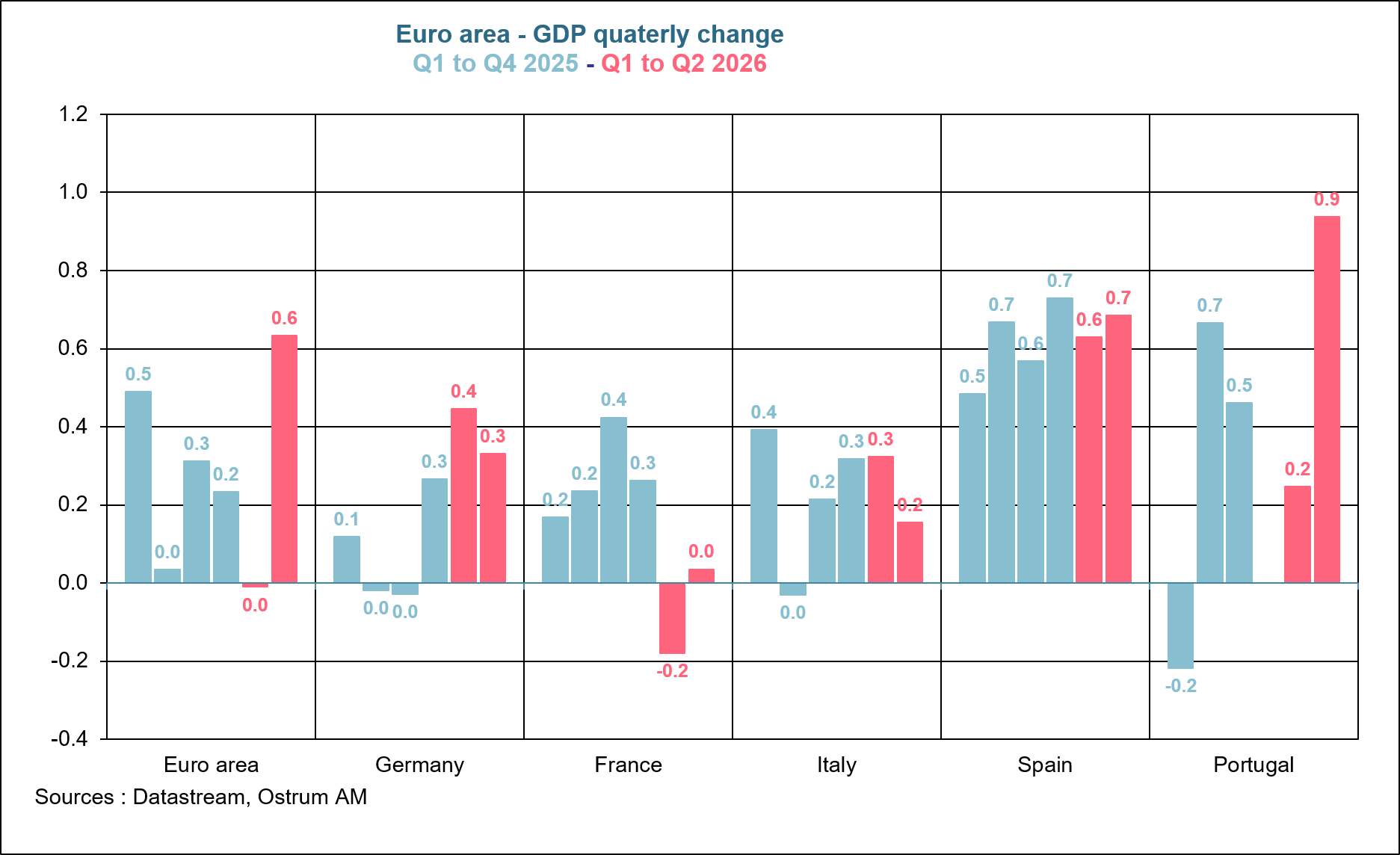
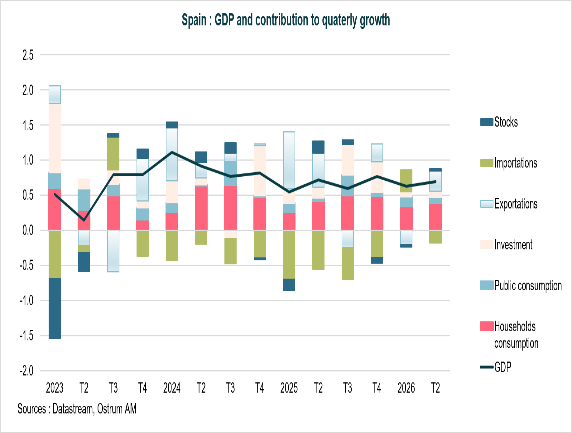
Spain has significantly outperformed the euro area since 2022. Between 2021 and 2025, annual GDP growth averaged 3.7%, compared with 1.7% for the euro area. In 2026, Spain remains the euro area's growth engine, with GDP expanding by 0.6% in Q1 and 0.7% in Q2, compared with 0.3% in both quarters for the euro area excluding Ireland. This strong performance has been driven primarily by domestic demand. Private consumption continues to benefit from a robust labour market and rising real incomes, despite inflation remaining higher than the euro area average. Investment, particularly in construction and intangible assets, has been supported by disbursements from the European Union's Recovery and Resilience Facility (RRF). Business surveys also point to continued solid growth in the coming months, underpinned by resilient domestic demand.
Although Pedro Sánchez's government has been unable to pass a budget since 2024 due to its minority status and a highly fragmented parliament, public finances have continued to improve. The fiscal deficit fell below 3% of GDP in 2025, reaching 2.4%, down from 3.3% in 2023 and 9.9% in 2020, and below the euro-area average of 2.9%. The deficit is expected to remain at 2.4% of GDP in 2026, while the primary balance (budget balance excluding interest payments) has returned to equilibrium. This fiscal improvement has largely been driven by strong nominal economic growth, as the absence of a new budget forced the government to extend the 2023 fiscal framework automatically. Combined with robust growth, deficit reduction has helped lower the public debt ratio from 105.2% of GDP in 2023 to 100.5% in 2025. Public debt is expected to fall below 100% of GDP in 2026.
A change of government and the formation of a PP-Vox coalition would likely have only a limited impact on the growth outlook. If anything, the effect could be mildly positive for domestic demand, as both parties favour tax cuts and stronger incentives for private investment while maintaining a broadly prudent fiscal stance. A more stable parliamentary majority could also reduce political uncertainty and bring an end to the budgetary gridlock that has characterised recent years
- Migration Policy: A Key Medium-Term Issue
Spain’s economic outperformance relative to the euro area has been driven in large part by strong net migration inflows, primarily from Latin America. These inflows have boosted both the labour force and labour-market participation, supporting stronger employment growth and helping Spain achieve faster economic growth than its euro-area peers.
According to the FUNCAS think tank, immigration accounted for 47% of Spain’s cumulative economic growth between 2022 and 2025. A future PP-Vox coalition could mark a shift towards a more restrictive migration policy. Such a move would risk slowing labour-force growth, exacerbating labour shortages and weighing on growth, particularly in sectors that rely heavily on migrant workers, including tourism, construction and agriculture.
Conclusion
The outcome of the election is unlikely to alter Spain’s strong growth momentum or its broadly prudent fiscal stance in the near term. The key issue to monitor in the event of a coalition between the People's Party (PP) and Vox will be the future direction of migration policy. More restrictive measures aimed at curbing migration flows could weigh on labour-force growth and job creation, while exacerbating labor shortages in sectors such as tourism, construction and agriculture.
Aline Goupil-Raguénès
Chart of the week
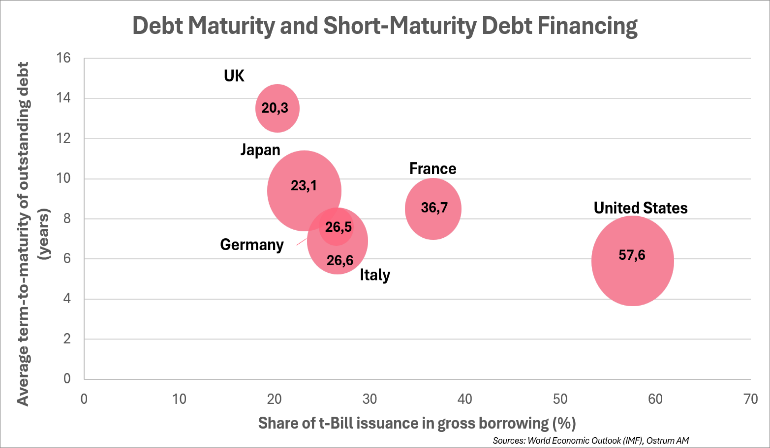
This chart, taken from the IMF’s latest World Economic Outlook, illustrates debt maturity profiles and short-term financing exposure among highly indebted advanced economies. Bubble size is proportional to gross financing needs as a share of GDP.
Financing profiles vary widely across countries. The United States stands out with the highest share of short-term debt (57%), a relatively short average maturity (5.9 years), and large financing needs (31% of GDP). By contrast, the United Kingdom has the most favorable profile, combining a long average debt maturity (13.5 years) with relatively modest financing needs (8.7% of GDP). Within the euro area, Italy stands out for its shorter debt maturity and higher financing requirements. The rise in real interest rates is increasing refinancing risks for highly indebted sovereigns.
Figure of the week
4F2
The announcement by Chinese memory-chip maker CXMT that it plans to launch its 4F2 DRAM technology (more compact) before year-end triggered a sharp decline in the KOSPI index.
Market review: United States: Inflation or Deflation?
- U.S.: Price indicators point to upside risks to inflation;
- Fed: A statu quo on interest rates is the most likely outcome in October;
- Rates: Safe-haven flows are pushing the 10-year Treasury yield lower, towards 5.10%;
- Equities: AI-related stocks are under pressure in both Asia and the United States.
United States: Inflation or Deflation?
Most inflation indicators have surprised on the upside. However, the sell-off in technology stocks, following tensions in European sovereign debt markets, and the sharp decline in long-term bond yields have brought financial stability risks back into focus.
The week was expected to be dominated by inflation data, but weakness in technology stocks, both in Asia (with the KOSPI down 15% last week) and in the United States, quickly overshadowed inflation concerns. As a result, the Federal Reserve now appears less inclined to raise rates at the end of the month. Meanwhile, pressure on euro-area sovereign bonds, the other major source of market concern, has eased somewhat. Long-term government bonds have resumed their safe-haven role alongside the US dollar, while gold has weakened.
Economic data were dominated by U.S. inflation releases. Headline CPI rose to 3.7%, driven by the expected increase in fuel prices and a renewed acceleration in housing inflation. Owners' equivalent rent increased by 0.4% in September, contributing to a rise in core inflation to 2.6%. Producer and import prices also reflected higher energy costs and strong investment demand for intermediate goods used throughout the technology supply chain. Should inflation linked to the AI investment boom move meaningfully higher, the Fed may have little choice but to tighten monetary policy further, despite the risk of a sharp tightening in financial conditions and a subsequent recession. Several Fed officials signaled that rates were likely to remain unchanged in October, a position not shared by Kevin Warsh. Nevertheless, we continue to expect the next rate hike to come in December.
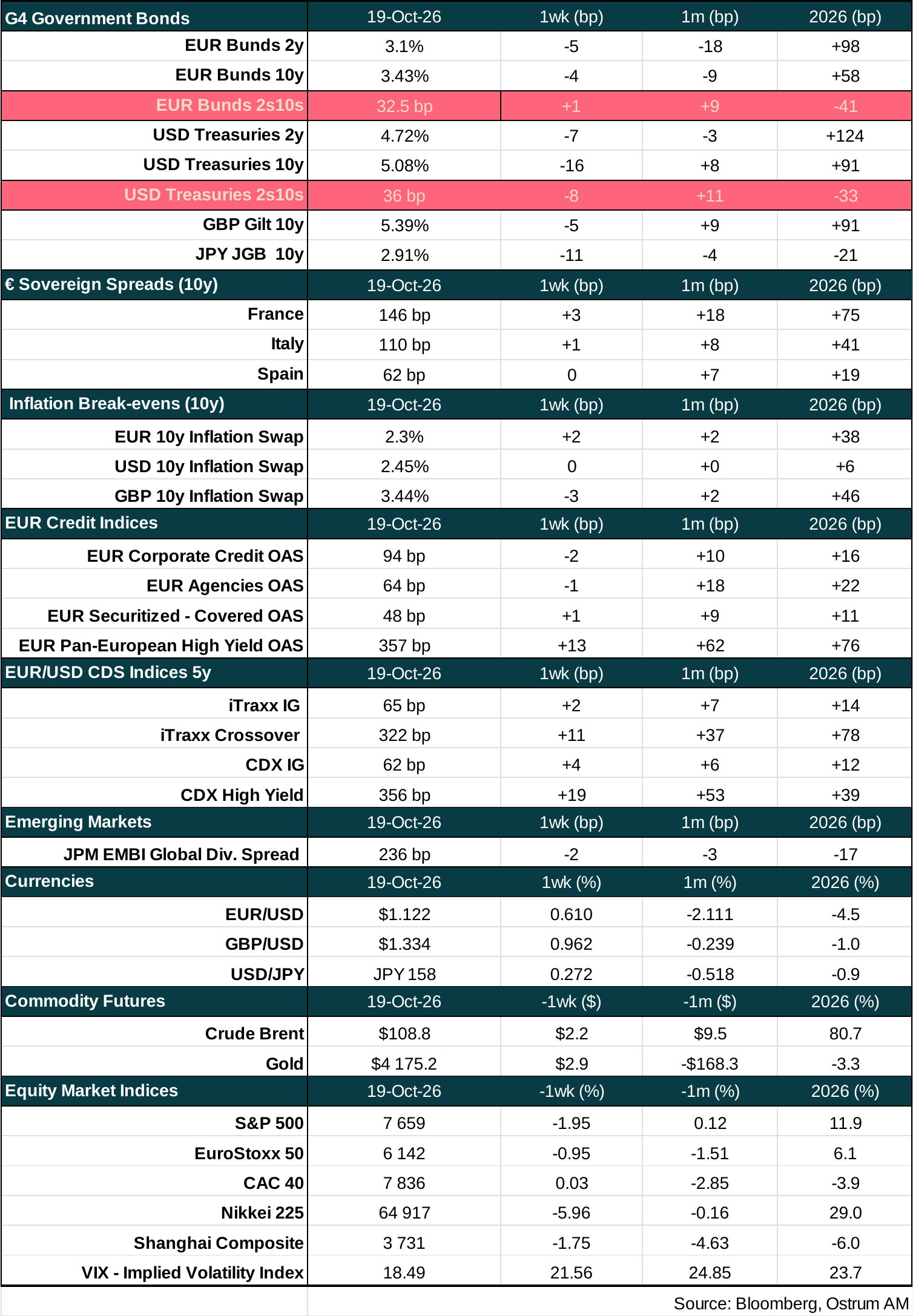
The most significant market move of the week originated in Asia. Advances made by CXMT in semiconductor architecture, despite lacking access to the most advanced lithography equipment, have increased pressure on its South Korean competitors. The reaction was severe, with the KOSPI falling 15% over the week and dragging regional markets lower, including the Nikkei, which lost 5%. In the United States, concerns surrounding CoreWeave, backed by Nvidia, have further undermined investor confidence, particularly after company insiders sold more than $3.3 billion worth of shares issued in last year's IPO. At the same time, several IPOs linked to data-center construction have been postponed in Asia. Against this backdrop, the S&P 500 declined 0.5%, while the underperformance of U.S. small-cap stocks intensified. European equities were comparatively resilient, with both the CAC 40 and the DAX gaining around 2% despite weakness in the technology sector. In fixed-income markets, the initial rise in Treasury yields following the release of the 3.7% CPI quickly reversed as investors sought to hedge against the Nasdaq correction. The 10-year Treasury yield retreated from 5.31% to an intra-week low of 5.05% before some profit-taking emerged. German Bund yields followed the move lower, ending the week near 3.43%. Sovereign spread tensions eased somewhat, although the 10-year OAT-Bund spread remained around 140 basis points ahead of Moody's (Aa3) rating decision on Friday. Meanwhile, the high-yield market remained under pressure despite some stabilization in swap spreads and broader credit markets.
Axel Botte
Main market indicators
-

Axel Botte Head of markets strategy