

Every month, find out all about the sustainable market bonds news in our newsletter "MySustainableCorner".
This month in a nutshell
- Deforestation remains a major environmental and social risk, with agriculture driving nearly 90% of global tropical forest loss, primarily due to cattle ranching. The upcoming EU Deforestation Regulation (EUDR) - set to take effect in late 2026 - is forcing industry giants to adapt. While multinational corporations, which already have robust supply chain traceability, are well-positioned to comply, small producers and highly concentrated commodity markets (such as cocoa) are expected to face the most severe short-term disruptions.
- On May 27, 2026, UNEDIC, the French agency responsible for unemployment insurance, issued its third social bond, raising €1.5 bn with an investor demand that was almost three times higher. Through this fundraising, UNEDIC will finance the protection of French workers by guaranteeing the payment of unemployment benefits. The proceeds will also be allocated to support re-employment initiatives and vocational training.
- In early June 2026, Latvia issued a sustainability bond to finance its green and social transition. Supported by a robust policy framework, Latvia aims to achieve carbon neutrality by 2050. The proceeds will target key environmental projects - including renewable energy, energy efficiency, clean transportation, sustainable agriculture, reforestation, and the circular economy - while incorporating a strong social inclusion and protection component.
- Alstom, the French multinational company specializing in rail transportation, issued its first green bond aligned with the European Taxonomy (EU Green Bond Standards). This issuance is part of the group's climate strategy, which promotes the efficient development of low-carbon transportation.
Figure of the month
95 %
Share of European territory that experienced above-normal annual temperatures in 2025
Chart of the month
Share of global electricity generation (%)
Renewable energy has overtaken coal for the first time in over a century, accounting for 33.8% of global electricity generation in 2025, compared to 33% for coal.
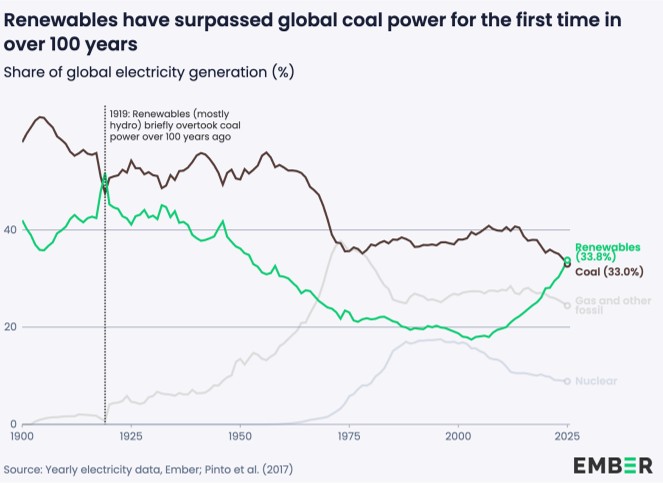
Source: Ember, January 2026
-

Timothée Pubellier, CFA Senior Fixed Income Portfolio Manager

Podcast
Reading time : 15 min.
INSIGHTS
CSR / ESG
10/09/2026
Reserved for pros

Reading time : 5 min.
Reading time : 5 min.