

Every month, find out all about the sustainable market bonds news in our newsletter "MySustainableCorner".
This month in a nutshell
- 1% of the global population generates nearly 50% of aviation CO2 emissions. This concentration highlights a striking inequality: a small group of frequent travelers accounts for the bulk of the climate impact. According to the International Air Transport Association, about 80% of humanity has never flown. Yet air transport represents 2–3% of global CO2 emissions. The climate challenge of aviation therefore lies as much in the over- frequency of a mobile elite as in the sector’s overall volume.
- Water has become an immediate and underappreciated risk that is already reshaping the contours of sustainable portfolios. Water scarcity will redefine entire sectors such as energy, agriculture, mining, and heavy industry. By 2030, 36% of electricity generation and 42% of data center capacity will be located in regions facing high water-stress.
- The Maldives, an archipelago in the Indian Ocean, is the world’s lowest-lying country, with 80% of its land area situated less than one meter above sea level. Historically, the country has faced multiple climate-related disasters and remains vulnerable to floods and heavy rainfall. In this context, the Maldives has launched a national sustainable finance roadmap to accelerate green investments and actively participate in the fight against climate change.
- This month, Aeroporti Di Roma issued its fourth Sustainability-Linked Bond (SLB). The company is committed to reducing its CO2e emissions (captures all greenhouse gases) both in absolute terms and on a per-passenger basis, while also increasing the share of women in leadership positions. ADR has set a target to achieve carbon neutrality by 2030 for its direct emission. However, some responsible investors remain cautious, given the company’s exposure to a highly carbon-intensive sector.
Figure of the month
80%
of people worldwide have never been on a flight
Chart of the month
Wind and solar power dominate electricity generation
The energy transition takes a new step in 2025: wind and solar outpace fossil fuels in the European electricity mix.
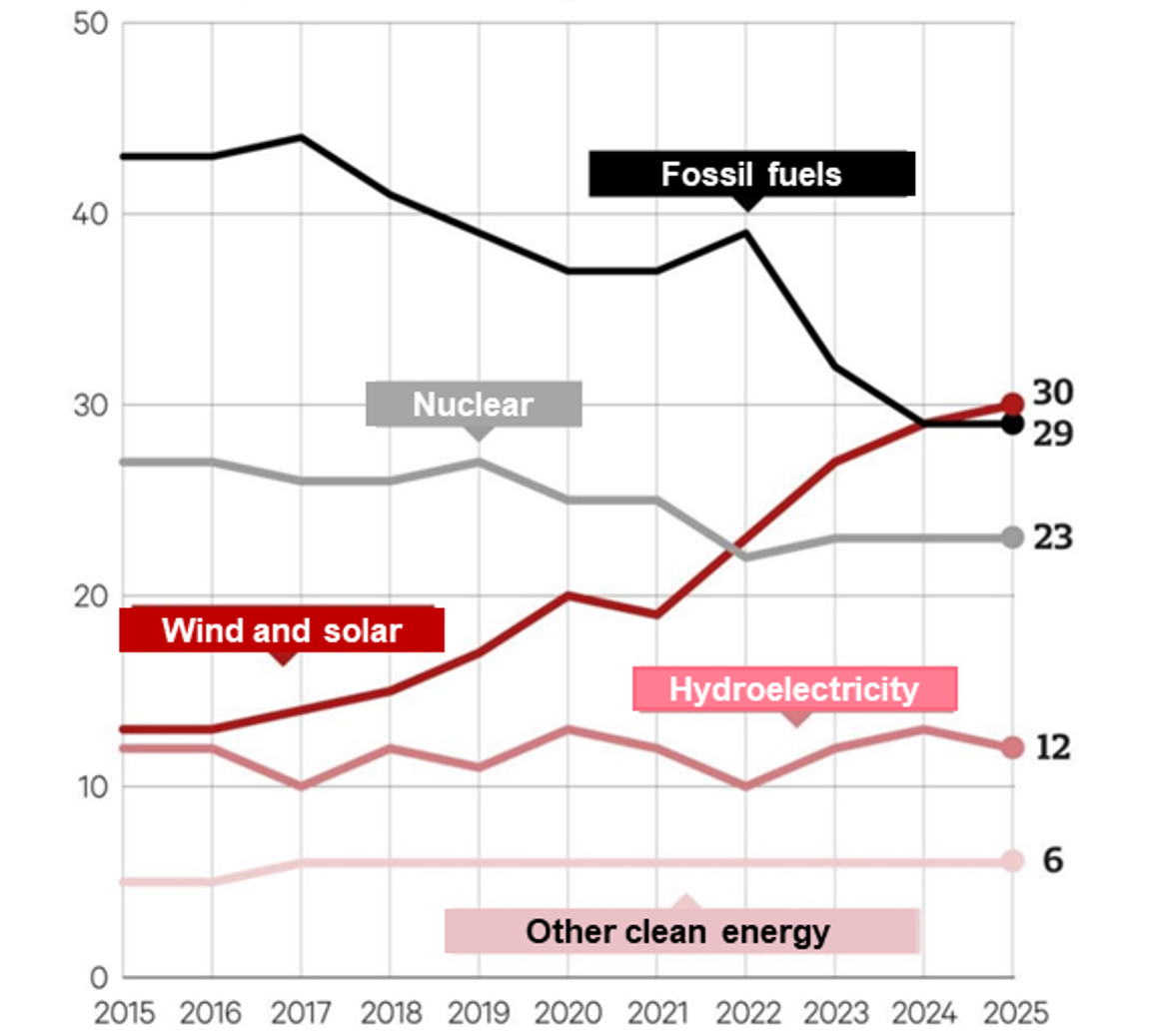
Source: Les Echos, Ember 2026
-

Timothée Pubellier, CFA Senior Fixed Income Portfolio Manager

Podcast
Reading time : 15 min.
INSIGHTS
CSR / ESG
10/09/2026
Reserved for pros

Reading time : 5 min.
Reading time : 5 min.