

Every month, find out all about the sustainable market bonds news in our newsletter "MySustainableCorner".
This month in a nutshell
- Since 1 September, France has become the first country in the world to impose a tax on ultra-fast fashion: every T-shirt sold by Shein or Temu is subject to a €2 surcharge, every pair of jeans to a €9 surcharge, and every jacket to a €12 surcharge*. These levies are set to rise progressively through to 2030, reaching €19.50 per item, capped at 50% of the product’s pre-tax price. Beijing has denounced the measure as discriminatory and threatened retaliatory action. For Shein, however, the biggest setback may come from elsewhere: financial markets are also turning away from this business model. Its IPO valued the company at $26.5bn - four times lower than its 2022 valuation. One factor is its poor climate record: 99.9% of its emissions come from its supply chain (Scope 3), and those emissions have increased by 20%. Several ESG funds have already excluded the company from their portfolios, judging its volume-driven business model incompatible with decarbonisation targets.
- A new format has recently emerged in the sustainable bond market: the "outcome bond“. This innovative instrument allows investors to earn a higher coupon if the financed project achieves significant environmental impact objectives announced by the issuer - for instance, linked to biodiversity. First introduced by the World Bank, this new type of bond could become a way to match financial returns with a positive impact on the planet.
- The rapid growth of AI is driving a significant expansion in data centres and their electricity requirements. According to VanEck, electricity demand from data centres could increase by more than 160% by 2030 compared with 2023. Industry players are increasingly turning to green financing: around $61bn is estimated to have been raised since 2020, nearly 80% of it since 2024. These complex projects need to be assessed on a case-by-case basis. Ostrum AM applies particularly stringent criteria before classifying them as green, to mitigate the risk of greenwashing.
Figure of the month
77 %
Share of global greenhouse gas emissions from G20 countries
Chart of the month
Annual climate damages by country ($bn)
Global climate damages have risen sharply since 2000, reaching nearly $1.4 trillion in 2024 and highlighting the growing economic impact of climate change
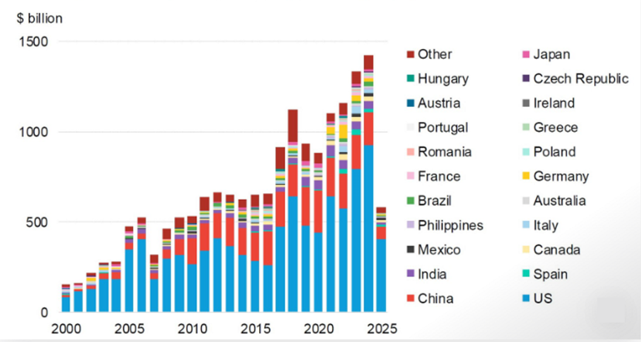
Source: BloombergNEF, Bloomberg Intelligence.
Note: 2025 data cover the period through May. Total climate damages include all categories tracked by Bloomberg Intelligence, including public spending on reconstruction, private property losses, damage to agricultural crops, and more.
-

Timothée Pubellier, CFA Senior Fixed Income Portfolio Manager
-

Martin Lebelle Sustainability and Credit Analyst

Podcast
Reading time : 15 min.
INSIGHTS
CSR / ESG
10/09/2026
Reserved for pros

Reading time : 5 min.
Reading time : 5 min.