

Reset your portfolio towards Growth & Innovation at attractive valuations
For nearly a decade, global asset allocation has followed a singular, highly profitable pattern: long US equities and underweight the rest of the world. Backed by innovation and momentum in its Tech sectors, the United States has come to command roughly 70% of the MSCI World Index—despite representing only about 25% of global GDP (Sources: MSCI, World Bank, June 2026).
We can observe that US dominance has been fueled by a "narrative and celebrity premium" that has heavily rewarded high-profile intellectual property (IP) and charismatic founders. Asia is different. Here, tech giants have quietly built the essential hardware, advanced battery chemistry, and physical infrastructure powering the AI and digital revolution. Operating without marketing hype, these Asian innovators are generating massive revenues and hold vital global monopolies. This has created a "discretion discount" versus their Western peers.
The tide may now be turning.
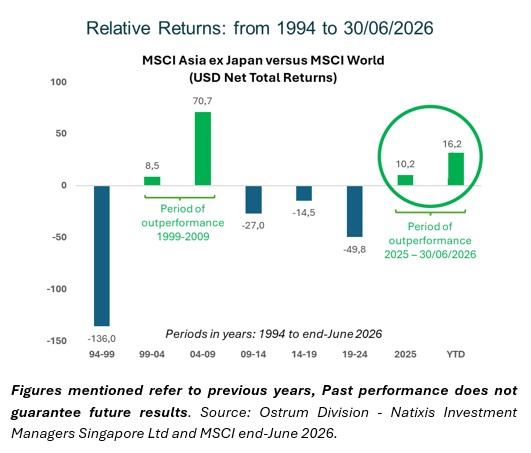
We are now into the second consecutive year where Asia ex-Japan equities are demonstrating relative outperformance against global benchmarks. While absolute returns are notable (+33% in 2025 and +26.2% YTD as of the end of June), the relative pivot may well be structural (see chart).
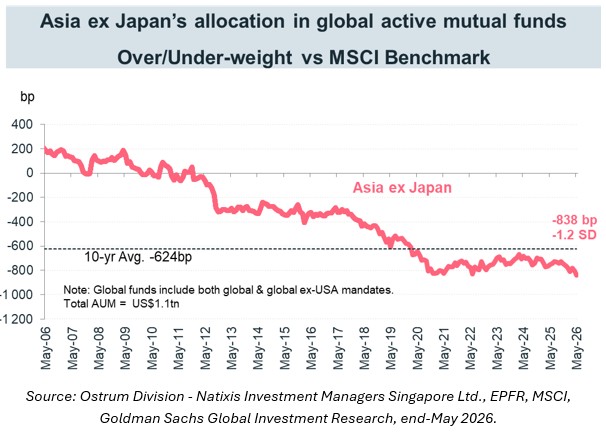
At some point, the global investment community will take note of Asia's relative outperformance. Capital currently clustered in high-valuation US mega-caps could shift and accelerate to capture the technological, industrial, and consumer center of gravity that has decisively migrated to the East.
This paper outlines and makes the case for 7 structural, thematic, and economic arguments in favor of making a structural allocation to Asia ex-Japan equities. From its indispensable role as the physical backbone of the global AI revolution to the radical business-model breakthroughs identified by McKinsey, Asia is clearly no longer just an emerging, highly volatile "satellite" play.
An Unprecedented Valuation Disconnect
Despite superior growth metrics and technological leadership, Asia remains heavily under-allocated and deeply discounted.
- The Valuation Gap: At 11.9x forward P/E, Asia ex-Japan trades at a 46% discount compared to the US equity market.
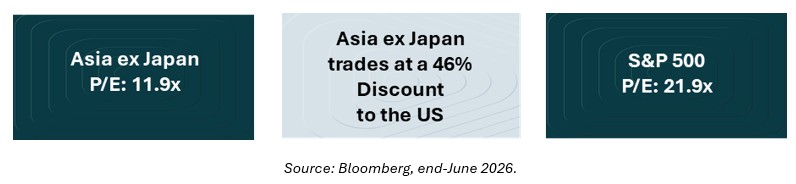
- Global Growth Engine: Asia’s projected earnings growth of 26% in 2027 is the highest in the world, eclipsing every major Western region (Source: Bloomberg, end-June 2026).
- Corporate Balance Sheet Quality: Driven by robust capital discipline, extensive share buybacks, and local governance reforms (such as South Korea’s "Value-Up" initiative), corporate profitability across the region has risen by up to 40% over the last decade (Sources: Natixis, UBS Holt, June 2026).
Beyond semi-conductors: The Agentic AI Revolution (Phase 2)
When investors think of AI in Asia, they immediately point to the hardware giants of North Asia: TSMC in Taiwan and Samsung or SK Hynix in South Korea.
This hardware trade was Phase 1. It drove a massive index weight rebalancing: between the end of 2024 and mid-2026, Tech’s weight in the Asia ex-Japan index surged from 26% to 50%, while Taiwan’s index weight rose to 30.5% and South Korea’s reached 26.5%. Conversely, India’s weight—highly valued but lacking direct AI hardware fabricators—halved from 24% to 12% (Source: MSCI as at end-June 2026).
Importantly, this structural shift has been driven independently of China, proving that Asia no longer requires a Chinese macro recovery to deliver world-class technology outperformance.
The Move to Agentic AI: Why Phase 2 Demands Even More Hardware
We are now entering Phase 2 of the AI Revolution. Contrary to the early internet days, this transition is not a simple shift from hardware to software. Instead, it is the evolution from Generative AI (chatbots) to Agentic AI (autonomous AI agents).
While traditional generative AI chatbots require constant human interaction and prompts, AI agents work completely autonomously in the background, executing complex multi-step workflows 24/7.
- Because Agentic AI operates continuously without human limitations, it translates to exponentially higher token utilization and compute time.
- More tokens and continuous autonomous processing require significantly more computing power, smarter grids, and advanced physical hardware.
- As the undisputed global factory for advanced silicon, high-bandwidth memory (HBM), and advanced packaging, Asia’s hardware moat becomes even more critical and profitable in Phase 2 than it was in Phase 1.
The Power Bottleneck: AI as an "Accelerator for Innovation and Energy"
AI’s structural hurdle is physical: computing hardware consumes vast amounts of electricity.
- Every single ChatGPT (or equivalent) prompt performs billions of calculations and uses around 10x the energy of a standard Google search.
- Generating just one AI image consumes the equivalent amount of power needed to fully charge your smartphone.
- This reality pivots the AI investment narrative from silicon chips to energy infrastructure, smart power grids, and nuclear power—areas where South Korea and China possess global manufacturing and deployment monopolies.
The Soft Skill Revolution: Six Breakthrough Business Models
Asia’s rising influence is not merely a story of cheap labor and manufacturing depth. In a March 2026 report, McKinsey identified six breakthrough business models piloted in Asia that are rewriting the global playbook for sustainable, high-margin corporate growth.
These models—supported by incredibly deep super-app ecosystems and highly progressive digital regulations—have already allowed Asian companies to achieve CAGRs exceeding 15% while rapidly doubling their Gross Merchandise Value (GMV).
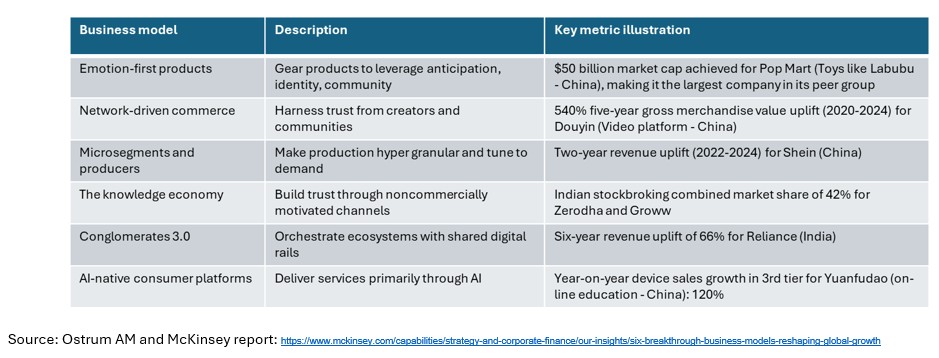
These archetypes highlight five fundamental lessons that global companies must adapt to survive:
- Customer Focus: Trust Overreach. Authentic influencer voices and free, high-quality educational channels (especially in finance and healthcare) build customer acquisition loops far more effectively than traditional, multi-million-dollar Western ad campaigns.
- Product Design: Engineered Emotional Resonance. Utilizing digital supply chains and demand sensing, Asian innovators can execute micro production—delivering personalized, culturally attuned products at massive scale.
- Distribution Channel: Peer Networks. The shopping experience has transitioned from sterile checkout screens to participatory environments where the boundaries between shopping, community, and entertainment (livestream commerce) are entirely blurred.
- Operating Model: Integrated Capabilities. Modern Asian conglomerates no longer operate as disjointed, siloed holding companies. Instead, they share technology, data, and distribution rails across their entire portfolios, ensuring that each new service amplifies the other.
- Technology: Complete AI Integration. Leading Asian companies do not treat AI as a back-office tool; they build AI-native services that actively redefine how customers interact with their brands while keeping human trust at the center.
The Dual Engines of Asian Growth: Global and Local
Investing in Asia ex-Japan equity offers exposure to two powerful, counter-cyclical growth engines:
- The Global Play: The "China + 1" Manufacturing Boom
As global multinationals attempt to insulate their supply chains from geopolitical frictions, they are aggressively diversifying. This has triggered a massive capital inflow into South-East Asia and India.
- Manufacturing Clusters: Countries like Vietnam, Malaysia, Thailand, and India are inheriting highly mature manufacturing infrastructure.
- Regional Free Trade: Frameworks like the Regional Comprehensive Economic Partnership (RCEP) and ASEAN Free Trade Area (AFTA) are forging highly efficient, friction-free trade blocs across Asia, bypassing Western tariffs.
- The Domestic Play: The Indestructible "Home Advantage"
Unlike export-oriented strategies of the 1990s, today's Asian leaders are better backed by domestic consumption.
- Insulated Revenues: Companies in India, Indonesia, and the Philippines generate 70% to 90% of their revenues domestically, (Source: World Bank), protecting them from global macroeconomic shocks.
- A Rising Consuming Class: Millions of individuals across India and ASEAN join the middle class every year, creating a long-term, secular demand engine for local banks, modern retail, digital services, and utilities.
China's Industrial Realignment: Designing the New Global Superpower
To successfully invest in Asia, one must dismantle Western biases about China. When Beijing made the strategic choice to cool real estate speculation, they did not cause a systemic collapse; they deliberately rerouted capital directly into advanced manufacturing, clean energy, and AI.
- The Production Monolith: China represents ~18% of global GDP, and its 2025 trade surplus hit an unprecedented $1.2 trillion (comparable to Saudi Arabia’s entire GDP) (Source: World Bank). It features the world's most competitive cost of capital, labor, and electricity.
- Decoupling and Dominance: Following Western semiconductor sanctions, China achieved technological self-sufficiency in record time—dominating global markets in Electric Vehicles (BYD), wind and solar generation, rare earth processing, and open-source AI algorithms (DeepSeek).
- The De-Dollarizing Reality: Approximately 20% of the global oil trade is now settled in non-USD currencies (Source: IMF). By settling trade in the local Yuan and domestic currencies, Asian economic systems have insulated their infrastructure pipelines from the monetary policy whims of the US Federal Reserve.
The Ostrum Division - NIM Singapore Ltd Advantage: Blended Active Selection
We reject the passive indexing approach for emerging markets. Passive strategies are generally allocated purely based on market capitalization, effectively locking investors into crowded consensus trades. In doing so, they miss the critical inflection points of emerging giants that are still under-represented in the index, failing to reflect the future structural shifts of the region. To illustrate this phenomenon, based on publicly available data, one can identify that there are numerous companies in each of the big-4 markets in Asia (India, China, Taiwan and S. Korea) that are potentially well positioned to emerge as potential giants based on ROI (return on investment) projections that are currently higher than historical averages.
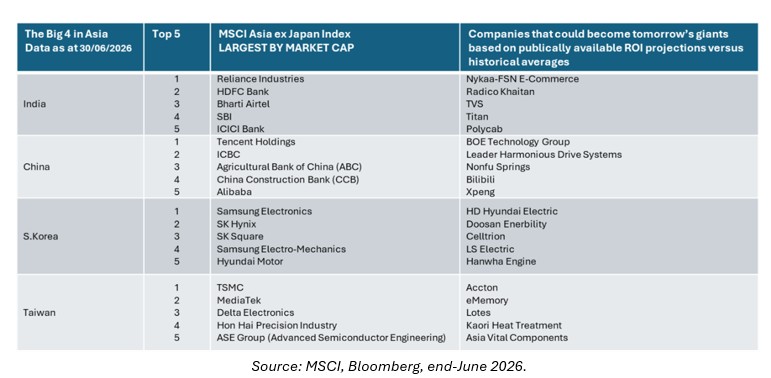
Our active, high-conviction management approach relies on three key pillars:
- Blended Stock-Picking: We combine exposure to structural domestic value creators (such as fast-growing private banks in India and Indonesia) with global technology champions (shaping the global AI software and hardware ecosystem).
- Proprietary Life-Cycle Classification: We evaluate companies through their unique maturity stages rather than simple sector classifications. This allows us to tailor financial criteria and return expectations precisely, avoiding expensive "growth traps" and identifying highly cash-generative, defensive compounders.
- Active Risk Management: We leverage deep local insights to position our clients ahead of global asset flows, capturing structural alpha as global capital rotates back to Asia’s undervalued market leaders.
Addressing Common Objections
Objection 1: "China is politically risky and uninvestable."
Response: Geopolitical noise is a permanent market feature, but operational realities tell a different story. Chinese tech leaders are no longer simple copycats—companies like BYD, Tencent, and DeepSeek are establishing global technological benchmarks. By trading at a historic valuation discount while maintaining a massive $1.2 trillion trade surplus (Source: World Bank), China offers the most asymmetric risk/reward ratio in global equities. With the government backing technological self-reliance, you are investing alongside the policymaker, not against them.
Objection 2: "I already have enough global exposure through US multi-national stocks."
Response: US multinationals expose you to global retail spending, but they do not capture the domestic champions dominating Asia’s internal growth. Leading enterprises in India, Indonesia, and the Philippines generate 70% to 90% of their revenues locally (Source: World Bank). Investing in Ostrum’s active Asia ex-Japan strategy gives you direct access to the local banks, logistics networks, and digital platforms that US tech giants cannot replicate or access.
Objection 3: "Is the AI rally in Asia over?"
Response: Statistically, we have only finished Phase 1 (basic foundries and memory chips). The transition to Agentic AI represents a structural multiplier. Because autonomous AI agents run continuously, Phase 2 will demand exponentially more tokens, more power, and more advanced hardware than the chatbot era. When you pair this indispensable hardware moat (led by Taiwan and South Korea) with a 46% valuation discount to the US (Source: Bloomberg, end-June 2026), Asia represents the most attractive and fundamentally backed entry point in the global tech ecosystem.
-

Rushil Khanna Head of Asian Equities - Ostrum Division - Natixis Investment Managers Singapore Ltd